Category Archives: Uncategorized

Center Stage with Rudy Lamone, Founder of the Dingman Center for Entrepreneurship

At 80 years old, Rudy Lamone is still an active member of the Dingman Center team. Keep reading for Rudy’s reflection on his years with the Dingman Center as its founder and the Smith School of Business as dean for 20 years.

What keeps you interested in the Dingman Center at your age?
Students. My young entrepreneurs energize me all the time.

What has been your greatest accomplishment during your career?
The Dingman Center is my favorite accomplishment. Secondly, starting the Dingman Center academic program, and together with Charlie Heller, former director of the Dingman Center, helping to establish the Global Consortium of Entrepreneurship Centers. We started with about 30 schools attending the first conference. Today, the GCEC has over 220 colleges and universities worldwide as members.

Do you have any regrets?
My greatest regret is not being able to start a school for entrepreneurship in Baltimore years and years ago. I wanted very much to have a presence in Baltimore and my idea for a school for entrepreneurship was a way I felt we could get approval to start a program. For a number of reasons, mostly political, we were not able to get into the Baltimore marketplace. That has now changed as we have a physical presence with our Smith School campus at the University of Maryland BioPark which opened a few years ago.

What advice do you have for young entrepreneurs?
Be passionate in what you believe to be a great entrepreneurial opportunity. Do what you have to do to make your dream come true.

What is your idea for the future of entrepreneurship and innovation on campus?
I am excited about the proposed new Center for Innovation and Entrepreneurship because I believe it will open up significant new pathways to explore ideas in entrepreneurship and innovation. The campus-wide center will open enumerable ways for students to pursue entrepreneurial dreams.

Dr. Rudolph P. Lamone is the Founder and member of the Board of Advisors of the Dingman Center for Entrepreneurship and a Professor Emeritus at the Robert H. Smith School of Business. From 1973 to 1992, Dr. Lamone served as Dean of the Robert H. Smith School of Business and as the first chair of the Program in Entrepreneurship. He is co-founder of the National Consortium of Entrepreneurship Centers and a founding member of the National Consortium for Life Science Entrepreneurship Programs.In 1996, Dr. Lamone was named “Entrepreneur of the Year” by Ernst & Young for his work in support of entrepreneurship. In 1998, Dr. Lamone was selected to receive the President’s Medal at the University of Maryland. In 1999, Dr. Lamone co-founded DirectGene, a biotechnology company that has developed gene therapies directed toward the treatment of metastatic prostate and breast cancer. A member of Phi Beta Kappa, Dr. Lamone received his B.S. and Ph.D. degrees from the business school at the University of North Carolina at Chapel Hill.

Tagged , , , , , , , ,

Pitching for Dough–It’s a 5 Chapter Story Baby

By Glen Hellman, Dingman Center Board member and Dingman Center Angels investor from his blog “Forward Thinking: Driving Thoughtful Success

Slide1

You’re a hot startup.  You’ve got it going.  You’re a lean, mean, fighting machine team.  You’ve got all the mojo, karma, and feng shui of the next Google. You’ve got everything but the cash required to put you over the finish line. So how do you get that cash?

Well you’ll need to get your first date with an investor to get that cash.  You’ll need to present a plan that convinces that investor to appreciate your idea, your plan and your ability to execute and you’re going to have to be able to pitch your story in just a few slides.

You have an audience with an investor group to give an 8 minute pitch.  Your job is to generate enough interest in that meeting to motivate those investors to look under your company hood.  This is your match.com moment and you are pitching for your first date.

You can go up there and present 8 minutes worth of slides or you can tell a story… a five chapter story that moves investors to action.

Here’s the plan and I’m going to use an imaginary company that invented aspirin as an example.

  • Chapter 1: Market Pain (Place the audience in the shoes of the buyer and make them feel the pain.)
  • Chapter 2: Solution (After you hurt the audience rescue the with a solution.)
  • Chapter 3: Market Size (Let them know this problem is worth solving.)
  • Chapter 4: Why Invest In Us (Why can you be trusted to make this thing work?)
  • Chapter 5: What’s in it For The Investor (What’s the exit?)

So let me tell the story:

Chapter 1: Market Pain

Slide3

“Imagine that your head hurt so bad that you couldn’t see. You couldn’t drive, go to work, care for your child.” (Asking the audience to put themselves in the shoes of the target customer by using the “imagine that” term, personalizes the problem and is more impactful than simply addressing a large faceless demographic.)

Chapter 2: Solution

Slide4

“Imagine that by taking just two small pills the pain could be erased in minutes.  Imagine the impact on your life”.

Chapter 3: Market Size

Slide5

“There are 45 billion people in the United States with chronic headaches translating to over 1 billion headaches per year.”

Chapter 4: Why Invest in Us

Slide5

“This team has done this before.  We’ve got the experience, the Rolodex and we’re operating as a high-performance, functioning team.”

Slide6

“We’ve secured a cost-effective manufacturing capability to keep up with demand. Our Sales team has already developed key distribution agreements and we’re in negotiations to expand sales to overseas markets”

Slide8

“Today there are a myriad of competitors. From the people who hit themselves in the head with a hammer because it feels so good when they stop.  No solution is as consistently effective and works as fast as Aspirin.”

(Alternate Competitive Slide Format) There are times that the “Gartner Magic Quadrant” slide won’t work for your company and in that case go with the checkbox.

Slide7

Chapter 5: What’s in it for the Investor?

Slide8

“We’ve built a financial model based on our current distribution, manufacturing agreements and staffing projections.  We’d welcome your critical review of our model.”

Slide9

“We’re raising $5 million and believe that should take us to cash-flow positive so no further funding is anticipated.”

“Based on recent M&A activity we believe that a $100 million dollar return for your investment is reasonable in the next 4 years.”

Summary

So that’s the plan and here are some tips on creating the slides.

  1. Use graphics to express concepts over words when ever you can.
  2. Try to limit slides to 5 bullets of no more than seven words.
  3. Use images on word slides that evoke the meaning of your slide.
  4. Ask yourself, do I need this slide, if I take it out of the presentation does it detract from my story?  If the answer is no, get rid of it.  Less is more.
  5. Remember that you’re not trying to close the deal, you’re pitching for the next date. Leave some mystery. Give the audience enough information to want to learn more but leave them curious enough to come back for more.

Good Pitching!

Glen Hellman helps exceptional entrepreneurs figure out what to do and gets them to do it. He’s an angel investor, serial entrepreneur, and has worked for venture capitalists as a turn-around specialist. He’s a principal at Driven Forward, board member at The University of Maryland’s Dingman Center for Entrepreneurship, a Vistage coach and a mentor at the Founder Institute which is a good excuse but not the reason he is such a horrible hockey player.

Connect with Glen on Twitter on LinkedIn

An MBA Student’s Take on China

Everything in my Washington, D.C. apartment had been to China but me. The Rogue acoustic guitar I was learning to play Greenday songs on? Chinese. The University of Maryland sunglasses I’m packing for the trip? From China. Even the “Japanese” Toshiba laptop I typed this on was actually made in China. Once, I bought frozen organic broccoli at our local Whole Foods Market. I honestly assumed I was doing my part in reducing my carbon footprint, but printed in unmistakable 6-point font on the edge of the bag: Product of China.

This January, I joined forty of my classmates from the full-time, part-time and executive MBA programs at Smith, along with a couple masters and undergraduate students and two MBAs from the Technion in Israel in making the trip to China for the 2012 edition of the Dingman Center’s China Business Plan Competition trip. We were all super excited to see how entrepreneurs fit into China’s “harmonious society.” We toured factories, met with business owners and managers, and did a little sightseeing, too. Learning about doing business in China was nothing short of amazing.

We began our trip with a visit to the U.S. Embassy office. Kevin and Sally, two state department employees, gave a fascinating overview of the business climate in China. It’s a wondrous, fast changing place, they said. There is a lot of money to be made…

…as long as you are very, very careful.

IPR (Intellectual Property Rights) is a phantom! Enforcement of law is more political than judicial! This room you’re sitting in is bugged, and if you brought a computer on this trip, know that the government has already hacked into it! We heard stories of Chinese-U.S. business partnerships going sour for all sorts of reasons. “Do heavy due diligence on your Chinese partners before you make deals,” they told us. “You don’t want to hear the phone calls we get every day.” More than one head was spinning as we headed back to the bus.

A thought-provoking afternoon of speakers from the law firm Jones Day, Venture Capital group CVCA and accounting firm Bernstein Pinchuk lead us to a delicious banquet at Jin Xiang You. Chinese students competing in the next day’s competition met us for the dinner. Much of the conversation focused on the complicated rules of dining etiquette, though a few custom business pitches were passed around the tables as well.

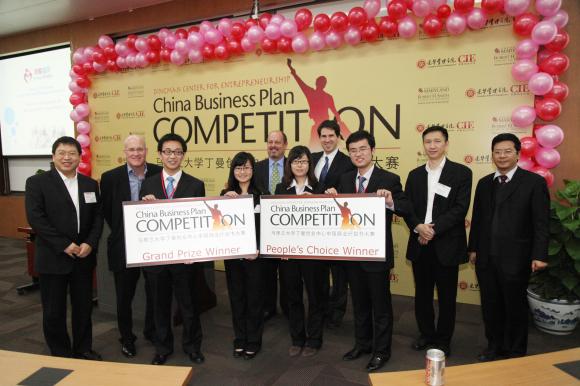
The competition finals at Beida, the so-called “Harvard of China,” were electric. Teams had traveled from as far as 13 hours away by train, with diverse ideas from increasing rail efficiency in northern coal mining cities to teaching newborn babies to read. “Tenacity,” a team of Chinese undergraduate students from near Shanghai, took first place with their idea for an innovative new cane for the blind.  The students proposed a “smart walking stick” that used radars to precisely identify obstacles in the path of a blind person.

Grand Prize Winners from Zhejiang University

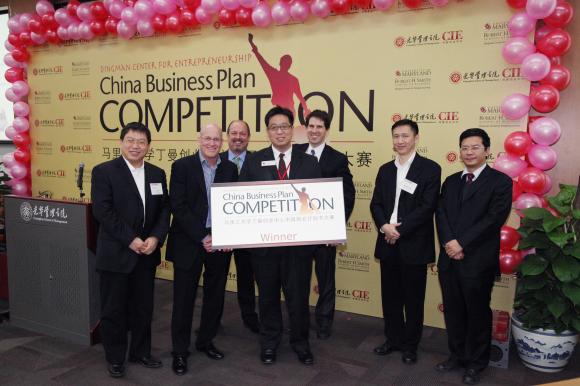
Second place went to Smith first-year MBA Marvin Yueh. Along with his partner, first-year MBA Angela Suthrave (not present on the China trip), Marvin has been working on Live-a-Betes, a program of lifestyle education for people who have diabetes.

Second Place Team, Live-a-betes, from the University of Maryland

Smith E-MBA team “Integrata” also placed, winning with their  comprehensive personal executive security system. Honorable mentions went to Smith teams Comrade Brewing, Avatravel and Spark Computing.

In two more days of company visits after the competition, we had our preconceptions challenged again and again. We took a bullet train to visit factories in Tianjin, a huge quickly-developing city closer to the coast. After passing hundreds of boring 30-story apartment buildings that seemed randomly sprinkled along the hour-long rail route, we went right into the boring one-story warehouse buildings where all those people work.

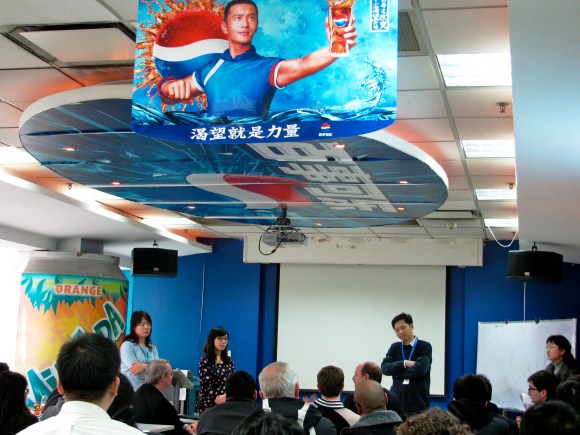
We talked with managers who run the composites factory that makes airplane components for Boeing; saw the manufacturing lines for 20,000 Otis Elevator parts, and even glimpsed the clean rooms where 36,000 bottles of Pepsi get filled every hour, 24/7/365 [read about us inadvertently shutting down the line on the trip blog here]. We met with TenCent, the enormous internet service provider responsible for QQ and several other popular Chinese social media apps. We heard about IPR struggles at Danfoss, as well as the major benefits of doing business in such a huge, dynamic market.

After a week of inside views and privileged conversations I was even more amazed and impressed by the Chinese business world.  What’s more, the Dingman Center’s China trip highlighted for me the beauty of the Smith MBA. We learn about business globalization in the classroom from top-rated faculty, then travel to business hotspots to test what we’ve learned. Whether with CIBER, Dingman or student-initiated trips, classrooms are only one part of our Smith education.

Frankie Abralind, MBA Candidate 2012

Frankie Abralind loves selling new ideas. Before pursuing his MBA, he operated what was once Maryland’s largest biodiesel plant, having designed the facility himself. In the years after finishing his undergraduate degree in Interior Architecture at Cornell University, Frankie also worked as a grassroots organizer fighting global warming, founded and published a real paper magazine with thousands of readers, and learned to love performing improv comedy. Frankie came to the Smith School of Business to learn how to start a profitable business that would make a difference. He’s now the president of the entrepreneurship club.

http://umddingman.blog.com/

Tagged , , , , , , ,

Elana Fine, Associate Director, on ABC’s Washington Business Report

Associate Director, Elana Fine was interviewed by Rebecca Cooper of  ABC’s Washington Business Report about the Dingman Center for Entrepreneurship. The segment includes an overview of our key programs: Pitch Dingman, Dingman Center Angels, and Cupid’s Cup. The segment originally aired on ABC 7 on Sunday, February 5. Watch the video below and leave your comments!

Tagged , , , , , , , ,

Center Stage with Liz Sara MA ’80, Managing Director of Best Marketing, LLC

What made you want to run your own business?

I’ve been at it from two different perspectives. During the 1990s I was the co-founder of a software company. I thoroughly enjoyed the ups and downs, even though there were more downs than ups. When we sold that company in 2001, the last thing I wanted to do was start another software company, but I didn’t know what I was going to do next. After the sale, a couple of CEOs that I knew called me and were having trouble with marketing their startups. That got me started in consulting with early-stage companies; helping with business and marketing challenges. I’ve worked with about 60 companies since then.

The “go to market” part is where many founders run into trouble, and that’s where I come in. They’re technologists, and haven’t come at this from a business perspective. I enjoy the energy, the passion, the decision-making and the attitude of entrepreneurs. I like the pace, and I like the focus on new things and innovation.

As someone that specializes in marketing technology startups, what would you say is the biggest mistake that most entrepreneurs make in marketing their respective companies?

There is a common thread through a lot of these marketing mistakes. Startup founders often think that they don’t need marketing. They get incorrectly supported by the marketplace when they’re able to get the first couple of sales without any real concerted market plan. Many startup founders think that the product will sell itself. Even Apple can’t do that. There are a lot of products and competitors out there. Companies need to break through the noise. You can’t do that by just putting a website up. There is this naïve notion that companies don’t have to put together a marketing plan because they’re just going to “go viral.”  You have to take steps to let people know that you’re there.

Why do you think the Dingman Center is a special place?

Unlike other entrepreneurial support groups, the Dingman Center has an academic component to it. It has access to professors, mentors, funding, etc. Once an idea is at the right stage, people on the outside can get a shot at it. The Dingman Center combines everything that an entrepreneur needs in a central location. It’s a complete ecosystem.

What was the best piece of advice anyone ever gave you about launching a new business?

I think a lot of entrepreneurs know this, but “don’t give up”. When I was looking for venture capital, I made countless trips to Silicon Valley. It was many trips; it was many presentations; it was many rejections. At any one of those stages, I could have given up. But if you really believe in the idea and the way the business operates, then it’s about sticking to it and being tenacious. A lot of entrepreneurs don’t succeed on their first venture.

Liz Sara

Liz Sara

She has played principal roles in such firms as SpaceWorks, an eCommerce software developer, where as co-founder/VP Marketing she facilitated its startup and growth to nearly $25 million in revenue; at America Online, where she designed the PR program and investor road show for the IPO; at United Press International, where she facilitated a turn-around strategy; and for LEXIS/NEXIS, where she was instrumental in the creation and launch of a new division. 

Ms. Sara holds Advisory Board positions at several technology and media companies. She participates on boards of local Washington area tech associations and in membership organizations catering to CXO’s as well as those supporting the cultural arts community in Washington, DC. She is an adjunct professor of Marketing at the R H Smith School of Business at the University of Maryland.  

Welcome to the Dingman Center Blog

Welcome to our first blog for the Dingman Center for Entrepreneurship. This is where you’ll hear from our entrepreneurs-in- residence, students, faculty, experts and more. We’ll tackle the challenges of entrepreneurship–from the idea to the pitch to the first million in financing. Also stay tuned to reviews from our events, photos from competitions and updates on our China and Israel programs.

If you’re getting the entrepreneurial itch this summer and think you may be the next Mark Zuckerberg, contact us to set up a time to meet with our entrepreneurs-in-residence for feedback and advice.  To make an appointment, email us at dingman@rhsmith.umd.edu.