This summer, the Dingman Center will be conducting interviews with the 11 student startups participating in our in-person Terp Startup summer accelerator since 2020. Participating student entrepreneurs will receive a stipend of up to $5,000 that will enable them to work exclusively on their startups over the next eight weeks.
Founder: Anna Boyd ’24, Plant Science
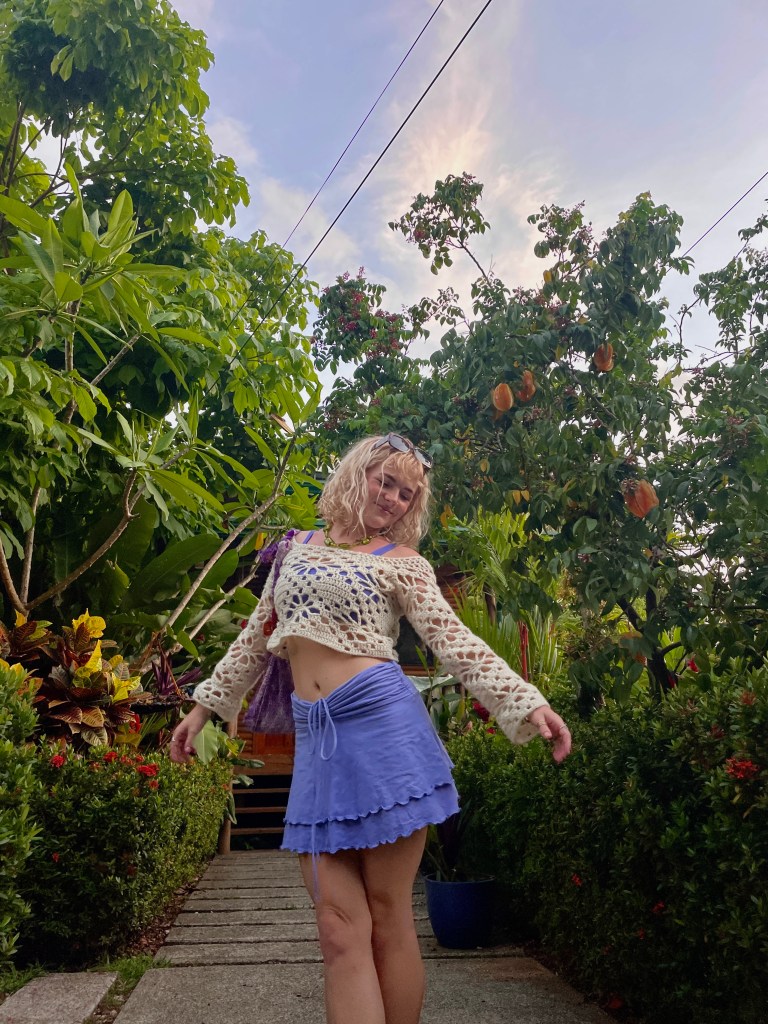
Anna Boyd is pictured in her flower sweater.
DC: In two to three sentences, how would you describe your startup?
Boyd: My startup is my crochet business. I make and sell full custom outfits, as well as tops, skirts, bikinis, sweaters, pants, hats, accessories, and more. I also aim to decrease unethical practices in crochet being sold by fast fashion companies and to promote a more positive use of the word “slut” to mean wearing what you want and feeling confident doing it.
DC: At what point did you know you wanted to create your own startup?
Madison Mazer and Sofia Alkon wearing Slut for Yarn at Coachella.
Boyd: I have been crocheting for over ten years and had my first pop-up shop at 13. This has always been a passion of mine, but I began getting serious about my art and created the Slut for Yarn brand my sophomore year at UMD.
DC: Who or what is your biggest influence for your startup? Boyd: My biggest influences are my Aunt Kelly and my Grandma GG. They taught me how to knit when I was a kid and make the most gorgeous socks, shawls, and sweaters for my family and I. Although our projects are often quite different styles, I love working with them and getting advice on all my projects.
DC: Why did you decide to start a business in this industry? Boyd: Slut for yarn fully began because I love to crochet, I quickly realized I could make money off of it and would sell baby hats, stuffed animals, and scarves as a kid. I picked it up again when I got older and began making things that were more my style now, lots of my friends loved the stuff I made and would buy them, so I decided to make an Instagram just for my crochet and it took off from there!
Hailey Yellin wearing her black and white set from Slut for Yarn.
DC: What updates or significant accomplishments can you share with us about your company from the last few months? Boyd: Terp startup accelerator is a big accomplishment, and I have loved learning more about defining and running my business. I have made a few big custom orders recently that I am very proud of like a black and white skirt set I did for my friend Hailey, and lots of outfits for friends going to festivals in the summer which I really enjoy doing. I also recently hit $10,000 in revenue which was a huge goal of mine for a while.
DC: When it comes to your startup, how do you define success? Boyd: I feel successful when I make things that make people happy. I have received so much love and support from my friends and customers and would not be able to do this without them.
DC: What are you hoping to achieve during Terp Startup Accelerator this summer?
Boyd: During the accelerator, I am working on creating and marketing a knitted line of dresses, sweaters, and other wearables. I have not done much knitting before so these projects are a different style than most other things I have released, but I love the projects I have made so far.
DC: If you could give advice to any aspiring entrepreneurs, what would it be? Boyd: If you have an idea, go for it and be confident! You will never get anywhere if you don’t take the first step.
To learn more about Slut for Yarn, please visit the websitehere.
This summer, the Dingman Center will be conducting interviews with the 11 student startups participating in our in-person Terp Startup summer accelerator since 2020. Participating student entrepreneurs will receive a stipend of up to $5,000 that will enable them to work exclusively on their startups over the next eight weeks.
Founder: Akshaya Anand ’23, Computer Science
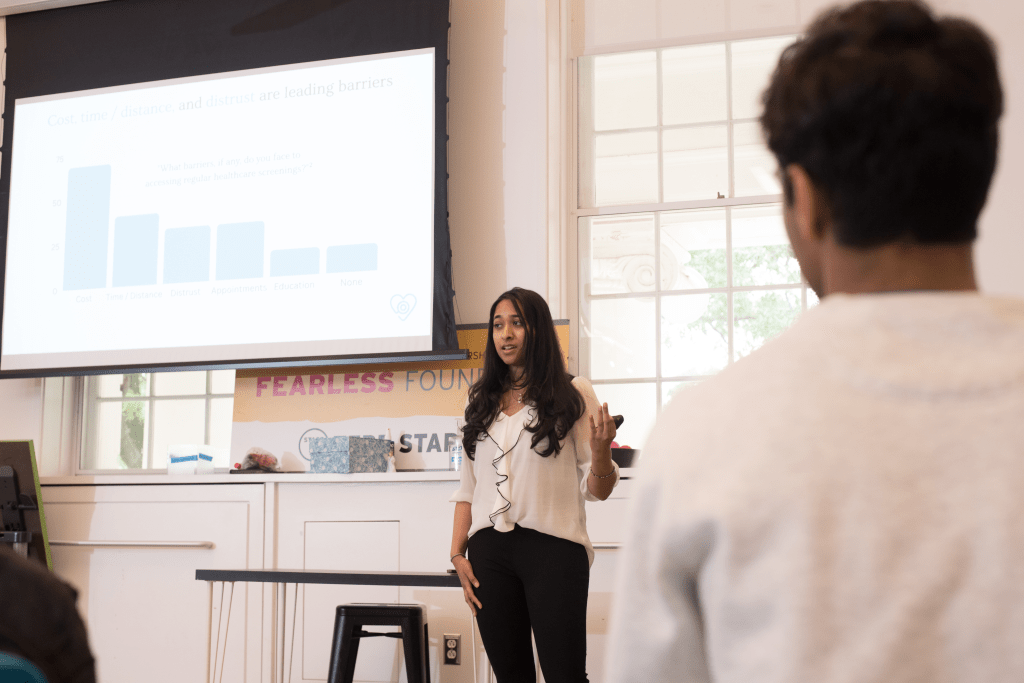
Akshaya practicing her pitch with the Terp Startup Accelerator cohort
DC: In two to three sentences, how would you describe your startup?
Anand: Korion Health is building tools to enable patients to conduct health screenings from the comfort of their homes. Our first product is an electronic stethoscope and guided user interface that allows patients to quickly and effectively record their own heart and lung sounds.
DC: At what point did you know you wanted to create your own startup?
Anand: This idea was born during a hackathon. Our idea was a solution we truly believed the world needed, and at first, we wanted to just make it open source. However, our mentors advised us that commercialization would be the best option to bring this technology into the hands of people who would use it. This startup was born because bringing the dream of accessible patient-centric healthcare was too important to give up on.
DC: Who or what is your biggest influence for your startup? Anand: Anna Li, our CEO, is the heart of Korion Health. She drives the company culture and mission with her ultra-patient-centric focus. I am really grateful to be working with her, and I am constantly inspired!
DC: Why did you decide to start a business in this industry? Anand: Heart disease is the number 1 killer in the world, yet many of these deaths could have been prevented through earlier screening and disease management. A driving cause of why people aren’t catching heart disease earlier is that they don’t have access to routine screenings. Our product aims to bridge this gap and provide an accessible tool that is easy, simple, and effective for patients to use from the comfort and convenience of their own homes.
DC: What updates or significant accomplishments can you share with us about your company from the last few months? Anand: We recently surpassed our minimum crowdfunding goal of 100k. The reason we chose crowdfunding, as opposed to taking VC money initially, was not because it’s the fastest or easiest way to get funds. We really wanted to call in the community and allow anyone to invest in the product and our mission. Many of the issues in healthcare are caused by misaligned healthcare incentive structures – and this ultimately impacts patient care. With our crowdfunding approach, we hope to empower patients in their own healthcare. We are grateful to the 100+ investors who have believed in us, and will do our best to ensure a return on your investment!
Korion Health Team takes a fun fitness class together — health is important!
DC: When it comes to your startup, how do you define success? Anand: To me, success would be any instance where our product helps empower patients in their own healthcare and helps someone identify the early stages of heart disease before they land in the ER.
DC: What are you hoping to achieve during Terp Startup Accelerator this summer?
Anand: I am hoping to expand my network and Korion Health’s presence in the Maryland ecosystem.
DC: If you could give advice to any aspiring entrepreneurs, what would it be? Anand: Work on developing a product/service that is meaningful to you. As an entrepreneur, there is so much that you need to learn and figure out. Sometimes this can be stressful. Having a mission that you believe in is going to make all the difference if you wake up feeling energized or drained. Along these lines, please prioritize your health and well-being and surround yourself with mentors who can support you!
To learn more about Korion Health, please visit the websitehere.
This summer, the Dingman Center will be conducting interviews with the 11 student startups participating in our in-person Terp Startup summer accelerator since 2020. Participating student entrepreneurs will receive a stipend of up to $5,000 that will enable them to work exclusively on their startups over the next eight weeks.
Founder: Matthew Foulk ’23, Mathematics
Matthew Foulk pitching to judges at the 2023 Pitch Dingman Competition.
DC: In two to three sentences, how would you describe your startup?
Foulk: At Kaalmi, we are creating sensory-based solutions for individuals facing mental health struggles. We are empowering people to take control of their well-being by offering innovative tools that can support traditional methods.
DC: At what point did you know you wanted to create your own startup?
Foulk: I come from a family of serial entrepreneurs. My grandfather has started numerous companies, my dad is developing his startup (Argo Navigation), and my sisters are both working on starting their own businesses (wecansaw.com, Pots for Plants with Personality). I love the idea of adding value to the world and an innovative startup is a clear path to do exactly that. So to answer the question, I don’t feel there has ever been a point where I actually knew what I wanted to do. But given the influences around me and the dreams I have for the future, I’ve almost always been on a path to creating my own company.
DC: Who or what is your biggest influence for your startup? Foulk: My partner Paige is the inspiration behind this startup. Her compassion and empathy has shaped our vision to support those struggling with their mental health. And on top of that, she created the original design of our Five Senses Box.
DC: Why did you decide to start a business in this industry? Foulk: Recognizing the lack of physical resources in the mental health space, we saw an opportunity to address a critical problem impacting millions of people. The growing mental health crisis necessitates innovative solutions, and we are determined to fill the gap and provide valuable support.
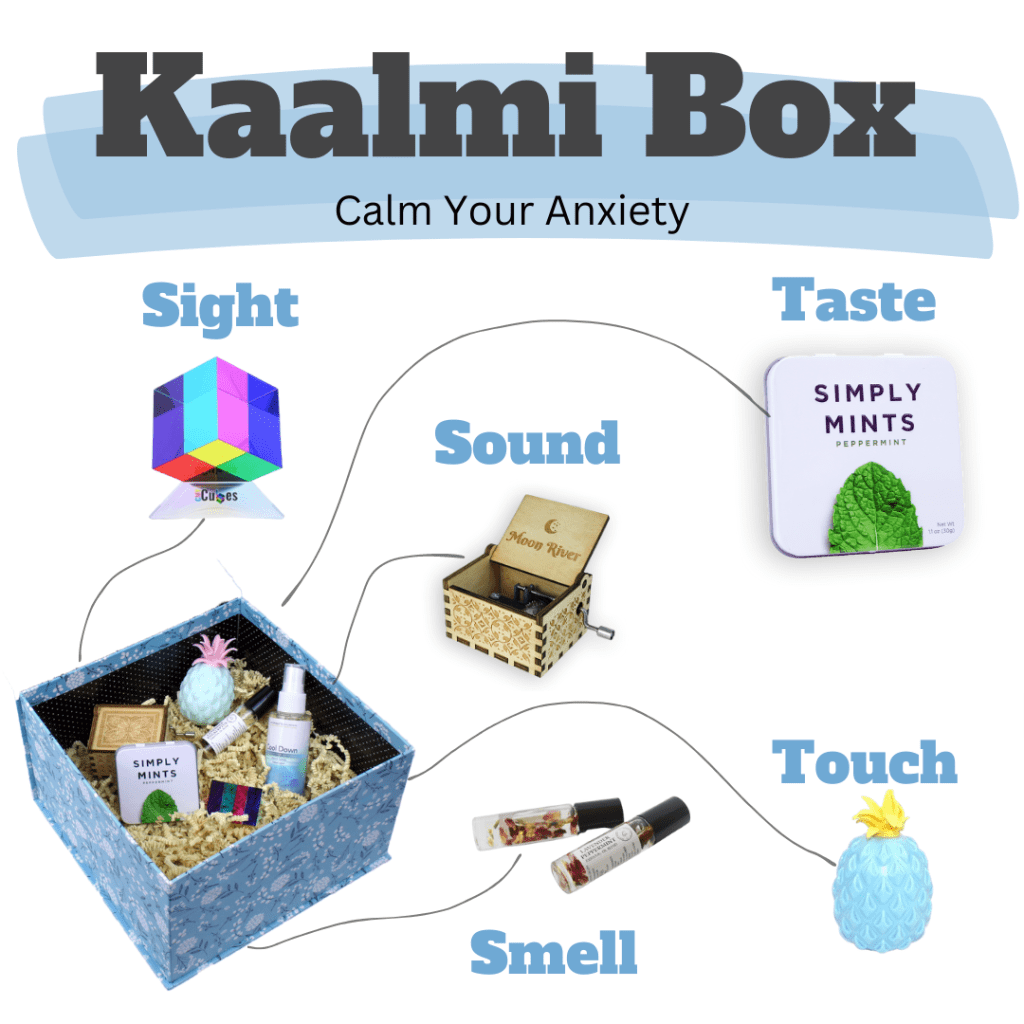
A Kaalmi Box, designed to engage the five senses, offers a tangible solution for managing anxiety and panic attacks, drawing inspiration from coping techniques like the 5-4-3-2-1 method.
DC: What updates or significant accomplishments can you share with us about your company from the last few months? Foulk: Our company has been catalyzed through the support of UMD and the Dingman team. We were a finalist in Pitch Dingman’s Idea Track this spring and are currently participating in the Terp Startup Accelerator. This has allowed us to explore the fundamentals of our business through in-depth interviews and develop functional prototypes of our Five Senses Box.
DC: When it comes to your startup, how do you define success? Foulk: Every day is a new success. The interactions I’ve had with peers and mentors have opened so many opportunities and continue to expand my understanding of the world. I’ve learned so much that I wouldn’t have otherwise, and the fact that I get to continue to work on this is a major success for me. Our ultimate success will be when therapists actively recommend our products to their clients, which will be a testament to the value we add to the mental health journey.
DC: What are you hoping to achieve during Terp Startup Accelerator this summer?
Foulk: Our primary goal is to refine our understanding of our customers and market to ensure we are developing resources that maximize our positive social impact. We have so much to learn, so I hope we can absorb as much expertise as possible from the Dingman team and the other amazing entrepreneurs (education through osmosis). I hope to walk out after 8-weeks with a brain filled with useful information and a renewed confidence that we are going in the right direction.
DC: If you could give advice to any aspiring entrepreneurs, what would it be? Foulk: Start.
To learn more about Kaalmi, please visit the websitehere.
This summer, the Dingman Center will be conducting interviews with the 11 student startups participating in our Terp Startup Accelerator summer program. Participating student entrepreneurs will receive a stipend of up to $5,000 that will enable them to work exclusively on their startups over the next eight weeks.
Founder: Brian Spinner ’23, Environmental Science and Policy
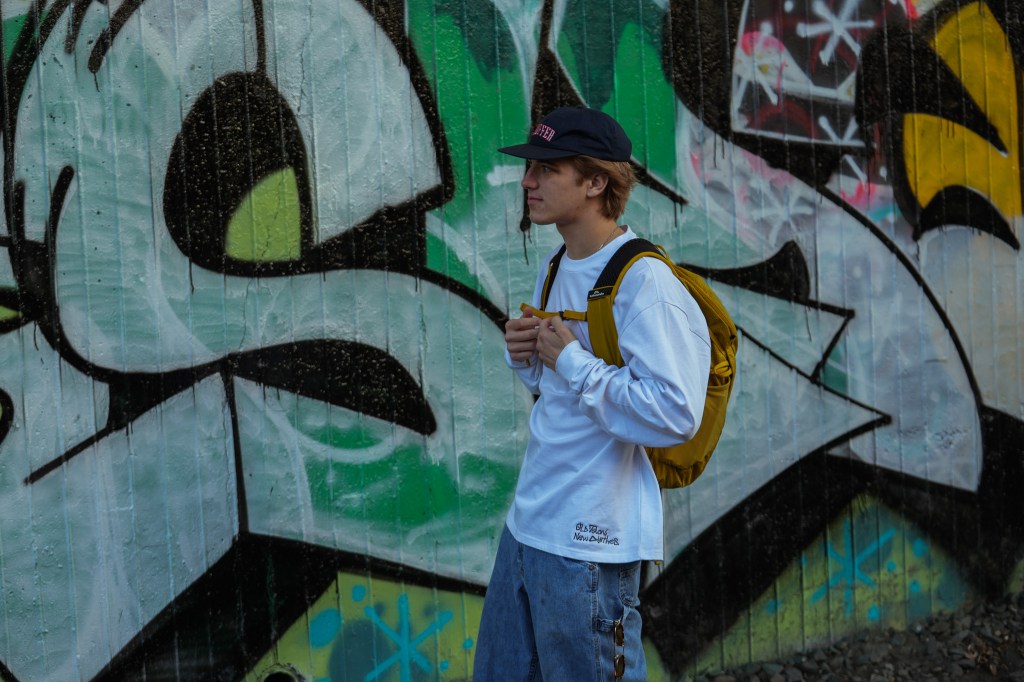
Spinner on set for the “New Zealand Collection” photoshoot. A limited collection inspired by his winter abroad in New Zealand the location these pieces were sourced.
DC: In two to three sentences, how would you describe your startup?
Spinner: Old Town, New Clothes is the creative outlet I use to introduce clothing that is currently non-existent in the world of clothing.
DC: At what point did you know you wanted to create your own startup?
Spinner: In March 2022, I set out to Mckeldin to sell clothing to make money for a spring break trip. It was a success and I got a sense of how much I enjoyed curating collections of clothing and seeing other people enjoy the clothes I picked out. Come August 2022 I began making my own branded merchandise which was a hit. This success was all I needed to give it my all.
DC: Who or what is your biggest influence for your startup? Spinner: I first felt inspired creatively when I started consuming the media that AWGE produces. AWGE is a creative agency founded by A$AP Rocky. I began watching their content, following the featured artists, and checking out their merchandise in Highschool with some of my friends. Watching AWGE create something out of nothing gave me the desire to do the same. Years later this took the form of Old Town, New Clothes.
DC: Why did you decide to start a business in this industry? Spinner: I call myself a “glorified hoarder”. I have so many clothes. I love clothing; brands, thrifting, marketing, cultures surrounding clothing, and expressing myself in my outfits. Whatever it is, I developed a strong passion for clothes during college and gained the confidence to wear whatever I want. On any given nice day in College Park there is a good chance someone is having a pop-up on Mckeldin selling whatever their “something” is. I realized there was such a growing market for second-hand clothing. Now is a unique time as our generation understands the importance of purchasing clothing second-hand. Looking at the clothing industry through multiple lenses showed me how malleable it truly is. One day I am screen printing, the next I am embroidering, the next I am editing a video, and the next I’m on Mckeldin on a beautiful day selling clothes and sharing my passion with people I didn’t know the morning prior. In this industry, I can be a designer, artist, photographer, videographer, tailor, accountant, founder, brand ambassador, and the list goes on and on. Old Town, New Clothes is whatever I want it to be and quickly became a therapeutic avenue for me.
Using all second-hand garments Spinner aims to make something new out of something old.
DC: What updates or significant accomplishments can you share with us about your company from the last few months? Spinner: Getting accepted into the Terp Startup accelerator is something I am very proud of. Made my 600th sale all while keeping Old Town, New Clothes fully sustainable. Completed ARTT343 “Elements of Screen Printing” with Justin Strom this past semester after not taking an art class since middle school. Made Old Town, New Clothes worldwide by gifting a 1/1 hoodie to my tour guide from my winter abroad experience in New Zealand. This list as well could go on and on.
DC: When it comes to your startup, how do you define success? Spinner: I define success as sticking to my values as a business owner. Early on I received some very important advice. This was to really dig deep and think about why I am doing this and to never lose sight of that. I continue with Old Town, New Clothes because I enjoy it and I can still say with confidence that I enjoy it. As long as this continues Old Town, New Clothes will continue to be guided by me as a business owner and creative.
DC: What are you hoping to achieve during Terp Startup Accelerator this summer?
Spinner: One tangible goal for Terp Startup is to have my own set of blanks. By the end of this program when customers shop Old Town, New Clothes they will be walking away with an Old Town, New Clothes tag on their garment. This is an avenue I have been intimidated by as there is so much to it but I know it is attainable through this program.
DC: If you could give advice to any aspiring entrepreneurs, what would it be? Spinner: Go for it. I used the term “something” earlier. Whatever your “something” is, go for it. If you need to count on friends and family in the beginning, that’s normal. College is a unique period of time in which you have access to this vast community to be your early adopters. Your circle should want to see you dive into something you are truly passionate about. If you are really enjoying your “something” and finding your definition of success then keep the ball rolling. If it doesn’t work, pat yourself on the back and figure out how or if you want to continue your journey. Minimizing risk is an important part of entrepreneurship and sometimes learning the hard way is the best way to understand the importance of this. My last piece of advice would be to follow this super cool clothing brand called @oldtownnewclothes on Instagram. The guy who runs it makes some really cool clothes and would appreciate anyone who supports it.
To learn more about Old Town, New Clothes, please visit the websitehere.
This summer, the Dingman Center will be conducting interviews with the 11 student startups participating in our Terp Startup Accelerator summer program. Participating student entrepreneurs will receive a stipend of up to $5,000 that will enable them to work exclusively on their startups over the next eight weeks.
Founder: Sonny Tu ’23, Information Science
DISTRICT5’s Team
DC: In two to three sentences, how would you describe your startup?
Tu: Fun, refreshing and inspiring creativity. DISTRICT5 strives to connect brands and consumers with thrilling storytelling, visuals, and digital media content.
DC: At what point did you know you wanted to create your own startup?
Tu: I’ve always been interested in entrepreneurship. I knew it was the right time when I started to surround myself with like-minded people. I had all the reasons to, but I did not know whether I had the support I was looking for to make the jump.
DC: Who or what is your biggest influence for your startup? Tu: My biggest influence is seeing a lot of my peers, colleagues, and like-wise leave the area and move. Personally, I was never a fan of the thought of moving to live in places like LA or NY. I like visiting and being there for a time, but I wouldn’t move there. That drives me to think bigger for the company.
DC: Why did you decide to start a business in this industry? Tu: It’s what I’m interested in.
DC: What updates or significant accomplishments can you share with us about your company from the last few months? Tu: We’ve closed out a bunch of contracts that I’m excited to share when the time comes. What I can share is that one project is in talks to be showcased on New York Times Times Square billboards.
DC: When it comes to your startup, how do you define success? Tu: For something such as our startup, one of the things that are often left out are basic things such as healthcare, 401K, and more. We’re in the process of setting that up for our company and our employees, and we hope to continue to set standards like that for others to follow suit.
DC: What are you hoping to achieve during Terp Startup Accelerator this summer?
Tu: I’m hoping to sort out a lot of the infrastructure of the company. There’s a lot that in the midst of action was just not set up, and I would love to also work on networking and partnership/relationships.
DC: If you could give advice to any aspiring entrepreneurs, what would it be? Tu: Keep learning. I don’t think there’s ever a clear-cut solution for businesses to follow in order to succeed. As long as you have a clear head on your shoulders and learn from every experience and can apply that knowledge, you’ll be growing along with the company.
To learn more about DISTRICT5, please visit the websitehere.
This summer, the Dingman Center will be conducting interviews with the 11 student startups participating in our Terp Startup Accelerator summer program. Participating student entrepreneurs will receive a stipend of up to $5,000 that will enable them to work exclusively on their startups over the next eight weeks.
Founder: Ijeoma Asonye ’24, mechanical engineering major, creative writing minor
DC: In two to three sentences, how would you describe your startup?
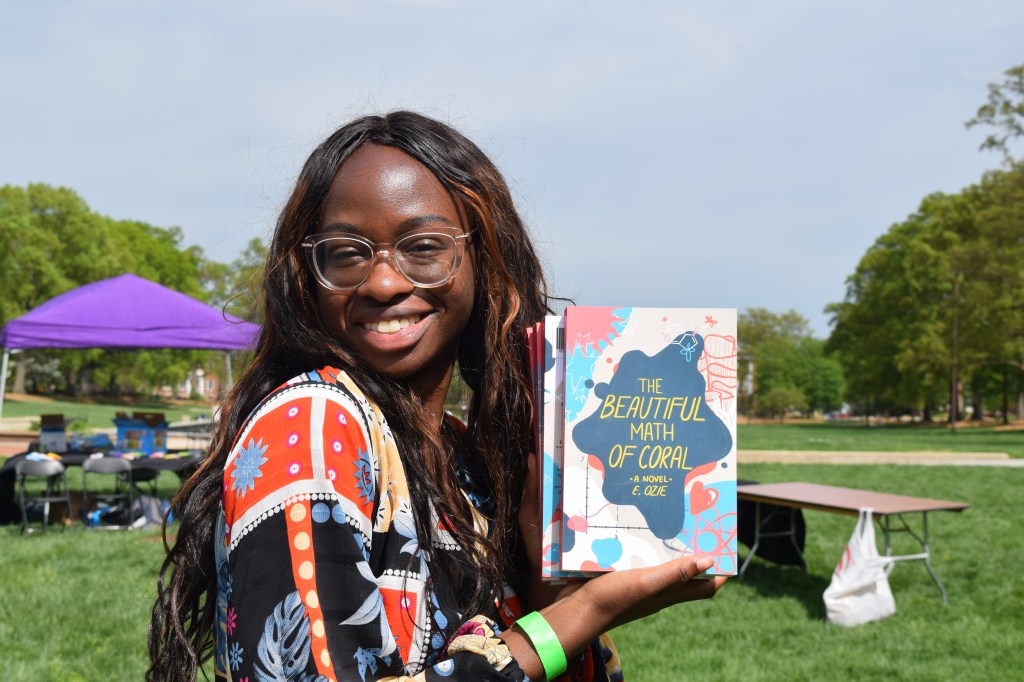
Asonye: E. Ozie Studios is a multimedia creative house currently engaging young adults and the young-at-heart with the beauty of STEM and Art. Our powerhouse is based on the core values of our novel The Beautiful Math of Coral: produce impactful stories that focus on the wonders of the universe about us. We are creating revolutionary conversations in both traditional and innovative ways including books, poetry, films, board games, and more.
DC: At what point did you know you wanted to create your own startup?
Asonye: I’ve always loved books so the idea of writing a book came across my mind and I just jumped on the opportunity. My venture started off with my book “The Beautiful Math of Coral” after watching a TED talk of the same name. I would call my book a coming-of- age story that creates metaphors with concepts in STEM, mixed with lots of love and other intangible things. I think it’s a very swoon-worthy book. Now I want to expand the creative house as what we are doing feels niche and I know there are people that would be interested in supporting our creative works.
DC: Who or what is your biggest influence for your startup? Asonye: I was inspired to create my own creative house by learning about Einhorn’s Epic Productions which is an entertainment creative house. I think they are doing some really cool stuff for underserved gen-z fandoms which is an industry E. Ozie Stiudios is also tapping into with our work. One of the co-founders of the company purchased my book and that is how I learned more about them. On the film side of things, I am inspired by A24 and some of the thought-provoking, niche, and creative films they have put out. A24 is my dream collaborator so if an executive from A24 is reading this, let’s connect!
Ijeoma sells her books at the Black Creatives Matter Event 2022!
DC: Why did you decide to start a business in this industry? Asonye: To create innovation (and disruption) in the entertainment industry. There is a growing need to produce films and other media that show women and people of color in STEM. This has primarily been a target for younger individuals like elementary and middle schoolers. I think there is a mass market though, of connecting with high schoolers and older that has been untapped. I also wanted to show a new perspective on creating symbolic content that relates STEM and art to the human experience.
DC: What updates or significant accomplishments can you share with us about your company from the last few months? Asonye: We received grants from the Clarice Performing Arts Center and the Arts for All Initiative. We finished production on our short film that is based on the novel “The Beautiful Math of Coral”. But as a creative who has a personal standard and is always finding ways to make things better, there are some scenes I would like to add so we are in a semi-post-production phase. We also sold some books at in-person events during the spring which allowed us to build our subscribers to our newsletter.
DC: When it comes to your startup, how do you define success? Asonye: Wow such an important question I have never asked myself. I define success as continued support from supporters. I think the way my business has been able to grow is through word-of-mouth. I want to leverage word-of-mouth this year through social media which is an avenue I have struggled to explore. I know my business is succeeding and gaining traction through the growth of new customers and having a reputable amount of passionate customers who will advocate for my brand. I think in the future when my business is able to establish itself in other markets, success will be the ability to score collaborations and partnerships.
DC: What are you hoping to achieve during Terp Startup Accelerator this summer?
Asonye: I want to achieve launching a Kickstarter campaign for our board game, begin the manufacturing phase for the board game, partner with stores to sell our book and merchandise, and find ways to promote our short film as it’s in the post-production phase and open our e-commerce store. I also want to use Terp Startup Accelerator as a way to connect with other entrepreneurs in the entertainment industry to gain advice and grow my network.
DC: If you could give advice to any aspiring entrepreneurs, what would it be? Asonye: It feels like a reminder more than advice: There will be several nos before a yes. The moment before your yes could be when you decide to reinvent yourself. Don’t give up even if you have to give yourself a break. Give yourself time to chill if you feel burnt out from the nos but don’t give up on your story and passion.
To learn more about E. Ozie Studios, please visit the websitehere.
The Dingman Center for Entrepreneurship is proud to announce its fourth cohort of the Terp Startup Fellows program, made possible by a generous donation from Dingman Center board member Bill Boyle ’81. This program was created due to the success of Terp Startup Accelerator, the center’s eight-week summer program which has been running for eight years. Terp Startup Fellows aims to further advance the most promising student startups and selects student founders from the accelerator program that have demonstrated a strong commitment to their ventures and the ability to innovate as they push towards commercialization. The Dingman Center has named three Terp Startup Fellows ventures for the 2022-23 academic year: Arch Dash, Juju Food Delivery, and Platybase.
The founders of these three ventures will receive up to $20,000 in non-dilutive funding, coaching, and co-working space to work on their businesses for 10 hours a week with the Dingman Center. These founders have all been heavily involved with the Dingman Center’s programs and have all participated in Terp Startup Accelerator. The founders have also won several awards and accolades outside of the university through the entrepreneurial community.
Throughout the next year, the Dingman Center team including Holly DeArmond, MBA ’17, Tsega Tadesse Belachew, Lottie Byram, MPH, and Alex Onufrak ’21, will work directly with the selected fellows and their ventures.
“During the last few years, the Terp Startup Fellows program has provided individualized support and funding for our most advanced founders,” said Belachew, director of venture development at the Dingman Center. “The fellowship has enabled founders to grow their ventures by capitalizing on initial business traction and securing additional funding. We are excited about a strong and diverse cohort of founders this year leading technology ventures that are working to solve problems across industries: mental health, food delivery, and architecture.”
Student ventures selected to participate in the 2022-23 Terp Startup Fellows
Arch Dash, founded by Ina Kovacheva ’23, enables architects to make data-driven decisions that will result in healthier, efficient, and more sustainable building designs. Kovacheva participated in Terp Startup Accelerator in 2022, where she won the Go-to-Market Award ($1,000) at Demo Day and received the second place Audience Choice award. Kovacheva also recently completed the regional I-CORPS program.
JuJu Food Delivery, founded by Weixiang Wang ’22, Ziqi Zhang ’22, Zijian Zhang ’22, and Zeyang Liu ’22, offers an affordable bulk delivery and order pickup service for customers and restaurants that are facing higher-than-ever food delivery expenses. The JuJu Food Delivery team participated in Terp Startup Accelerator in 2022, where they received the Path to Product-Market Fit Award ($1,000) at Demo Day. They were also recently awarded second place at Contrary Capital Pitch Competition. Juju Food Delivery currently has 600 users and has generated $10,000 in revenue over two months.
Platybase, founded by Mika Panday, ’21, Colleen Baldwin and Olivia Bruno, is a HIPAA-compliant visual diary that celebrates milestones between families and providers of autism care centers while increasing behavioral outcomes, creating community, and allowing center operations to emerge competitively from a historically analog industry. Platybase is a company founded exclusively by disabled women, for the disability community. The company, formerly known as Dorothy’s Place, participated in Terp Startup Accelerator in 2021. The team also won the 2Gether International women’s pitch competition last spring and received a $10,000 prize.
One of the benefits of being selected as a Terp Startup Fellow is the ability to access funds for the purpose of travel, whether it be for commuting to a conference or a client meeting.
ARCH DASH
Student(s): Ina Kovacheva
Prize: $923.98
Award Purpose
New Haven Pitch Travel Expenses (Airfare/buses/lodging) ($208.98)
$350 for nail forms, nail design elements, shipping and packaging supplies
$460 for e-commerce platform and POS system for in-person sales.”
Learn Prompting (Prompt Labs)
A Free, Open Source Course on Communicating with Artificial Intelligence Student(s): Sander Schulhoff Prize: $1000
Award Purpose
$300 to start LLC
$200 for designers
$300 for web developers
$200 for site content contributors”
Lingo AI
Student(s): Pranav Shikarpur Prize: $1000
Award Purpose $200 – Running GPUs servers in the cloud for a few months $100 – Get access to youtube analytics for the first month $400 – hiring translators on Upwork to verify our AI-generated translated videos for our creators $300 – Running a large ad campaign targeted towards creators after we have 3 creators on-onboarded (PS – We have already onboarded one creator and have 2 in the pipeline)”
Cursive Technology
Cursive Technology, Inc. utilizes machine learning and other technologies to identify unique writers in a secure online text box to protect academic integrity from the risk of copy/pasting from generative artificial intelligence programs (such as ChatGPT) or contract cheating threats. Our goal is to provide faculty and teachers with better tools for assessing student writing in the classroom, providing institutions a better solution for ensuring Academic Integrity.
Student(s): Joe (Joseph) Thibault Prize: $1000
Award Purpose Travel to pitch competition ($1000)
Korion Health
We are designing tools that empower patients to conduct their own health screenings. Our first tool, the Sound Heart System, provides an affordable stethoscope and user interface to guide patients through heart screenings.
Student(s): Akshaya Anand
Prize: $1000
Award Purpose
$270 Google Workspace Business Starter Plan for 5 team members for 9 months ($6/user/month)
$130 to support form submissions on website (via webflow basic site plan ($14/month))
$100 for Google Colab Pro to support development of algorithms (training machine learning models, computer vision tasks using GPU and storing large datasets)
$500 for surveying or focus group testing ($5/person compensation for 100 surveys to learn more about the market size and target customer demographics OR $15/person compensation for 30-person focus group to give user experience feedback about product)
Room 242
Room 242 is an independent artist services company designed for the college musician. From living space and record label services to intuitive artist data and events, we provide not only a pathway to the career every new artist wants but the creative community every artist needs.
Student(s): Kang Ewimbi
Prize: $1000
Award Purpose
$700 for venue setup (microphones, cables, subwoofers, cleaning supplies, and lights)
$300 for marketing (ads for upcoming songs, social media page promo, and shooting short-form content)
inhale.AI
As a low income, mixed race black male in a low-income community, I was keenly aware of how the health literacy crisis affected my inner city community, especially with regards to pulmonary issues. As a result, I created inhale.AI, a mobile app that will provide accessible troubleshooting and instructions to people using an inhaler. Studies have shown that only 31 percent of individuals who have asthma or COPD use an inhaler correctly. Further, inhaler errors are found to be strongly associated with exacerbated pulmonary issues, furthering the health-economic gap. Individuals who disproportionately fall under this category include folks from Black, Native American and Latinx communities. Studies show that inhaler technique interventions significantly reduced inhaler errors and had very positive effects on disease and patient outcome.
Student(s): Saad Pirzada
Prize: $1000
Award Purpose
$300 Animate vector images within the app
$180 Professional demonstration video of inhaler usage within the app
$80 Language voiceover for each step in English and Spanish
$250 intricate side animations for each step to guide user
$190 Website hosting and UX design for WordPress
FrontGround
Student(s): Kenneth Yeaher
Prize: $1500
Award Purpose
Research and Development – ($775) +Second round of customer discovery, will be proving preliminary questionnaire and interviewing healthcare workers, and admin in medical facilities in Liberia, Nigeria, Ghana, Cote d’Ivoire, and Senegal. ~10 USD compliantly reward for participants in interviews. 5 in Liberia, 15 in Nigeria, 10 in Ghana, 10 in Cote d’Ivoire, and 10 in Senegal. – $525 ~Google Workplace for cofounders – $150 +Website dev/hosting cost – $100 Business Development – ($725) +Legal services for risk management and registration (Liberia and Maryland) – $200 + Maryland corp registration – $125 +Havard Africa Health Conference ~ Tickets – $200 ~ Roundtrip Tickets – $200
Kaalmi is creating a comprehensive resource center for mental health and self-care needs, with an initial focus on our five-senses box that aids in grounding individuals experiencing anxiety and panic attacks.
Student(s): Matt (Matthew) Foulk
Prize: $1000
Award Purpose
$360: One-year subscription to Quickbooks
$348: One-year subscription to Shopify
$292: Shipping materials
Cured Leaves Tea Co
Student(s): Lawrence Shaw
Prize: $1000
Award Purpose
Trademarking their logo ($1,000)
MatRx
Student(s): James Dawson
Prize: $799.58
Award Purpose
2 Plane tickets for trip to Fort Worth to compete in TCU’s Values and Ventures.
Ticker
Ticker brings private equity to smaller capital-size investors by offering lower entry prices and higher liquidity. Simultaneously, we bring new liquidity options to limited partners of traditional funds, providing a value add to the investors and managers of the fund.
Student(s): Max Harris
Prize: $1000
Award Purpose
$400 for set up of series LLC in Delaware
$600 towards legal fees for fund integration and submitting first form D
Total: $1,000.00
Whytfox
Student(s): Destini Chesley Prize: $1000
Award Purpose
Attorney fee of $650
Closing costs of $350 for her business
Alperian
We are developing our first product, the Astro Rack. The Astro Rack is a patent pending portable power rack for weightlifters who want a home gym, but don’t have the time, space, or money to build one. Our goal is to develop a resistance machine that is a better experience than traditional weightlifting.
Student(s): Jason Harwert Prize: $1000
Award Purpose
$350 for a 3D-printer
$200 for test equipment including sensors and controllers
Pitch Dingman Competition 2023 received over 100 student applications and 65 venture applications, all vying for a piece of over $100,000 in prizes. Our panel of judges was able to narrow down our wide range of applicants to reveal the top 5 teams that will be advancing in the Main Street Track, Quattrone Venture Track, and Idea Track for the 2023 competition. The founders of these teams will each receive a $500 prize, participate in workshops, and meet with advisors in the coming weeks to help them further accelerate their businesses and make them more competitive for the upcoming Round 3 of the competition. On Friday, March 31 our 15 remaining teams will pitch their businesses to an expert panel of judges in Van Munching Hall. We’re excited to see who wins the opportunity to pitch on the big stage at our finals event on April 18 at Samuel Riggs IV Alumni Center, for a shot at our grand prize of$30,000!
Read on to learn more about the ventures that will be advancing in our competition:
TOP 5 Main Street Track Semifinalists:
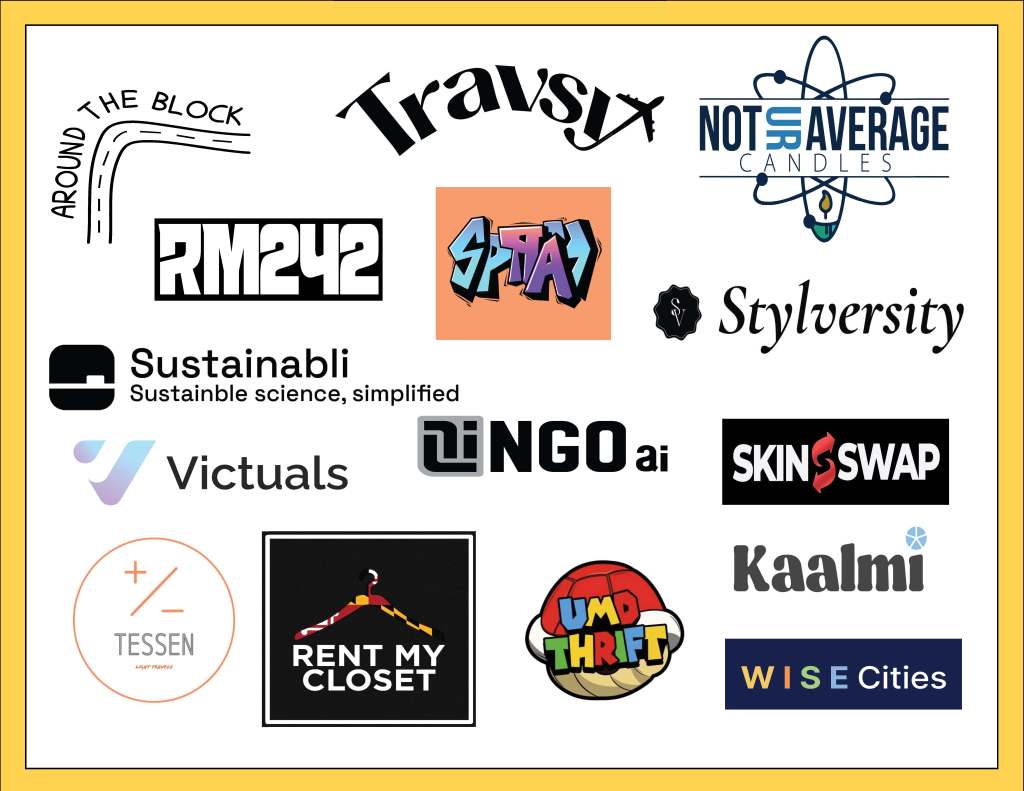
Around the Block – Gabrielle McLaughlin ’23, Joelle Anselmo ’23 Around the Block is an apparel company that invokes nostalgia and camaraderie in the university community through our one-of-a-kind designs. The company prioritizes sustainable processes and philanthropic initiatives in everything we do.
NotUrAverage Candles – Courtney Johnson ’23 We are NotUrAverage Candles (pronounced “Not Your Average” Candles), a coconut wax candle company that illuminates the world to science through fragrance.
Rent My Closet – Ariyan Khana’23, Arvyn Garchitorena ’23, Jamil Mailk ’23 Rent My Closet is focused on creating a peer-to-peer network for students on campus where items can be rented out for various occasions at an affordable price. The purpose of our venture is to tackle fast-fashion head on, provide students with an opportunity to earn extra income, and create a sense of community for students on campus through our network.
Room 242 – Kang Ewimbi ’24 Room 242 is an independent artist services company designed for college musicians. From living space and record label services to intuitive artist data and events, we provide not only a pathway to the career every new artist wants but the creative community every artist needs.
UMD Thrift – (Ethan) An Pham’24 UMD Thrift is a student-run premium second-hand clothing business. We aim to bring a sustainable alternative to fast fashion to students at the University of Maryland.
TOP 5 Quattrone Venture Track Semifinalists:
Lingo AI – Pranav Shikarpur ’23, Ian Costello ’22 Lingo AI is an AI-powered multilingual content tool designed to help content creators launch language-specific channels with no extra work/cost to the creator. This helps content creators reach untapped global audiences on platforms like YouTube, Snapchat, and Tiktok.
SkinSwap – Andrew Pomeroy ’24 SkinSwap allows gamers to trade, sell, and buy virtual game items (“skins”) for the games Counter-Strike: Global Offense (CS:GO) and Rust. SkinSwap enables users to do so easily using a complex pricing algorithm to evaluate the prices of user “skins” and an intuitive interface with 24/7 live support.
Sustainabli – Kevin Tu ’23, Telon Yan ’23, Oliver D’Esposito ’26 Sustainabli provides avenues for research institutions to reach sustainability goals by making labs greener.
Victuals Life Sciences Pvt Ltd – Sourabh Mane ’23, Vrushali Deshpande We ensure mother & child nutrition during and after pregnancy using user-centered tracking, training & management interventions. We aim to ensure that the right nutrition reaches the right stakeholder at the right time in the right quality & with the right nutritional potency.
WISE Cities – Marie Brodsky ’24, Katherine-Aria Close ’23, Victoria Chai ’25, Sonia Warrior WISE Cities is a women-run startup creating accessible technology for seniors experiencing social isolation to connect with their communities. Our platform allows seniors to easily discover local groups and resources and gives community centers, city departments, and businesses the opportunity to share their services with this typically hard-to-reach audience.
TOP 5 Idea Track Finalists:
Kaalmi – Matthew Foulk ’23, Paige Alban ’24 Creates a tangible solution to help those struggling with anxiety and panic disorder by helping them reconnect with their five senses.
Spray – Connor Hartzog ’23, Mari Ortega ’24, Jason Fotso-Puepi ’23, Ajitesh Kaladi ’25 Spray is an augmented reality (AR) street art application that allows people, such as artists and creatives, to compose murals on real-world physical surfaces. Spray will provide users the tools to beautify their world through immersive art.
Stylversity – Seun Sule ’23, Ezi Nwodim ’23 Stylversity is an app that serves to bridge the gap for college students seeking beauty services on campus in order to optimize their college experience while building connections and community.
Tessen – Celine Liptrot ’24, Kilian Liptrot ’23 Tessen designs and produces protective covers for large, high-quality lenses in the photography, scope, drone payload, and optical sight markets. Using a new, innovative, and patent-pending iris design, Tessen’s “Lens Blade” product allows anyone to use their large-high-quality glass optics in the field without having to ever remove their lens caps from their device.
Travsy – Joyce Tijani ’22, Dami Adigun ’23 Travsy is a platform that connects travel agents and travelers to book full vacation packages including accommodation, flights, activities, and transportation. We help busy and technologically challenged customers with disposable incomes travel by removing the pain points of the process such as the hard-to-navigate booking of activities and transportation.
The following quarterfinalist ventures will not be advancing in the competition, but we would like to honor the great business ideas and future potential these students have shown:
TOP 12 Main Street Track Quarterfinalists:
Exercise Network – Candace Austin ’23 Physical activity among kids is declining. Exercise Network seeks to combat this problem by designing fitness and aquatics programs that encourage kids to live life healthier.
Herbin’s Fashion – Herbert Obeng ’24, Philip Nyameasem We sell customized clothes and accessories made in Africa. The goal is to promote the heritage and style of African culture.
Lucid Productions – Griffin Shirodkar ’23, Jason Goldman ’23, Mervyn Akumbu We are an event planning venture that serves clubs on campus, local music groups, and UMD College students at large.
Old Town, New Clothes – Brian Spinner ’23 Old Town, New Clothes is a fully sustainable clothing brand aimed to capitalize on the rise in popularity of second-hand clothing while combating the rise in popularity of fast fashion.
S&A ToysWorld – Abdurahman Muhammad ’22 S&A ToysWorld buys hobby-grade remote-controlled toys from the manufacturer and disassembles them into parts and then separates the parts into groups and sells them on an e-commerce site. Its target audience is the RC hobbyist community in different locations around the globe.
Topflight Wellness – Timothy Hunter ’23 Topflight is wellness coaching and physical training to assist others in making long-term lifestyle changes promoting health and fitness for people of all ages who want to get better but need help. Beyond Topflight’s physical training and nutrition services, a significant aspect is creating and enhancing a person’s self-concept by revealing their strengths, talent, and hangups and figuring out how to overcome them.
Slut for yarn – Anna Boyd ’24 My venture aims to create more size inclusivity in the crochet community and to empower people to wear what they want and be confident in that. I also am changing the connotation of the word slut and taking the power from people who use this word as an insult by using it to show confidence and power.
TOP 12 Quattrone Venture Track Quarterfinalists:
FRICK – Fady Yanni ’23, Dhruv Srinivasan ’25 FRICK is dedicated to serving drivers, who often face the challenges of expired parking tickets, towed vehicles, window-smash-ins, and confusing in-street parking regulations. Our solution offers a Smart Dashcam that not only records driving footage but also prevents expired parking tickets, notifies you if you’ve been towed, glass-breakage alerts, and information on on-street parking restrictions.
Frontground – Kenneth Yeaher Jr. ’24, Kenneth Yeaher Sr. For medical facilities in Africa still using manual paper systems, Frontground provides secure software solutions that will effectively organize, manage, and analyze medical records. Unlike Epic Systems and other US vendors, Frontground provides tailored and personalized solutions that fit the needs of facilities in developing nations and emerging markets.
Kestrel – Kamal Narra ’25, Bobby George ’26 Kestrel builds alternative credit scores for the world’s 500 million smallholder farmers.
Pet Passport – Dorian Stephens ’23, Dorian Stephens ’23, Alex Sonnie ’22, Shahriar Jahanbani ’22, Ogugua Obii-Obioha ’23, Musangu Bukasa ’23 Pet Passport is an online platform that allows vets, kennels, and pet owners to instantly transfer pet health records, track behavioral analytics, and essential onboarding information. Our online network allows pet owners to track their pet’s vaccination status, virtually request veterinarian-certified health records, and instantly transfer health records to a kenneling facility when booking a stay.
UCleaner – Robert Choe ’23, Blake Kuzemchak ’23 The UCleaner device is the first all-in-one auto-flosser that caters specifically to adult dental implant and prosthetics patients. This comprehensive full-mouth oral hygiene device utilizes fluid mechanics to clean around your braces in less than 30 seconds.
Visionergy, LLC – Terry Goolsby ’25, Rachel Berley ’23, Medha Tumkur ’23, Emmanuel George ’24, David Bigio Visionergy, LLC is a woman-owned, UMD student-owned business exploiting 64% of waste in the energy system. It provides energy consulting and energy educational services for small businesses.
ARCH DASH – Ina Kovacheva ’25, Brian Godsey We enable architects to make data-driven decisions that will result in healthier, more efficient, and sustainable buildings.
TOP 12 Idea Track Quarterfinalists:
CloShare – Vina Chen ’25, Arieh Geller 25, Emily F. De Oliveira ’25 Our venture was created as an aid to assist individuals with their personal fashion concerns. Aimed at teenagers and young adults, our proposal can actually be used by anyone. A free-to-download app on the App Store, CloShare. We aim to create a virtual closet app that allows users to view their entire closet at a glance and create outfits easily. Additionally, a shareability feature allows them to share their entire closet with close friends to trade pieces and get input on their outfits.
Pills – Neelesh Mupparapu ’22, Neha Mupparapu ’25 Our venture aims to help patients organize as well as keep track of their prescription medications and enables improved compliance/adherence through the use of both an app as well as a “smart”-pill-bottle. We seek to provide adults in the US, and globally, with a new and more cost-effective way to manage their prescriptions by integrating with the FDA drug databases as well as health-record platforms such as MyChart.
Poolers – Ningxi Yan ’24 This venture is based on a carpool app, that let people able to carpool together. Specifically targeting young people (college level) to carpool together, distance range from grocery runs (right off-campus) to long-distance trips (end of semester out-of-state moving), and also event-based transporting (cooperating with event hosters). We aim to create a green, environmentally friendly transportation solution for everybody that wants to participate.
SeptSeven – Khali Williams ’22, Myia Elum ’23, Khali Williams ’22 SeptSeven is a multimedia collective that will optimize emerging vocal artists’ efforts to monetize original works, sustain ownership, and engage their community by providing record label services without signing long-term record contracts. Our services proposed to benefit artists most include audio production tools, marketing and promotion, event booking, and merchandising.
Serenitea – Keva Singhal ’24, Anna Phung ’23, Bryan Zhang ’24 Serenitea presents an integrated approach to creating an environment that combines somatic movement with traditional tea. Our hope is to engage customers in a yogic lifestyle by participating in not only somatic movement, but also taking into account health, wellness, and way of life.
Yong Kang Tea – Alexa Yang ’25, Emily Hai ’25 YK Tea is a B2C(DTC) e-commerce venture that sells a curated selection of premium loose-leaf Chinese tea. We aim to take advantage of the growing market for tea consumption to become the leading premium Chinese tea brand in the US.
Journy – Mildred Diggs ’24 Many minorities and immigrants from non-European backgrounds have difficulty finding a wellness program that works, especially a nutritional plan, because most do not include the food they eat daily. Hence, I am starting Journy, a culturally inclusive wellness app that provides content, coaching, community, and tools to help individuals eat healthily and reduce stress.
Rudy Lamone delivering a speech at the 2018 Rudy Awards.
Rudolph (Rudy) P. Lamone, the founder of the Dingman Center for Entrepreneurship, sadly passed away on Jan. 30, 2023. As previous dean of the Smith School (1973 to 1992), a co-founder of the National Consortium of Entrepreneurship Centers, and a founding member of the National Consortium for Life Science Entrepreneurship Programs, “Rudy” was a name not only known and beloved by the University of Maryland community but nationwide.
“His vision for what The Dingman Center could be shaped a resource that proved to be instrumental in my growth as well as my peers. His passion for entrepreneurship and empowering students who wanted to take that jump was very real. He was admired as a trailblazer, and someone with whom the students and staff looked upon with great admiration. Through his championing efforts, we provided multiple generations of Terps with a chance – a chance many of us would otherwise not have. His presence at Dingman events will absolutely be missed, but as a community we will celebrate his memory through our continued efforts to build a better future through entrepreneurship,” said Dingman Center Young Alumni Founders Council member, Jordan “Jay” Greenwald.
Rudy was an extraordinarily giving individual. Within the Dingman Center, he launched the Dingman Center Angels, a Maryland-based angel investment group that provides funding to early-stage companies. Additionally, The Rudy Awards, named after Rudy, were even created to honor members of our community who embody his entrepreneurial and generous spirit.
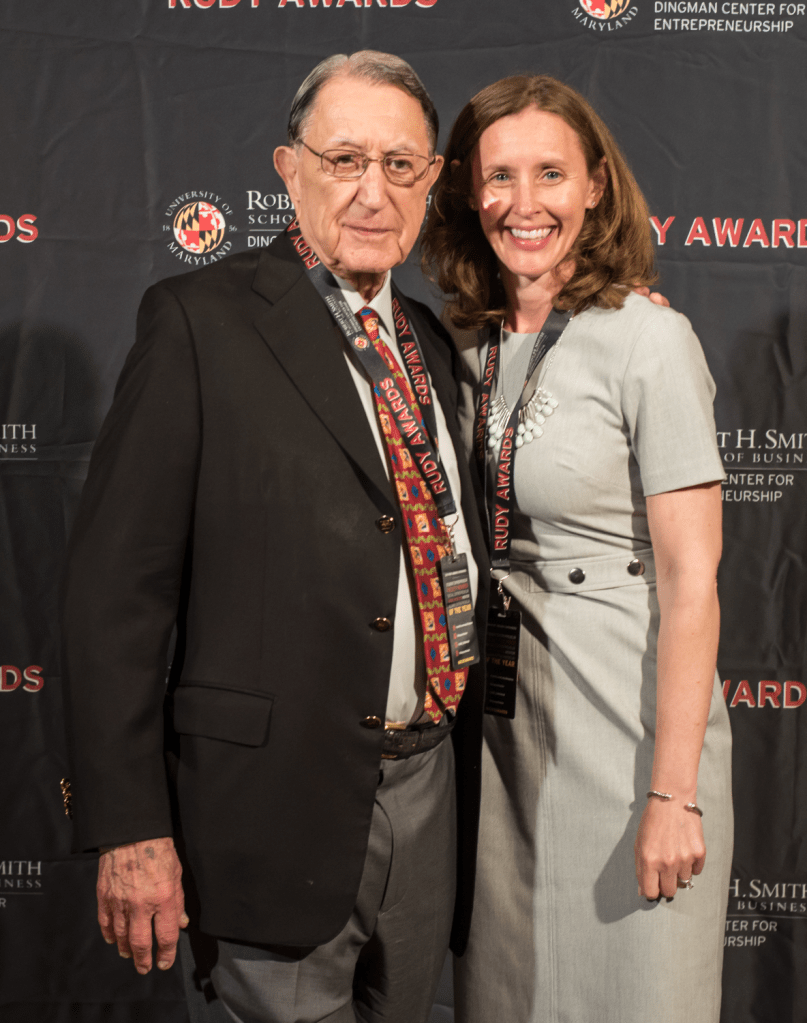
Rudy (left) and Holly (right), awarding Alex Onufrak a check during the 2019 Rudy Awards.
This spirit will continue to live on in all of the people Rudy mentored. He cared deeply about the success of his students and even referred to them as “his kids”.
“Rudy was an incredible role model who never stopped working to impact student lives through entrepreneurship, and worked tirelessly to support the Dingman Center and the Smith School,” says Brent Goldfarb, Dean’s Professor of Entrepreneurship and Academic Director of the Dingman Center. “Rudy was effective because he celebrated everybody’s talents. He was such a great human being. Any interaction with Rudy was a privilege. I hope his inspiration will live on in all of us.”
As a pioneer within the filed, Rudy was a role model for many students, but also had some of the strongest impacts on those who worked alongside him.
“Throughout my years at the Dingman Center, Rudy was always available to listen, encourage and offer relevant advice,” said Holly DeArmond, former Managing Director of the Dingman Center. “I loved hearing him say ‘hey kid’ every time he arrived in my office, or I called him on the phone. Rudy made me and countless others feel appreciated, supported, and qualified.”
Rudy was an innovative businessman with a gift for seeing the potential in all entrepreneurs regardless of their age or background. Even outside of accomplishments within the industry, Rudy was known for his genuine and kind demeanor. He was a man who loved getting to know people and always made everyone in the room feel heard and appreciated. Many who interacted with Rudy personally, truly understand his love for sharing a good meal and connecting with others.
Rudy and Elana at the 2019 Rudy Awards.
“Rudy’s rite of passage was taking new team members to Sergio’s, an Italian restaurant in Silver Spring, that unfortunately recently closed. He’d been going there for years, and true to his personality, had made deep connections with the maitre dee and the staff,” said Elana Fine, former Executive Director of the Dingman Center. “Walking in with Rudy you felt like royalty. That’s what made Rudy so remarkable – the number of deep connections he had with so many people – students, faculty, peers, family, donors, alum, etc. Rudy made a lifelong commitment to the people in his orbit. I can’t think of anyone so selfless, caring and dedicated as Rudy Lamone.”
DeArmond agreed, “for some reason, all my best memories of Rudy involve food. During my first few months at the Dingman Center, Rudy treated me and a co-worker to a long lunch at Sergios, his favorite Italian restaurant near campus. Many who know Rudy have probably been treated to a meal there. He was a frequent visitor. But it was the first time I got to have a real conversation with him. We bonded over music. My husband is a full-time musician and I love music in all forms. Rudy was a sax player back in the day and loved to talk about jazz. I always joked with him that he made the right decision moving out of music and into business–we always had a good laugh about that.The other great memory I have is when he and his wife Linda treated me and my husband to dinner at the beautiful Annapolis Yacht Club. During the dinner, Rudy was genuinely interested in learning more about us, how we met, how we ended up living in Annapolis. We talked about music, the military, and our mutual love for Annapolis.”
Despite your level of interaction with Rudy, his impact on the University of Maryland community is undeniable.
“Unfortunately, I never got to meet Rudy but I am so incredibly thankful for all the opportunities that he has given to me and many aspiring entrepreneurs. When I first transferred to UMD from MC, I had a very hard time finding people that I could relate to until I found the Dingman Center. The team and the incredible entrepreneurs that I have met through this center made me feel so welcomed and also challenged me every day to be a better version of myself and it’s all thanks to Rudy. I really wish I had a chance to meet him and thank him, but his legacy lives through the Dingman Center and all the people that he has impacted,” said Caroline Ta, member of the Dingman Center Young Alumni Founders Council.
Barathi Aravindan, another member of the Dingman Center Young Alumni Founders Council agrees. “Despite having only met him once or twice, I only ever heard great things about him. It was and still is clear how much of an impact he had on Smith and the students during and after his tenure (the Dingman Center itself being a prime example!). Although he’s gone, he certainly left quite a legacy to be remembered by and to be utilized for generations of students to come.”









 Dingman Center for Entrepreneurship