Cupid’s Cup 2009 & 2011 Winners: Where are they now?

The Dingman Center’s signature event, the UMD Entrepreneurship Invitational is tomorrow! The event feature’s Cupid’s Cup, a business competition where 5 student or recent alumni entrepreneurs pitch their businesses in front of a live audience for a chance to win $25,000 from Under Armour Founder & CEO, Kevin Plank.

This post features 2 previous winners, both of which are still operating their winning businesses. Amanda Nachman of College Media Group won top prize in 2009 with her uncensored guide to college life, College Magazine. Brothers Adam and Eric Van Wagner won Cupid’s Cup in 2011 with their dorm-sized regrigerator rental service, My Fridge Rental.

Cupid’s Cup 2012 will be held Friday March 30th from 2-4 PM in Hoff Theater. Keep reading to see what these past winners are doing now.

Amanda Nachman '07, College Media Group

How has your business grown since you won Cupid’s Cup in 2009 ?
We expanded our print reach to over 14 campuses and brought on national brands including Vitamin Water and ihome. Then in 2011 we moved to a digital platform and launched daily content on CollegeMagazine.com. In just a year we now reach 2 million college students online from universities nationwide. We’ve also run national contests including our “Wish I Had Known Freshman Year” postcard contest and the Kembrel Hipster photo contest. We recently had an article go viral, receiving national media coverage and just last month we were highlighted on The Conan O’Brien Show.

Have you had to pivot with your current business plan?
I had to pivot completely by cutting our print publication and redeveloping our online presence along with our media kit and editorial and sales systems. Our print business model did not have the growth potential that we could experience online. We’ve already proven that by moving online, we have surpassed our reach in print.

How did you know it was time and what steps did you take?
I knew it was time to pivot when I realized that students were spending more and more time online and that our guide could reach more college students more effectively in that space.

What advice do you have for students or young alumni looking to start their own business?
I have three pieces of advice for young entrepreneurs:

  1. Follow your passion and spread your enthusiasm to rally support. If you are passionate about your idea, you will be able to trudge through the challenges and also recruit others to help the business succeed.
  2. Find mentors in your industry–they are an invaluable resource.
  3. Start small, prove your concept, and then grow your business. Otherwise you’ll burn out fast.

Eric and Adam Van Wagner '11, My Fridge Rental

How has your business grown since you won Cupid’s Cup in 2011?
Our revenues increased by 35% the year after winning Cupid’s Cup. We established new vendor agreements with various schools and have been able to develop relationships with similar companies to help grow our business.

Just being a part of the Cupid’s Cup has been a very helpful tool for our business. The Dingman Center for Entrepreneurship has been and continues to be an instrumental source of advising for our company. Even if we didn’t win the competition, I know that just going through the process would have been worth it because of the time and effort the Dingman Center puts in and their true dedication to helping young entrepreneurs thrive.

Have you had to pivot with your current business plan?
We have definitely had to pivot our current business plan, in fact it is something we strive to do and is a continuous process. We are always adjusting to new factors that come into play, as well as attempting to find a better or more efficient way to run our current processes. We never settle.

How did you know it was time and what steps did you take?
One of our major pivot points happened soon after we had won the competition and we acquired a new contract with a school. Most of the previous inventory that we purchased had been ‘used’, and we were able to buy at a very discounted price. But for this new school and for growing at the rate we planned to, we knew that we had to get financing and restructure our procurement and growth processes a little bit. We needed the ability to purchase more expensive new units. Again, being part of Cupid’s Cup was very influential with this because of their partnership with BB&T. Through these connections, we were able to acquire a loan at a very low rate, and now have a solid business plan and financial model in place for any new school we happen to form an agreement with.

What advice do you have for students or young alumni looking to start their own business?
The thing that always motivated us about starting a business was knowing that whatever work we put in to it, we were going to directly gain out of it. There is no sitting around and hoping everything falls into place. If you have a passion and are willing to put the work in, go for it. For students, this is a great point in your life to think about starting a business because the time and resources that are available now are exponentially greater than what you will have in the future.

Tagged , , , , , ,

Center Stage with Rudy Lamone, Founder of the Dingman Center for Entrepreneurship

At 80 years old, Rudy Lamone is still an active member of the Dingman Center team. Keep reading for Rudy’s reflection on his years with the Dingman Center as its founder and the Smith School of Business as dean for 20 years.

What keeps you interested in the Dingman Center at your age?
Students. My young entrepreneurs energize me all the time.

What has been your greatest accomplishment during your career?
The Dingman Center is my favorite accomplishment. Secondly, starting the Dingman Center academic program, and together with Charlie Heller, former director of the Dingman Center, helping to establish the Global Consortium of Entrepreneurship Centers. We started with about 30 schools attending the first conference. Today, the GCEC has over 220 colleges and universities worldwide as members.

Do you have any regrets?
My greatest regret is not being able to start a school for entrepreneurship in Baltimore years and years ago. I wanted very much to have a presence in Baltimore and my idea for a school for entrepreneurship was a way I felt we could get approval to start a program. For a number of reasons, mostly political, we were not able to get into the Baltimore marketplace. That has now changed as we have a physical presence with our Smith School campus at the University of Maryland BioPark which opened a few years ago.

What advice do you have for young entrepreneurs?
Be passionate in what you believe to be a great entrepreneurial opportunity. Do what you have to do to make your dream come true.

What is your idea for the future of entrepreneurship and innovation on campus?
I am excited about the proposed new Center for Innovation and Entrepreneurship because I believe it will open up significant new pathways to explore ideas in entrepreneurship and innovation. The campus-wide center will open enumerable ways for students to pursue entrepreneurial dreams.

Dr. Rudolph P. Lamone is the Founder and member of the Board of Advisors of the Dingman Center for Entrepreneurship and a Professor Emeritus at the Robert H. Smith School of Business. From 1973 to 1992, Dr. Lamone served as Dean of the Robert H. Smith School of Business and as the first chair of the Program in Entrepreneurship. He is co-founder of the National Consortium of Entrepreneurship Centers and a founding member of the National Consortium for Life Science Entrepreneurship Programs.In 1996, Dr. Lamone was named “Entrepreneur of the Year” by Ernst & Young for his work in support of entrepreneurship. In 1998, Dr. Lamone was selected to receive the President’s Medal at the University of Maryland. In 1999, Dr. Lamone co-founded DirectGene, a biotechnology company that has developed gene therapies directed toward the treatment of metastatic prostate and breast cancer. A member of Phi Beta Kappa, Dr. Lamone received his B.S. and Ph.D. degrees from the business school at the University of North Carolina at Chapel Hill.

Tagged , , , , , , , ,

Startup Success: Seva Call

Startup Success, a new feature of the Dingman Center Blog, will feature interviews with regional entrepreneurs who received funding from the Dingman Center Angels investor network.  In 2011, members invested in eight regional companies, making it the network’s most active year since its founding in 2004. Investments included Brazen Careerist, CirrusWorks, Nexercise, SevaCall, Spinnakr, Spotflux, Veenome, and YouEye. Click HERE to see the rest of the Dingman Center Angels portfolio companies.

Seva Call is the next-generation request aggregator and filtering search engine. It goes beyond traditional search engines by eliminating the inefficiency caused by the “guess and check” method of matching consumers to service providers.

Seva Call received funding through the Dingman Center Angels in 2011.  This interview in our “Startup Success” series features Seva Call President & COO and UMD alum Manpreet Singh.

As a startup, what are some of the greatest challenges you face?
The sheer volume and breadth of tasks can feel very overwhelming. You have to be a jack of all trades.

How did you get the idea for your business?
Seva Call comes from my brother Gurpreet’s experiences advertising his IT consulting  firm, Geeks On-Site. He spent almost $1 million in advertising over the last 7 years but was bogged down by upfront fees, many contracts, and the inability to track the return on investment each on advertising form. We want to build an efficient marketplace for businesses and consumers that gives flexible pricing options to businesses so that they can choose how much to spend and the ability to measure ROI. For the consumer we wanted to allow them to find a local service professional quickly without spending countless hours researching and playing phone tag with companies.

What is your best networking tool?
I use Facebook and Linkedin extensively.

What advice would you give student entrepreneurs who want to start their own business?
Just do it!

What piece of advice/information have you received that has added the most value to your business?
As a consumer to business local search service, we took to heart the advice that stressed quality. Consumers care about the quality of the professionals that we find, and we had to develop a system of finding the best quality professionals.

What was the Dingman Center Angels review process like?
The review process had simple and well-defined steps. We received great advice from the mentors that we were able to use to do a successful pitch.

Have you had to pivot with your current business plan?
Yes. One challenge we encountered was signing up companies for our service. Our solution was to use a lazy login system to decrease friction and make it easier for companies to interact with our consumers.

Manpreet spent many years as technology investor, at a Washington DC based investment management firm with over $2 billion in assets.  Manpreet is one of the youngest CFA charterholders in the world. Manpreet has been quoted numerous times by Bloomberg, TheStreet.com and other media for various technology pieces. He is a director of the LK Foundation, a philanthropic organization, and is active in the Sikh Council on Religion and Education and the Sikh Caucus. He is also a charter member of TiE DC, Washington DC area’s top network of Entrepreneurs. Manpreet has an MBA from the Wharton School of Business and holds a B.S. Cum Laude in Finance with a citation in Entrepreneurship from the University of Maryland at College Park.

Connect with Seva Call: 

Tagged , , ,

Pitching for Dough–It’s a 5 Chapter Story Baby

By Glen Hellman, Dingman Center Board member and Dingman Center Angels investor from his blog “Forward Thinking: Driving Thoughtful Success

Slide1

You’re a hot startup.  You’ve got it going.  You’re a lean, mean, fighting machine team.  You’ve got all the mojo, karma, and feng shui of the next Google. You’ve got everything but the cash required to put you over the finish line. So how do you get that cash?

Well you’ll need to get your first date with an investor to get that cash.  You’ll need to present a plan that convinces that investor to appreciate your idea, your plan and your ability to execute and you’re going to have to be able to pitch your story in just a few slides.

You have an audience with an investor group to give an 8 minute pitch.  Your job is to generate enough interest in that meeting to motivate those investors to look under your company hood.  This is your match.com moment and you are pitching for your first date.

You can go up there and present 8 minutes worth of slides or you can tell a story… a five chapter story that moves investors to action.

Here’s the plan and I’m going to use an imaginary company that invented aspirin as an example.

  • Chapter 1: Market Pain (Place the audience in the shoes of the buyer and make them feel the pain.)
  • Chapter 2: Solution (After you hurt the audience rescue the with a solution.)
  • Chapter 3: Market Size (Let them know this problem is worth solving.)
  • Chapter 4: Why Invest In Us (Why can you be trusted to make this thing work?)
  • Chapter 5: What’s in it For The Investor (What’s the exit?)

So let me tell the story:

Chapter 1: Market Pain

Slide3

“Imagine that your head hurt so bad that you couldn’t see. You couldn’t drive, go to work, care for your child.” (Asking the audience to put themselves in the shoes of the target customer by using the “imagine that” term, personalizes the problem and is more impactful than simply addressing a large faceless demographic.)

Chapter 2: Solution

Slide4

“Imagine that by taking just two small pills the pain could be erased in minutes.  Imagine the impact on your life”.

Chapter 3: Market Size

Slide5

“There are 45 billion people in the United States with chronic headaches translating to over 1 billion headaches per year.”

Chapter 4: Why Invest in Us

Slide5

“This team has done this before.  We’ve got the experience, the Rolodex and we’re operating as a high-performance, functioning team.”

Slide6

“We’ve secured a cost-effective manufacturing capability to keep up with demand. Our Sales team has already developed key distribution agreements and we’re in negotiations to expand sales to overseas markets”

Slide8

“Today there are a myriad of competitors. From the people who hit themselves in the head with a hammer because it feels so good when they stop.  No solution is as consistently effective and works as fast as Aspirin.”

(Alternate Competitive Slide Format) There are times that the “Gartner Magic Quadrant” slide won’t work for your company and in that case go with the checkbox.

Slide7

Chapter 5: What’s in it for the Investor?

Slide8

“We’ve built a financial model based on our current distribution, manufacturing agreements and staffing projections.  We’d welcome your critical review of our model.”

Slide9

“We’re raising $5 million and believe that should take us to cash-flow positive so no further funding is anticipated.”

“Based on recent M&A activity we believe that a $100 million dollar return for your investment is reasonable in the next 4 years.”

Summary

So that’s the plan and here are some tips on creating the slides.

  1. Use graphics to express concepts over words when ever you can.
  2. Try to limit slides to 5 bullets of no more than seven words.
  3. Use images on word slides that evoke the meaning of your slide.
  4. Ask yourself, do I need this slide, if I take it out of the presentation does it detract from my story?  If the answer is no, get rid of it.  Less is more.
  5. Remember that you’re not trying to close the deal, you’re pitching for the next date. Leave some mystery. Give the audience enough information to want to learn more but leave them curious enough to come back for more.

Good Pitching!

Glen Hellman helps exceptional entrepreneurs figure out what to do and gets them to do it. He’s an angel investor, serial entrepreneur, and has worked for venture capitalists as a turn-around specialist. He’s a principal at Driven Forward, board member at The University of Maryland’s Dingman Center for Entrepreneurship, a Vistage coach and a mentor at the Founder Institute which is a good excuse but not the reason he is such a horrible hockey player.

Connect with Glen on Twitter on LinkedIn

Startup Success: Veenome

Startup Success, a new feature of the Dingman Center Blog, includes interviews with regional entrepreneurs who received funding from the Dingman Center Angels investor network.  In 2011, members invested in eight companies, making it the network’s most active year since its founding in 2004. Investments included Brazen Careerist, CirrusWorks, Nexercise, SevaCall, Spinnakr, Spotflux, Veenome, and YouEye. Click HERE to view all Dingman Center Angels portoflio companies.

Veenome is a video indexing platform — translating the “stuff” in video into machine-readable data for superior organization, publishing, searching and monetization.
Utilizing video recognition technology, Veenome discovers products, objects, and brands in popular online videos. These objects are auto-tagged, indexed and relayed as clickable objects for  display in video. So if you like the shoes in the Lady GaGa video, just click on them to buy. The data can also be delivered en masse via API for enterprise search and ad targeting. 

Veenome received funding through the Dingman Center Angels in 2011. This interview features Kevin Lenane, Founder and CEO.

As a startup, what are some of the greatest challenges you face?
One of the biggest challenges is that you’re a really small organization. In a startup there is a never ending list of duties and you have to know how to succeed no matter what it is that you’re doing. You don’t have specialist to do everything and you have to be able to manage the stress that comes with that. You also have to be able to figure out what you’re good at and delegate what you’re not. The hardest thing is trying to manage multiple roles.

What is your #1 source of funding?
It was self funded for the first few months; it is investor funded now. There wasn’t a traditional friends and family round.

How did you get the idea for your business?
I had been working on a lot of mobile apps with image recognition as a form of alternate entry. I found that there’s a lot for room for error there; for example flash could obscure the text. User error rate was high, so I wanted to see if there were ways to get more information, which was to take more photos. I wanted to find a way to do this with video so I did some tests on my own and found a place in the market to start a company because there is a need for this. It is really powerful if you can do it right. I’ve had a lot of ideas like this, but the difference with Veenome is that this was tested a lot. I got a lot of data to prove that it would work and the data helped take me from an idea to a business that could be started. It validated that there was a market and it could be achieved

What is your best networking tool?
If you want to talk to someone, first check to see if you know someone connected to them. You’ll be surprised what your second and third tier network contains. In my case, I’ll take a video related to what that person does and I’ll tag it, put it on our webpage, and send it to them in an email to show them what I can do. The video is made custom to the person I want to connect with. If you can demonstrate that you put in effort before the conversation happens, people will be more willing to talk to you.

What advice would you give student entrepreneurs who want to start their own business?
Working for a startup first is critical. The worst that could happen is you raise money and realize that all you want to do is work for a big company. Startups aren’t for everyone and you won’t know that until you work for a startup. Interning at a startup is less pressure, a lot of fun, and will give you an idea of what it is like to start a business.

Why a startup?
I like the idea of improving progress especially in technology. Technology is one of our leading industries, so being able to contribute in a way that increases the general progress of technology and be a part of the technology movement is important to me. I like the idea of being able to build something that I can work at and use and know that it helped progress the industry.

What was the DCA review process like? Were you able to handle the criticism? Did you find the feedback beneficial?
Elana [Fine] was really helpful early on with our deck. Getting feedback on your deck alone is beneficial. I had some really helpful questions and concerns from the students and the Angels-in-Residence. One of the angels was asking very hard ball questions but later ended up investing. I took the feedback and reworked my deck quite a bit, then went back a few weeks later and did the formal pitch to the angels. It was a great way of consolidating some active DC angels. A big problem is finding angels that are really investing and Dingman is a great place to look. They’ve done a great job of getting into really good startups in DC.

Kevin Lenane is co-founder and CEO of Veenome. He is an experienced project manager with a keen sense of how location, platform, and portability play in to the mobile experience for businesses and consumers. Kevin has worked with clients at PointAbout including OnStar, the Huffington Post, FEMA, and the ESRB. Prior to PointAbout, Kevin was part of the product management team behind the location management platform NAVTEQ Locations, which gives businesses total control over their location presence.

Connect with Veenome

Tagged , , ,

Center Stage with Harry Geller ’81, Entrepreneur-in-Residence

If you’ve ever been to a Pitch Dingman informal session, it’s likely you’ve met Entrepreneur-in-Residence Harry Geller. Harry generously volunteers his time every Friday to meet with students, providing advice and valuable feedback on starting a new business. He also helps prepare students for Pitch Dingman competitions, coaches students participating in the China Business Plan Competition, and mentors Cupid’s Cup finalists. Keep reading for Center Stage with Harry Geller.

How did you get involved with the Dingman Center?

About 8 years ago I worked with the Smith School of Business mentoring MBA students and at the time I was still quite busy with my various business interests. In early 2009, I sold my interest in a large restaurant group and approached [former managing director] Asher Epstein with the idea that I had more time and wanted to spend it helping aspiring entrepreneurs.

What do you look for in a good pitch?

An idea that is easily understandable within the first 15 seconds. The simpler the better.

How did you start your first business?

How most people do – after years working in a specific industry, in my case the logistics field, I became frustrated with the corporate world. I figured I could do it better than the company I was working for.

What has been your greatest entrepreneurial challenge?

My first startup experienced hyper growth. Being 20-something and virtually overnight managing hundreds of people and tens of millions of dollars in sales was quite a challenge.

What made you want to work for yourself?

My dad was an entrepreneur and I spent a lot of my early years around the various businesses he had in Washington, DC, so I had a good basis for entrepreneurship.

What makes a Cupid’s Cup winner different from companies that compete, but don’t win?

Showing passion for the idea, having a proven track record for execution, and being well prepared for the presentation.

What advice can you give to students entering a Pitch Dingman competition?

Use the resources at the Dingman Center to practice your pitch and develop your business idea. Have all your bases covered regarding what the idea is, what problem you’re solving, what market you’re serving, and what your competition is. Make sure the numbers add up, and refer to question 2, keep it simple so the judges understand right away what you are pitching.

Why do you spend so much time with the Dingman Center?

I’m blessed that I have the time, and I enjoy hearing business ideas and helping and learning from the next generation of entrepreneurs.

Harry Geller

Harry Geller is an Entrepreneur-in-Residence and a member of the Dingman Center Board of Advisors. He is also on the University of Maryland, President’s Advisory Board and has been an active mentor of entrepreneurial students at the Smith School. Harry founded SoDel Concepts, a successful restaurant development company focusing on upscale, relaxed resort dining that has opened and operated five fine and casual dining seafood restaurants. Previously, Harry owned and managed seven multi-million dollar businesses, mostly in the logistics and distribution fields. He is the former CEO of the America’s of Deutsche Post, the world’s largest logistics company that now operates under the DHL/Global Mail name. Four of his companies have been named to the INC. 500 list of fastest growing companies, the most recent one in 2009. Geller is married to a successful entrepreneur Nicole, and they have two children, residing in McLean, Virginia.

Tagged , ,

An MBA Student’s Take on China

Everything in my Washington, D.C. apartment had been to China but me. The Rogue acoustic guitar I was learning to play Greenday songs on? Chinese. The University of Maryland sunglasses I’m packing for the trip? From China. Even the “Japanese” Toshiba laptop I typed this on was actually made in China. Once, I bought frozen organic broccoli at our local Whole Foods Market. I honestly assumed I was doing my part in reducing my carbon footprint, but printed in unmistakable 6-point font on the edge of the bag: Product of China.

This January, I joined forty of my classmates from the full-time, part-time and executive MBA programs at Smith, along with a couple masters and undergraduate students and two MBAs from the Technion in Israel in making the trip to China for the 2012 edition of the Dingman Center’s China Business Plan Competition trip. We were all super excited to see how entrepreneurs fit into China’s “harmonious society.” We toured factories, met with business owners and managers, and did a little sightseeing, too. Learning about doing business in China was nothing short of amazing.

We began our trip with a visit to the U.S. Embassy office. Kevin and Sally, two state department employees, gave a fascinating overview of the business climate in China. It’s a wondrous, fast changing place, they said. There is a lot of money to be made…

…as long as you are very, very careful.

IPR (Intellectual Property Rights) is a phantom! Enforcement of law is more political than judicial! This room you’re sitting in is bugged, and if you brought a computer on this trip, know that the government has already hacked into it! We heard stories of Chinese-U.S. business partnerships going sour for all sorts of reasons. “Do heavy due diligence on your Chinese partners before you make deals,” they told us. “You don’t want to hear the phone calls we get every day.” More than one head was spinning as we headed back to the bus.

A thought-provoking afternoon of speakers from the law firm Jones Day, Venture Capital group CVCA and accounting firm Bernstein Pinchuk lead us to a delicious banquet at Jin Xiang You. Chinese students competing in the next day’s competition met us for the dinner. Much of the conversation focused on the complicated rules of dining etiquette, though a few custom business pitches were passed around the tables as well.

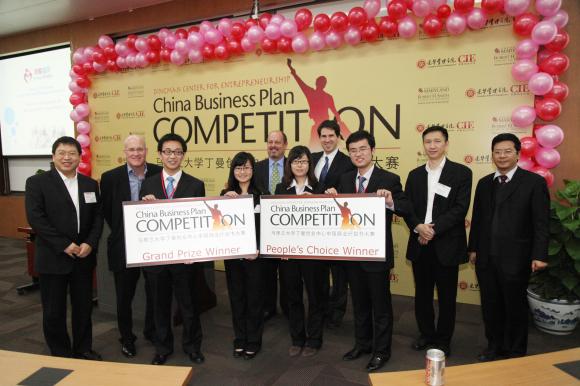
The competition finals at Beida, the so-called “Harvard of China,” were electric. Teams had traveled from as far as 13 hours away by train, with diverse ideas from increasing rail efficiency in northern coal mining cities to teaching newborn babies to read. “Tenacity,” a team of Chinese undergraduate students from near Shanghai, took first place with their idea for an innovative new cane for the blind.  The students proposed a “smart walking stick” that used radars to precisely identify obstacles in the path of a blind person.

Grand Prize Winners from Zhejiang University

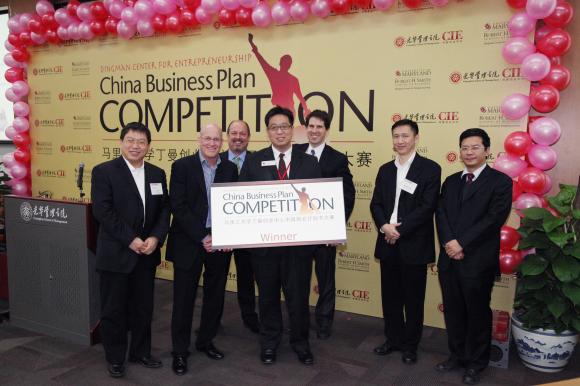
Second place went to Smith first-year MBA Marvin Yueh. Along with his partner, first-year MBA Angela Suthrave (not present on the China trip), Marvin has been working on Live-a-Betes, a program of lifestyle education for people who have diabetes.

Second Place Team, Live-a-betes, from the University of Maryland

Smith E-MBA team “Integrata” also placed, winning with their  comprehensive personal executive security system. Honorable mentions went to Smith teams Comrade Brewing, Avatravel and Spark Computing.

In two more days of company visits after the competition, we had our preconceptions challenged again and again. We took a bullet train to visit factories in Tianjin, a huge quickly-developing city closer to the coast. After passing hundreds of boring 30-story apartment buildings that seemed randomly sprinkled along the hour-long rail route, we went right into the boring one-story warehouse buildings where all those people work.

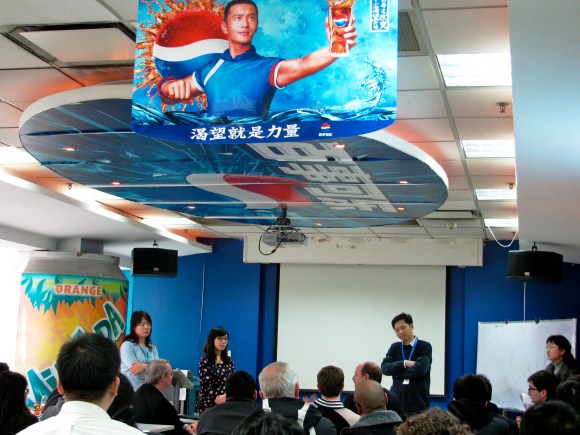
We talked with managers who run the composites factory that makes airplane components for Boeing; saw the manufacturing lines for 20,000 Otis Elevator parts, and even glimpsed the clean rooms where 36,000 bottles of Pepsi get filled every hour, 24/7/365 [read about us inadvertently shutting down the line on the trip blog here]. We met with TenCent, the enormous internet service provider responsible for QQ and several other popular Chinese social media apps. We heard about IPR struggles at Danfoss, as well as the major benefits of doing business in such a huge, dynamic market.

After a week of inside views and privileged conversations I was even more amazed and impressed by the Chinese business world.  What’s more, the Dingman Center’s China trip highlighted for me the beauty of the Smith MBA. We learn about business globalization in the classroom from top-rated faculty, then travel to business hotspots to test what we’ve learned. Whether with CIBER, Dingman or student-initiated trips, classrooms are only one part of our Smith education.

Frankie Abralind, MBA Candidate 2012

Frankie Abralind loves selling new ideas. Before pursuing his MBA, he operated what was once Maryland’s largest biodiesel plant, having designed the facility himself. In the years after finishing his undergraduate degree in Interior Architecture at Cornell University, Frankie also worked as a grassroots organizer fighting global warming, founded and published a real paper magazine with thousands of readers, and learned to love performing improv comedy. Frankie came to the Smith School of Business to learn how to start a profitable business that would make a difference. He’s now the president of the entrepreneurship club.

http://umddingman.blog.com/

Tagged , , , , , , ,

Elana Fine, Associate Director, on ABC’s Washington Business Report

Associate Director, Elana Fine was interviewed by Rebecca Cooper of  ABC’s Washington Business Report about the Dingman Center for Entrepreneurship. The segment includes an overview of our key programs: Pitch Dingman, Dingman Center Angels, and Cupid’s Cup. The segment originally aired on ABC 7 on Sunday, February 5. Watch the video below and leave your comments!

Tagged , , , , , , , ,

Center Stage with Liz Sara MA ’80, Managing Director of Best Marketing, LLC

What made you want to run your own business?

I’ve been at it from two different perspectives. During the 1990s I was the co-founder of a software company. I thoroughly enjoyed the ups and downs, even though there were more downs than ups. When we sold that company in 2001, the last thing I wanted to do was start another software company, but I didn’t know what I was going to do next. After the sale, a couple of CEOs that I knew called me and were having trouble with marketing their startups. That got me started in consulting with early-stage companies; helping with business and marketing challenges. I’ve worked with about 60 companies since then.

The “go to market” part is where many founders run into trouble, and that’s where I come in. They’re technologists, and haven’t come at this from a business perspective. I enjoy the energy, the passion, the decision-making and the attitude of entrepreneurs. I like the pace, and I like the focus on new things and innovation.

As someone that specializes in marketing technology startups, what would you say is the biggest mistake that most entrepreneurs make in marketing their respective companies?

There is a common thread through a lot of these marketing mistakes. Startup founders often think that they don’t need marketing. They get incorrectly supported by the marketplace when they’re able to get the first couple of sales without any real concerted market plan. Many startup founders think that the product will sell itself. Even Apple can’t do that. There are a lot of products and competitors out there. Companies need to break through the noise. You can’t do that by just putting a website up. There is this naïve notion that companies don’t have to put together a marketing plan because they’re just going to “go viral.”  You have to take steps to let people know that you’re there.

Why do you think the Dingman Center is a special place?

Unlike other entrepreneurial support groups, the Dingman Center has an academic component to it. It has access to professors, mentors, funding, etc. Once an idea is at the right stage, people on the outside can get a shot at it. The Dingman Center combines everything that an entrepreneur needs in a central location. It’s a complete ecosystem.

What was the best piece of advice anyone ever gave you about launching a new business?

I think a lot of entrepreneurs know this, but “don’t give up”. When I was looking for venture capital, I made countless trips to Silicon Valley. It was many trips; it was many presentations; it was many rejections. At any one of those stages, I could have given up. But if you really believe in the idea and the way the business operates, then it’s about sticking to it and being tenacious. A lot of entrepreneurs don’t succeed on their first venture.

Liz Sara

Liz Sara

She has played principal roles in such firms as SpaceWorks, an eCommerce software developer, where as co-founder/VP Marketing she facilitated its startup and growth to nearly $25 million in revenue; at America Online, where she designed the PR program and investor road show for the IPO; at United Press International, where she facilitated a turn-around strategy; and for LEXIS/NEXIS, where she was instrumental in the creation and launch of a new division. 

Ms. Sara holds Advisory Board positions at several technology and media companies. She participates on boards of local Washington area tech associations and in membership organizations catering to CXO’s as well as those supporting the cultural arts community in Washington, DC. She is an adjunct professor of Marketing at the R H Smith School of Business at the University of Maryland.  

Center Stage with Dr. Gloria Jacobovitz, Tech Transfer Committee Member

What are you working on right now?

Right now I consult for startups in the USA, Brazil and Europe. Most recently I co-founded an LED lighting business in Brazil. With the fast pace of development and the World Cup coming up, the country is in need of better infrastructure. In fact, one of the reasons some of the Brazilian cities are so violent is that the streets are not well illuminated. We had eminent contract with six world cups stadiums, large shopping malls, and some cities but we had issues with the supplier and couldn’t move forward in an acceptable time frame.

Where are you seeing the most opportunity right now for entrepreneurs?

In today’s economy, the problem is investment. Software is a wonderful field to be in for an entrepreneur, it doesn’t require much investment and may address some of the major issues today such as harnessing and analyzing enormous volume of information. Some of the most successful companies in the world right now have the least amount of people working for them. It’s one of the only type of startups where  you can be in an early stage and not worry too much about investment.  Biotechnology is also an exciting field to be in.  All the recent innovations in therapeutics and diagnostics create an environment for disruptive technologies to surface.  However, it is a much more expensive, longer and riskier process. At the same time, the federal government is working on creating incentives to encourage entrepreneurship, but funding remains a problem.

Are there greater opportunities in emerging markets right now for entrepreneurs?

Oh yes. There are incredible opportunities, especially in Latin America and the BRIC countries, because a large number of poor people are moving into the middle class. There is need for everything; food, infrastructure, high tech and etc. It is much riskier, though.  There is high level of corruption in a lot of these countries.  You have to really understand the country you’re investing in before you decide to make a move.  The laws right now in many emerging markets are made to be very difficult for the entrepreneur. In Brazil, for example, you need a PhD to understand the tax code. Additionally, the laws are being adjusted and modified frequently. There is a risk of not understanding how the country works or not understanding the culture. In the U.S. people say “let’s make a deal” and they mean it. In Brazil, that may not be the case. You’re guilty until you’ve proven the contrary, especially if you are a “gringo”.

How did you get involved with the Dingman Center?

A friend invited me. I really enjoy it. It’s a great place to see innovation. I love technology and I love business. You can see the potential in some of the technologies. It’s a great way to use my experience and background top help the community.

From my own perspective as a PhD, the Dingman Center provides a great opportunity for the UMD students to become an entrepreneur. When I was a graduate student it never crossed my mind that I could use my ideas to start a company. If I had then the support that Dingman has to offer, I would have started a company a long time ago.

As an entrepreneur, it’s also great to help young people that are creating technologies and don’t know how to take it to the next stage. I’ve learned a lot from the Dingman experience, and I also hope we are adding value for these students. We want to be mentors and cheerleaders to help them succeed in ways they never thought they would.

What traits do all successful entrepreneurs have in common?

Persistence and a bit of shamelessness. If you want to do something innovative, everyone will say you’re crazy. You have to believe in yourself. Don’t be afraid to fail. You have to take a lot of “no” answers and be prepared to fail many times.

Gloria Jacobovitz

Dr. Jacobovitz has over 20 years experience in international entrepreneurship, business strategy and development, fund raising, and marketing with fortune 500 as well as startup companies. She has held senior management positions in Biotechnology, Telecommunication, and Biofuels, has co-founded and supported technology based start-up companies, and is an accomplished researcher with many published peer reviewed papers and 6 filed patents. She has extensively consulted, developed corporate and marketing strategy, business & investment plan for national and international companies that contributed to $1 billion IPO, and millions of dollars in private equity investments and International Development Bank loan.  She holds a MS in Biotechnology from Johns Hopkins University and a PhD in Applied Physics from UNICAMP (Sao Paulo, Brazil).

Tagged , , , , ,