Category Archives: Community

Catching Up With Dingman Venture Fellow Bethy Hagan

By Danielle Bennings

Second-year MBA student, Bethy Hagan was not the traditional MBA candidate. After completing her undergraduate degree in liberal arts at the University of Virgina, she wasn’t interested in the corporate culture and stumbled into a job at a startup in California. Although it wasn’t what she initially envisioned for herself, Bethy fell in love with the exciting startup culture on the west coast. Knowing she wanted to move back to her hometown of Baltimore, MD, she searched for top-tier entrepreneurship centers in the area, which brought her to the Smith School and the Dingman Center for Entrepreneurship. Bethy dove in head first during her first year as a Smith MBA. You may remember her as one of the guest bloggers from the AdVENTURE Challenge: China and as a member of the winning team at the China Business Model competition!


Grand Prize winning team, Wireless ISP, with Smith School and Peking University leadership.

Continue reading

Tagged , , ,

Entrepreneur Alumni Spotlight: Daniel Noskin ’14

By Danielle Bennings

Daniel Noskin ‘14 is an entrepreneur at heart. The first time he came to the Dingman Center was in September of 2010 to attend the first Pitch Dingman (now Innovation Fridays) session of his freshman year. Only on campus for a short time, the 17-year-old self-starter was excited to pitch his first business idea. Daniel developed the idea for Greek Recruits, a social networking site that facilitated Fraternity Rush on campus. His original Greek Recruits co-founder was Scott Block, another student entrepreneur who is now working on the startup, VentureBoard. The pair later went on to become two of the co-founders of the Startup Shell, UMD’s first ever student-run incubator. After spending many one-on-one advising hours with Entrepreneur-in-Residence, Harry Geller, Noskin persisted and was selected to compete in the Pitch Dingman Competition in the Fall of 2011. Although he did not win, Noskin competed again in February 2013. noskin Continue reading

Tagged , , , ,

Alumni Spotlight with KidFit Academy

Since 1986, the Dingman Center for Entrepreneurship has helped foster countless students and entrepreneurs. We are always excited to speak with alumni about their successes. Today, we caught up with Margaret Croushore (Maggie), a 2013 UMD graduate who launched her business, KidFit Academy, in Oakland, California.

Grant Lee (GL): Hi Maggie! Tell me about yourself?
Maggie Croushore (MC): I graduated from the University of Maryland School of Public Policy in May 2013, with a focus in education policy and nonprofit management and leadership. Prior to UMD, I taught middle school literacy in Washington, DC for four years. I became involved with the Dingman Center at the end of my first year at UMD, when I pitched an idea that would get students more active throughout the school day. The idea has evolved over time into what is now KidFit Academy. Continue reading

Tagged , , , , , , ,

Diagnostic anSERS Launches Affordable Trace Detection Technology

We first began working with Diagnostic anSERS a few years ago when Sean Virgile began coming to the Dingman Center for advising. Since then, Sean has competed in Cupid’s Cup, become a Fearless Founder, and moved into M Square Research Park. Take a look at the latest press release from Diagnostic anSERS for an update on the company.


Diagnostic anSERS has introduced a groundbreaking SERS sensor that enables trace chemical detection for only a few dollars per test, a sensor that is poised to bring SERS into the mainstream.

DA Logo HR

SERS, or Surface Enhanced Raman Spectroscopy, enables measurement of a molecule’s uniquely identifying Raman “fingerprint” at trace levels. While Raman alone can only identify bulk materials, SERS enables the sample’s molecular fingerprint to be obtained at millions of times lower concentrations than would be possible using Raman alone.

By applying a sample to a SERS substrate (sensor) and measuring the fingerprint with a handheld spectrometer, molecular identification can be carried out at the parts per billion level in under a minute. Despite this incredible promise, SERS has been hamstrung by the high cost of commercially available SERS substrates, at $50-100 per disposable sensor.

P-SERS™ is the first SERS sensor that is both cost effective, at a few dollars per test, and highly sensitive, outperforming the $100 market leader by 10-100× in independent testing. While existing substrates are rigid sensors on silicon wafers, P-SERS™ substrates are flexible and can be used as dipsticks or surface swabs as well as a cost-effective alternative to existing silicon wafer substrates. Diagnostic anSERS is able to achieve this combination of low-cost and high sensitivity through a patent pending technique in which roll to roll ink-jet printing is used to precisely deposit special nanoparticle ink onto paper and other flexible support materials.

P-SERS Slide Mounted

These easy-to-use sensors can be used for detection of a wide variety of molecules, including drugs, explosives, food contaminants and taggants for anti-counterfeiting. Custom sensors are available which can be optimized for detection of targets which are difficult to measure and/or require ultra-high sensitivity, such as biological markers. Tests which previously would have required samples being sent to centralized labs, with the consequent multi-day wait and high price tag, can now be performed on-site. Affordable access to this class of ultra-trace detection enables practical screening in a wide variety of applications.

P-SERS™ research was recently featured as the cover article in the prestigious analytical chemistry journal Analyst. In this article, the researchers demonstrated detection of malathion, an organophosphate (class of insecticides and nerve agents) at 413 picograms. They also demonstrated detection of heroin and cocaine at 9 and 15 nanograms, respectively. Notably, these dipsticks and surface swabs were shown to provide repeatable, quantitative measurements, reporting the amount of drug residue on the surface (not merely presence/absence).

DSC_2699_out

Eric Hoppmann, co-founder of Diagnostic anSERS, said, “We have combined best-in-class detection performance with ease of use and a game changing price point. While P-SERS™ substrates are a drop in replacement for existing substrates, what’s more exciting to us is the ability to apply this technology to address applications which were previously infeasible.”

P-SERS™ premiered at SPIE DSS 2014, a global conference on sensing for defense, security, industry, healthcare and the environment, held at the Baltimore Convention Center, Baltimore, MD, on May 5-9 2014.

For more information about P-SERS™, including a technical white paper, please visit:http://www.diagnosticansers.com/technical/.

Tagged , , , ,

MBA Students Work for Tipton Equity Partners in Venture Practicum Course

In this post on the Venture Practicum series, Dingman Center marketing graduate assistant Grant Lee interviews Aditya Dokania, a second-year MBA student focused on general management.

Grant Lee (GL): Hi Aditya. Good to see you. Why did you decide to participate in Venture Practicum?
Aditya Dokania (AD): I went to the Smith Experience information session to learn about the program and immediately gained interest.  Before coming to Smith, I had experience working in a startup in India and knew I wanted to work with startups in the United States.

GL: What startup are working with this semester?
AD: I am working for Tipton Equity Partners with Brian Banes. It is a private equity fund. Although my major is general management, I always wanted to utilize the resources that our school can offer for new venture finance and thought this would be a good opportunity.

GL: Tell me more about your project.
AD: My current project is to analyze the deals from last year. My goal is to understand the risk for the company and for the industry. I conduct data analysis that helps identify which startups to invest in the future and can also help us to understand how they get funded. I also write a biweekly newsletter.

GL: What do you want to achieve through this experience?
AD: The company’s goal is to improve communication and I can help to identify new targets for investment. Personally, I want to gain more insight about the private equity industry and to learn how people do research and identify targets. Back home in India, new venture financing is a relatively new field. I believe I can leverage this unique experience when I return to India.

GL: Do you think working at a startup will be unlike any other job you’ve had?
AD: Before my MBA, I worked as a consultant at Ernst and Young for more than two years. The scale was tremendously different. At Ernst and Young, it felt like there were thousands of other people there. At Tipton Equity, where there are around 6 or 7 people, I feel more valuable to the company.

GL: What skills or expertise do you offer to your startup?
AD: Research and industry analysis. My graduate assistantship experience has helped me a long way in doing research. I work in the Department of Decisions, Operations and Information Technology department here at the Smith School. My job is to do research on various subjects and prepare case studies for faculty members. I apply this experience to the projects that I am working on for Tipton Equity.

GL: How do you think the MBA program has helped you thus far?
AD: Coming from a consulting background, my goal after graduation is to go back to the consulting field in the US or India. A prestigious MBA will help me to move up the corporate ladder a bit faster. Moreover, the MBA has given me training in public speaking. I have had many opportunities to present on stage and that has helped me to improve my confidence and my communication abilities overall.

Aditya DokaniaDokania-23Aug12-11 (1)
Aditya spent two years in risk and assurance consulting prior to coming to the Smith School for his MBA. He focused on performing systems audits and identifying systemic weaknesses that may lead to leakage of financially significant information. While pursuing his MBA, he interned with the International Monetary Fund where he worked on enterprise architecture and roadmapping for the Information and Knowledge Management division.

Brian Banes
Brian spent three years in management consulting for financial services companies prior to his MBA. While pursuing his MBA, Brian has worked with a number of public and private investment firms. Post-MBA, he will be working in investment banking with a focus on healthcare.

Grant Lee
1512432_10100192309098222_25303874_n1
Grant Lee is a second year full-time MBA student focused on Marketing at Smith School of Business. Prior to Smith, he had four year experiences in retail marketing and sales management. He is passionate about sports, innovation, and entrepreneurship. He is currently seeking career opportunities in sports and marketing management. To know more about him, check out his blog: mrgrantlee.com 

About Tipton Equity Partners 

logo small copy Tipton Equity Partners is a middle-market private equity firm investing in promising enterprises in the US and in select emerging markets globally. Tipton Equity Partners primarily focuses on investments in healthcare, software and business services.
Tipton’s principals are experienced investors and operators who contribute strategic insight and execution experience to new ventures and growth-stage companies, in addition to equity capital investment. Tipton’s portfolio companies and managed interests are spread throughout the United States and across international locations, from southern Europe to the Middle East, South and Southeast Asia, and Australia.


Tagged , ,

MBA Students Work for MD Startup VisiSonics in Venture Practicum Course

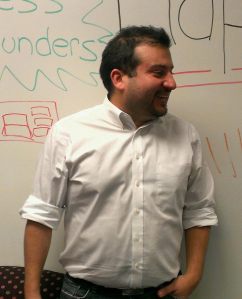
In the second installment of our Venture Practicum series, Dingman Center marketing graduate assistant Grant Lee interviews Salomon Camhi, a second year MBA student focused on marketing strategy. Camhi joined Venture Practicum to experience what startup life is all about.

Grant Lee (GL): What startup will you be working with this semester?
Salomon Camhi (SC): The startup I am working for is VisiSonics. Specifically, I am working for the product, RealSpace 3D Sound. RealSpace creates 3D immersive sound effects that allows users to use headphones enjoying sounds from 360 degree. The traditional sound effect is more flat and comes from 2D, whereas the RealSpace is more complete and exciting.

Grant Lee (GL): Describe your project? What are the deliverables?
Salomon Camhi (SC): My focus in the MBA program is marketing strategy, and this project is all about marketing and new product development. For the project, my MBA team partner, Semret Lemma, and I will be working on the competitor and SWOT analysis. We need to analyze VisiSonics’s own SWOT, create a go to market strategy and find a channel to enter. Other things that we might be tackling include webpage design and product positioning.
Salomon

Grant Lee (GL): What do you want to take away from this project?
Salomon Camhi (SC): Prior to Smith MBA, I had ten years experience in the sales, but I have never been involved with the strategic planning process. This project serves a good opportunity for me to develop the strategy and actually implement it. Also, this is a real company not just a school project. I will see the impact of my work in real life.

Grant Lee (GL): Have you worked in a startup before? Describe the experience.
Salomon Camhi (SC): Yes, last summer I worked as a marketing and development intern for UberOffices in Virginia. My project was similar but the scale is much bigger this time. Working at a startup is different from a traditional corporate environment. It is less structured and the organization is more flat so communication is faster.

Grant Lee (GL): Describe the working environment. Is your startup located in a co-working space–like an incubator? Or, do they have their own office space?
Salomon Camhi (SC): Visionics belongs to Technology Advancement Program on the UMD campus. It is a cool place. I know two people who currently work there are UMD graduates. It used to be a chemistry lab, but now it is more of a demo-testing center. There is little office space there.

Grant Lee (GL): What skills do you think you can contribute to Visisonics?
Salomon Camhi (SC): Coming from the sales background, I understand the sales process. This specialty allows me to think from a sales’ perspective when creating marketing strategy. I will be able to develop more realistic and actionable strategy for the company to implement. Also, personally I like technology, especially gaming. This will help me to be familiarized with the industry.

Grant Lee (GL): How do you think the project will help you in your career?
Salomon Camhi (SC): This project will give me hands on experience in developing marketing strategy. It also gives me a picture of how a new technology product will be launched into the market.

About Salomon Camhi
Salomon Camhi is a second year full time MBA student at Smith School of Business. He was born and raised in Guatemala City, Guatemala. He graduated from Purdue University with dual degrees; one in Management with a Minor in Marketing and a the second in Computer Programming Technology. Professionally, he work as a sales representative for two different construction material companies in DC area. Solomon worked for a lumber yard in the DC before beginning his MBA journey.

Grant Lee1512432_10100192309098222_25303874_n1
Grant Lee is a second year full-time MBA student focused on Marketing Strategy at Smith School of Business. Prior to MBA, he had four years of experience in retail marketing and advertising in Taiwan. During first year, he differentiated himself by participating in three business plan competitions and won top five in Wake Forest Retail Innovation Challenge. Now in his second year, he is dedicated to learning more about entrepreneurship by working as a Marketing Graduate Assistant for the Dingman Center, where he enjoys every moment of it. Grant shares his perspectives in his personal website mrgrantlee.com 

About VisiSonics
VisiSonics’ was spun out of the department of computer science at UMD, and is led by the original scientific team working with experienced entrepreneurs. The technology, based on a deep understanding of how the human brain perceives 3D sound, allows creation of immersive sound over any headphones with pinpoint precision. This allows stunning virtual realism in gaming, movies and music. VisiSonics hardware also can capture and stream sound at live events with precision, creating a “best seat in the house”  experience.Visisonics Logo

Follow the Dingman Center blog for updates on the other students and startups participating in Venture Practicum.

Tagged , , , , , ,