Founder, Emily Garcia ’24, selling original artwork and products at Terp Marketplace.
DC: What is your name, major, minor, and graduation year? Garcia: Emily Garcia, Studio Art & Art Education double major, 2024 graduation year.
DC: Which Dingman Center programs have you been involved with? Garcia: Terp Marketplace and Fearless Founders: New Venture Practicum (BMGT 468R)
DC: In two to three sentences, how would you describe your startup? Garcia: Em G Art Design Studio offers handmade and personally designed products that can be gifted or used to personalize everyday living. These products are designed to be used as a source of inspiration, expression, and creativity.
DC: What or who is your biggest influence for your startup? Garcia: I understand what it’s like to juggle stressful events, illness, and lack of stability. Art is my source of expression. It is a place where I can create freely and with no restraints. But what also fuels my work is making someone smile from something I have made. Making someone smile is one of the best things in the world. For this reason, I strive to spread joy, inspiration, and hope through my startup.
DC: What updates or significant accomplishments can you share with us about your company from the last six months? Garcia: Within the last six months I have opened an Etsy shop, designed and made new products, registered into BMGT, applied for the TiE University Pitch Competition, designed my own business cards and certificates of authenticity for my paintings.
DC: What’s the most important thing you are working on right now and how are you making it happen? Garcia: I am working on getting more people to know about my business and presenting it in a professional way. In order to accomplish this, I have started creating videos to spread interest and to show behind the scenes on how I make my products. As well as, registering into BMGT at UMD.
DC: As a business owner, how do you define success? Garcia: Success is when you set a goal and actively worked on achieving that goal. It involves learning from mistakes, identifying what worked and what did not.
DC: If you could give advice to any aspiring entrepreneurs, what would it be? Garcia: Do not be afraid of moving passed the “planning” stage. Take the steps to make your venture a reality, even if they may be small steps. Go for it!
To learn more about Em G Art Design Studio please visit the Etsy here.
Treasure Valdez ’23, founder of Treasuremybeaute’.
DC: What is your name, major, minor, and graduation year? Valdez: My name is Treasure Valdez, my graduation year is 2023, and I major in Communications with a minor in Innovation and Entrepreneurship.
DC: Which Dingman Center programs have you been involved with? Valdez: So far, I have been involved with the Dingman Center by attending Dingman Fridays.
DC: In two to three sentences, how would you describe your startup? Valdez: I would describe Treasuremybeaute’ as a brand that is designed for women with demanding lifestyles that are in need of high-performing products that saves time without compromising quality. TreasureMyBeaute’ products were created to add value, premium quality, and exclusivity to Women across the globe. Creating an experience of glamour that starts with our packing sparking and emotional charge as YOU unlock your gorgeousness.
DC: What or who is your biggest influence for your startup? Valdez: My mother has been my biggest influence for my startup because she is the reason why I am the person I am today. She continues to push me and always encourages me to never play small and to walk in my power. With that being said, I have broken generational curses and will continue to break more as I build my legacy and create generational wealth for future generations.
DC: What updates or significant accomplishments can you share with us about your company from the last six months? Valdez: In the last six months, I was granted opportunities to be featured on different platforms, increasing awareness about Treasuremybeaute’ products and how they solve issues for women on the go that allows them to achieve pro-like results in minutes.
DC: What’s the most important thing you are working on right now and how are you making it happen? Valdez: The most important thing I am working on right now is launching an editorial campaign to increase visibility for the product lines Lip Heist Collection and Blink Obsession Collection. I plan on making this happen by hiring a creative director, an image consultant, and a professional editorial photographer.
DC: As a business owner, how do you define success? Valdez: I define success as self-love, when you are comfortable in your own skin and happy with who you are every day that you wake up. Also, using that self-love to build a legacy that I can be proud of.
DC: If you could give advice to any aspiring entrepreneurs, what would it be? Valdez: The phrase that I live by is to learn to become comfortable with being uncomfortable because this takes away any limitations that are placed upon you. Do not allow yourself to become the projections of someone else’s fears. Take that risk!
To learn more about Treasuremybeaute’ please visit the website here.
“The Beautiful Math of Coral,” an original novel by E. Ozie Productions founder, Ijeoma Asonye ’23
DC: What is your name, major, minor, and graduation year? Asonye: My name is Ijeoma Asonye. I am a junior mechanical engineering major and creative writing minor graduating in 2023. I am also part of the QUEST Honors Program.
DC: Which Dingman Center programs have you been involved with? Asonye: I have been involved in Ladies First Founders. In the past, I would actively come to First Fridays!
DC: In two to three sentences, how would you describe your startup? Asonye: With our foundations from the novel “The Beautiful Math of Coral”, E. Ozie Productions is a multimedia creative house. We are using our creative voice to rise to the forefront of revolutionary conversations about community, society, and identity. We believe in the power of art, STEM (science, technology, engineering, and mathematics), and storytelling for social impact through various different mediums.
DC: At what point did you know you wanted to start your own venture? Asonye: I’ve always loved books so the idea of writing a book came across my mind during the pandemic and I just jumped on the opportunity. My venture started off with my book “The Beautiful Math of Coral” after watching a TEDtalk of the same name. I would call my book a coming-of-age story that creates metaphors with concepts in STEM, mixed with lots of love and other intangible things. I think it’s a very swoon-worthy book. Now I am looking forward to expanding what kind of creative works we do in the future as a creative house like an AR app for books we are working on.
DC: What or who is your biggest influence for your startup? Asonye: As of right now, ARTECHOUSE plays a big influence for my startup showing the beauty in STEM with their recent exhibition of “Life of A Neuron”. I love how ARTECHOUSE integrates art, science, and technology in the visual sphere. I also was inspired to create my own creative house by learning more about Einhorn’s Epic Productions which is an entertainment creative house. I think they are doing some really cool stuff for underserved gen-z fandoms which is an industry I am tapping into with my book. One of the co-founders of the company purchased my book and that is how I learned more about them.
DC: What updates or significant accomplishments can you share with us about your company from the last six months? Asonye: My most significant accomplishment, as of right now, would have to be that my book “The Beautiful Math of Coral” debuted as a #1 New Release on Amazon! I also participated in Terp Marketplace which was super exciting. I sold a few copies and was able to meet lots of people with an interest in books. My book got featured in the mechanical engineering department magazine, Metrics. Although I don’t consider it as a direct project under my company, the research I started as an undergraduate researcher, which is similar to the values of my company called “E.Ozie and The Mixed Reality For Humanity Project” received a grant from the Do Good Institute at UMD!
DC: As a young business owner, what motivates you? Asonye: What I look to for motivation changes every day. It could be an hour long conversation I had with someone in the film industry that pumps me up or simple affirmations I say every day. As of lately, the music group BTS has motivated me to work hard. Funny enough my college essay was about their influence on me and now I’m a university student so I guess it must be working. I have a poster of them in my room on the cover of TIME Magazine with the headline “Next Generation Leaders”. Although the title “Next Generation Leader” seems like a lot to bear to me I imagine myself as one. Also hearing stories of boss women doing their thing in different industries like music, business, technology, etc.
DC: If you could give advice to any aspiring entrepreneurs, what would it be? Asonye: Three things: grow your network, explore, and surround yourself with like minded individuals.
To learn more about E. Ozie Productions please visit the website here.
DC: What is your name, major, and graduation year? Djampa: Edwin Bright Djampa, I go by my middle name Bright. My major is Nutritional Food Science, Graduation May 2022.
DC: Which Dingman Center programs have you been involved with? Djampa: I have been involved with the Pitch Dingman Competition in 2021.
DC: In two to three sentences, how would you describe your startup? Djampa: At Omega 3, we aim to provide consumers with an easy, accessible, and delicious way to incorporate omega-3 fatty acids into their daily diets and reap the many health benefits of this essential, brain-boosting nutrient. We hope to empower people to take charge of their mental health through nutrition. We want the link between nutrition and brain function to be at the forefront of the dialogue surrounding mental health. We hope one day, you can walk into any local grocery store and find a section of food items dedicated to brain support.
DC: What updates or significant accomplishments can you share with us about your company from the last six months? Djampa: In the last 6 months we’ve been able to get into all the retail locations and cafes on UMD campus. We have also been able to get on to Georgetown University retail locations. We have also been able to partner with NAMI to provide participants with granola bars. NAMI, the National Alliance on Mental Illness, is the nation’s largest grassroots mental health organization dedicated to building better lives.
DC: Can you describe your typical day as a student business owner? Djampa: My typical day is: I wake up at 6am and review all emails and all potential orders. I work to respond to emails and fulfill orders. Then around 7am I either run around and check up on stores in person or I ship the online orders. Around 8am I eat breakfast and begin my class work for the day. My classes typically end at 12pm. I then take a 1 hour break to relax. At 2pm I begin to work on social media and branding content to promote Omega 3 (this typically takes about an hour and a half). For the remainder of the day 4-8pm, I then work to find new gyms, stores, universities, and yoga studios to enter into. From 8 till about 12am I return to school work/class assignments.
DC: What’s the most important thing you are working on right now, and how are you making it happen? Djampa: Currently at Omega 3 we are working on a huge rebranding effort. To make it more clear on our packaging and social media platforms that we are a brain-centric food company. The rebranding efforts will be completely done in Mid January 2022.
DC: As a business owner, how do you define success? Djampa: It is honestly very hard to define success as a business owner because the marker for success is ever-evolving. I would say true success for most business owners is when the business is no longer running them, but instead, they are in a position where they are running the business.
DC: If you could give advice to any aspiring entrepreneurs, what would it be? Djampa: Your internal compass is the only thing that will get you through this entire journey of entrepreneurship. Remain true to your internal compass. Also never ride the highs for too long and certainly don’t ride the lows. As hard as it may be, try and remain even-keel as much as possible.
To learn more about Omega 3, please visit the website here.
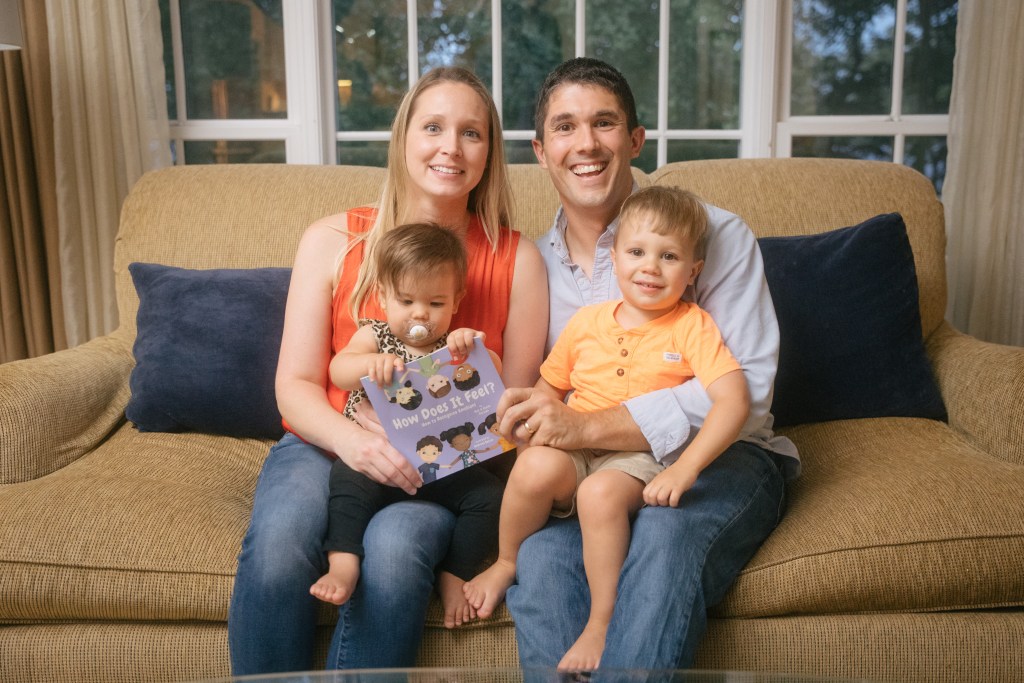
Co-founders Mat and Elaine Parsons MBA ’22 with their children reading original book, How Does It Feel.
DC: What are your names, majors, and graduation years? Parsons: Elaine and Mat Parsons, MBA program 2022.
DC: Which Dingman Center programs have you been involved with? Parsons: Pitch Dingman Competition 2021 Fearless Ideas Competition Grand Prize Winner, 2021 Terp Startup Accelerator Program, and weekly Dingman Friday Participant.
DC: In two to three sentences, how would you describe your startup? Parsons: We create products for parents to teach their children how to recognize and understand emotions. These tools will equip their children with self awareness and relationship skills to navigate through life.
DC: Now that you’ve completed Terp Startup Accelerator this past summer, what’s next for your company? Parsons: Our plan is to launch on Kickstarter Oct. 22nd in order to get support to launch our company. Our goal is to raise $5,000 dollars so we can batch order our book, doll, and puzzles.
DC: Can you describe your typical day as a business owner? Parsons: Putting out fires – I feel like a typical day is solving all of the things that have not worked out over the week!
DC: What’s the most important thing you are working on right now, and how are you making it happen? Parsons: Without a doubt the most important thing we are working on is our book. We really believe that this book will be a great bridge for parents to start teaching their toddlers how to recognize and understand emotions.
DC: As a business owner, how do you define success? Parsons: For our business success is helping as many kids as possible. Our two goals are:
1. Teaching toddlers that these strong emotions they are feeling is ok.
2. Donating holiday toys to kids who can’t afford them.
DC: If you could give advice to any aspiring entrepreneurs, what would it be? Parsons: Read…Read…Read…The two books Lean Start Up and The One Page Marketing Plan have been our best friend.
To learn more about North Star Creations, please visit the website here.
Aurora is an inclusive hosiery and apparel company that inspires wearers to be comfortable in their own skin.
DC: What’s your names, majors, minors, and graduation years? Rickerby:Imani Rickerby, Co-founder & COO, Public Health Science major, 2017 graduation year; Sydney Parker, Co-founder & CMO, Communications major, Women’s Studies certificate, 2018 graduation year; Jasmine Snead, Co-founder & CFO, Government & Politics major, African American Studies certificate, 2017 graduation year; Masters in Public Policy/Masters in Business Administration, 2021 graduation year
Imani Rickerby ’17
DC: Which Dingman Center programs have you been involved with? Rickerby: Dingman Jumpstart, Ladies First, Dingman Fridays, New Venture Practicum, Terp Startup Accelerator, Pitch Dingman Competition, and Terp Startup Fellows.
DC: In two to three sentences, how would you describe your startup? Rickerby: Aurora Tights is the #1 most inclusive athletic hosiery and apparel brand. We make tights for dancers and ice skaters in five shades and seven sizes, from Child Small to Adult 3X. Since its inception, Aurora has empowered performers to bring their own dynamic color and light to the stage. Aurora creates an inclusive space for all athletes to #performincolor.
DC: At what point did you know you wanted to create your own startup? Rickerby: The Aurora team is composed of a figure skater, synchronized ice skater, and a competitive dancer with over 60 years of performing experience combined. Imani Rickerby, Jasmine Snead, and Sydney Parker attended the University of Maryland, College Park, and are sisters of Delta Sigma Theta Sorority, Inc.
Jasmine, a figure skater of over 20 years, used to dye her tights in a bathtub before every competition, and the process was time-consuming, messy, experimental, and expensive. On the opposite end of the spectrum, Imani, a lifetime synchronized ice skater, grew up skating in tights that were too pale for her complexion. While they had different experiences, they were unified in feeling marginalized, unheard, and unseen in the sport they loved.
Jasmine Snead ’17
While coaching a team of young synchronized ice skaters, Jasmine and Imani noticed that many of their students, particularly those of color, were reliving their experiences of isolation. Due to the lack of diverse skating gear, their students were lacking confidence, loneliness, and identity issues. Many times, athletes of color draw away from the sport – not because of a lack of talent – but due to the lack of community. Inspired by their students, the duo both quickly realized that there was an unmet need and shared their stories with Sydney, their best friend and lifetime competitive dancer.
Sydney had a similar experience while dancing, with the added pressure of being a dark-skinned woman in a predominately white sport. The hair products, makeup, and especially the apparel never fit her appearance. Sydney’s feelings of isolation rose so high she avoided even looking in the mirror. It was only after finding her community on her collegiate team of predominantly black women that Sydney started to have confidence in not only her skills, but also her appearance. She understood then what it meant to have a support channel to turn to in times of need. Together the three decided to be the catalysts to end the destructive cycle of monoculturalism within performance sports and instead build a community of empowerment.
DC: What or who is your biggest influence for your startup? Rickerby: While we are a for-profit company, our social impact mission is directly baked into our business model. Supporting and empowering minority athletes to say involved in their passions is the fundamental driver of Aurora. We strive to make sure all athletes feel comfortable in their skin, excel at their athletic passions, and have a long-lasting tenure in their sport.
DC: Can you describe/outline your typical day as a business owner? Rickerby: Our typical day includes brainstorming strategies, solving day-to-day issues, responding to customers, monitoring our social media, and A LOT of meetings.
Sydney Parker ’18
DC: How have the effects of the pandemic changed your company’s focus or ideas? Rickerby: Before COVID-19, Aurora Tights had a lot of momentum. However, with social distancing policies, large events and team sports practices were canceled, and sports complexes and gyms were closed. As a result, there has been a substantial decline in tight sales, and several large accounts were postponed until teams can practice safely. As entrepreneurs, we looked for the silver lining. We launched our line of at-home workout apparel which kept Aurora alive while we all stayed safe in the home. Now with everything opening up, our large accounts are coming back into focus and our tights are set to be featured in the newest Shondaland show, “Inventing Anna,” and the Broadway show “SIX”!
DC: What updates or significant accomplishments can you share with us about your company from the last six months? Rickerby: There have been a lot milestones within the last six months! We were accepted in the Desai Accelerator, which has been a huge driver for growth. Also, we hosted our third cohort of the Aurora Tights Internship, added 11 teams to our Aurora Teams program, refreshed brand, and rolled out our newest product – shimmery tights!
DC: As a young business owner, what motivates you? Rickerby: Well, both ice skating and dance are diversifying rapidly, which is a huge motivator! To best support this inclusive environment, we need to change the definition of beauty in performance sports. To do this, the first step is ensuring that all performers have apparel in their unique skin tone. Currently, there is a whole population of performers who do not have tights that match their skin color or do not like the shades that are available to them. We strive to make sure adults and children, just like us, feel comfortable in their skin and excel at their athletic passions.
DC: If you could give advice to any aspiring entrepreneurs, what would it be? Rickerby: So many times as young people, we feel unqualified to go after our vision. We are so hard on ourselves and feel as if we must first become experts at something before execution. Yet many people do not put those same pressures on themselves and instead exude a confidence that is needed for the entrepreneurship world. I encourage young people to work every day on building that same level of confidence in themselves and to not be afraid to just do it. There is so much magic in our ideas and the world would be made better for it!
For more information about Aurora, please visit the website here.
Co-founders Jeff Su ’21 and Wyatt Talcott ’22 selling ModBars at the Derwood Farmers Market in Rockville, MD.
DC: What are your names, majors, and graduation years? Su: Jeff Su — Finance and Supply Chain Management ’21, Wyatt Talcott — Marketing ’22, Max Levine — Finance ’22, Joe Oleynik — Information Systems ’23
DC: Which Dingman Center programs have you been involved with? Su: Pitch Dingman 2019, Terp Startup 2020.
DC: In two to three sentences, how would you describe your startup? Su: We specialize in making a variety of different snack bars from protein, energy, to trail mix and even dessert bars. They’re low in sugar and packed with fiber so they’ll keep you feeling full without the sugar crash.
DC: What or who is your biggest influence for your startup? Su: Gary Vaynerchuk. He’s the one that inspired me to just start and the whole thing a shot.
DC: How have the effects of the pandemic changed your company’s focus or ideas? Su: We definitely switched gears and started doubling down on e-commerce. A majority of our sales are now coming from our website which has been awesome to see. It’s also given us enough time to think long term and plan for the future. We’ve got exciting projects ahead that’ll hopefully push us to our next milestone.
DC: What updates or significant accomplishments can you share with us about your company from the last six months? Su: In the past 6 months we’ve actually gotten the chance to sell at our first farmers market up in Rockville—Derwood Farmers Market. It was amazing to get back to our roots and do in-person sales again. On top of that, we had the opportunity to partner up with a few of the local neighborhood outdoor pools which not only drove more sales but also let us get our name out there to new customers. Overall, we’ve seen high recurring customer rates and overall really positive feedback from the community. We’ve also been doing a lot of R&D recently that’ll hopefully help drive more sales coming up. There may be a shift in our current product line but more time is needed. Moving forward we want to start investing heavily in media marketing since that has been one of the key areas we’ve been lacking for some time now.
DC: If you could give advice to any aspiring entrepreneurs, what would it be? Su: Be prepared to work really hard. It requires a lot of sacrifice. There’ll be a ton of distractions and things that won’t work in your favor; if you’re not willing or dedicated enough it’ll make you want to quit at every step. So ensure you’re having fun putting work into your venture and don’t gloss over even the smallest victories.
To learn more about ModBars, please visit the website here.
Vitalize is a digital wellness platform tailored to healthcare providers.
DC: What’s your names, majors, minors, and graduation years? Andhavarapu: My name is Sanketh Andhavarapu (May 2023) and I’m majoring in Health Decision Sciences and Neurobiology with a minor in Innovation and Entrepreneurship.
Shah: My name is Veeraj Shah (May 2021) and I graduated from the University of Maryland with degrees in Health Policy & Technology and Neurobiology. I’m now pursuing a PhD in Public Health at the University of Cambridge in the UK.
Sanketh Andhavarapu ’23
DC: Which Dingman Center programs have you been involved with? Andhavarapu: With Vitalize, we completed the Terp Startup Accelerator in 2020. We also frequently participate in Dingman Fridays to receive coaching. I also participated in the Pitch Dingman Competition earlier this year with my nonprofit STEPS, where we were awarded 2nd place in the Main Street Track.
DC: In two to three sentences, how would you describe your startup? Shah: Vitalize is a digital wellness platform tailored to healthcare providers to improve their well-being and reduce burnout. We offer clinician-focused cognitive behavioral therapy through a mobile app, and robust analytics and actionable insights on staff well-being trends and app engagement for hospital leadership.
DC: At what point did you know you wanted to create your own startup? Andhavarapu: In high school, I had the opportunity to be the Chief Human Resources Officer of a nonprofit organization. I learned that I really enjoyed leading and inspiring teams to collectively achieve social impact. This experience directly motivated me to found STEPS, a revenue-generating education nonprofit. In this role, I realized how important it was for me to take on an irreplaceable role in anything that I put time and effort into. I liked knowing that as a founder, there is no one more knowledgeable about your idea and innovation than yourself, and that you’re leaving a unique footprint on the world. I didn’t find this same sense of personal fulfillment when looking at the different clubs I could join when I first came to UMD. This is why, when I had the idea for Vitalize, I knew I had to take action and it was a no-brainer that I wanted to invest my time and effort into making it successful.
Veeraj Shah‘21
Shah: Early in my time at UMD, I dove into the field of public health. My sophomore year, I worked with the Chief Administrator of Health & Human Services for Prince George’s County as a health policy intern, and began to see the world of local public health in action. But what I saw was a landscape full of opportunities for innovation, and how policy alone would not be able to tackle some of the most pressing health disparities and equity gaps present right in my backyard. That summer, I worked as a business analyst intern at IBM Watson Health, spearheading health technology efforts that would improve the state-level innovation capacity of the Centers for Medicare and Medicaid Services. I quickly saw how simply innovations had the opportunity to improve the quality of healthcare delivery and prevent the burden of disease.
From that summer on, I knew that my interests lied as a health technology entrepreneur, where I was able to connect my interests in technology to solve critical problems in healthcare and public health. As a founder, I also soon realized how exciting it was to begin building a team and to truly become a subject matter expert on a topic you care about. Vitalize directly reflects these passions – leveraging technology to improve the wellbeing of healthcare providers, and building an incredible team of students committed to this mission.
DC: What or who is your biggest influence for your startup? Andhavarapu: Both of us have had mentors and family members suffer from burnout as healthcare providers. We saw how people who committed their professional life to helping others were constantly emotionally exhausted, had poor wellbeing, and in some cases wanted to leave healthcare completely. As aspiring healthcare providers and entrepreneurs, we wanted to ensure that healthcare providers had all the resources necessary to achieve the best wellbeing. We see Vitalize as the first step towards creating lasting cultural transformation surrounding wellness and stigma in healthcare.
DC: How have the effects of the pandemic changed your company’s focus or ideas? Shah: The idea for Vitalize was actually born prior to the pandemic. Burnout among healthcare providers is a decades-long issue. The onset of the pandemic exacerbated the problem and also highlighted the dire need for new solutions, motivating us to pursue Vitalize as a company. The added free time that came with online classes and being in quarantine also allowed us to put more time into Vitalize.
DC: What updates or significant accomplishments can you share with us about your company from the last six months? Andhavarapu: The last 6 months have been very exciting for Vitalize. We are just about finished the development of our product, which we will be launching through a public beta with over 100 clinicians in the next couple weeks. We also secured a hospital pilot with Midland Memorial Hospital in Texas, which we will be conducting as a research study in November to evaluate the efficacy of our product and collect data. Finally, we’ve also garnered interest from two hospital interests in larger scale pilots (1000+ providers), which we’re hoping to execute in early 2022.
DC: If you could give advice to any aspiring entrepreneurs, what would it be? Shah: Don’t underestimate the importance of customer discovery. If you have an idea that you are looking to pursue, it is important to conduct several unbiased interviews with all the potential stakeholders (customers, payers, partners, etc). Customer discovery is a great way to validate assumptions and de-risk your startup before investing too much money and time into a potentially flawed concept. It’s also important that you build a strong team with diverse skill sets who are all passionate about the problem being solved and are willing to commit long hours to see the company come to fruition.
For more information about Vitalize, please visit the website here.
Wendy Rodriguez ’22 is the founder of Wise Legacy Finance.
DC: What is your name, major, and anticipated graduation year? Rodriguez: Wendy Rodriguez — Finance, 2022
DC: In two to three sentences, how would you describe your startup? Rodriguez: Wise Legacy Finance is a company that provides personal finance products and services to Gen-Zers and Millennials to take control of their money, make wise financial decisions and achieve their financial goals. We value effectiveness, innovation and variety when offering financial solutions because we believe that personal finance is not a one-size-fits-all. For this reason, our services and products range from private financial coaching sessions to mini-courses/workshops to budget planners to a budgeting app.
DC: At what point did you know you wanted to create your own startup? Rodriguez: I don’t think there was an exact moment, but I’ve been wanting to start my own business as long as I can remember. I love the business world, and throughout the years I have become very passionate about the finance field. With this being said, there have been moments in my life that have led me to create Wise Legacy Finance, such as helping family and friends with their personal finances by creating their monthly budgets or plan for them to save money or pay off debt. I learned how vital personal finance is and how many young people especially, struggle in this area because they don’t find the necessary tools or solutions that effectively cater to their needs.
DC: What or who is your biggest influence for your startup? Rodriguez: My biggest influence for my startup is witnessing the positive change people can make in their lives. Whether they are just tired of not being in control of their money, want to change their financial habits/situation or build a strong financial foundation for their future — knowing that I can be a possibility in their lives motivates me to keep going.
DC: How have the effects of the pandemic changed your company’s focus or ideas? Rodriguez: The pandemic taught us that life can change at any moment and it’s imperative to be prepared, especially financially. I saw the effects of having to deal with unprecedented financial situations and individuals not having a clue of what their next step should be — the impact on mental, physical and emotional health is something that cannot be ignored. The pandemic truly emphasized the importance of being aware of where one stands financially and being prepared with an emergency fund, savings etc.
DC: What updates or significant accomplishments can you share with us about your company from the last six months? Rodriguez: Wise Legacy Finance is officially an LLC and as of August, we currently offer four services — private coaching sessions, group mini-course, budgeting 101 workshop and speaker events. In just a few weeks, we have received some inquiries and have already begun booking for this fall season. Our social media account on Instagram @wiselegacyfinance is growing every week which is incredible. In addition, we have started working on our budgeting app and budget planners and are eager to see where we will be in the next six months.
DC: What do you feel that you have achieved from participating in Terp Startup Accelerator this summer? Rodriguez: I can honestly say that Wise Legacy Finance wouldn’t be where it is right now if it wasn’t for Terp Startup Accelerator. I have achieved many things and have had significant accomplishments and for that I am extremely thankful. Week after week I learned from great speakers about important aspects of a business such as target market, financial modeling, scaling, branding, and so much more. In addition, I met incredible individuals from the Dingman Center and amazing fellow UMD entrepreneurs.
DC: If you could give advice to any aspiring entrepreneurs, what would it be? Rodriguez: Do it even if you’re afraid. Do it even if you have no idea where to begin. Do it even if you fail. There is no “perfect moment” to go after your dreams. Make it happen and work hard! Don’t underestimate the power of self-discipline and determination because it will take you further than motivation ever will. You can do it!
Ian Rosario ’22 holding an in-person Tiny Theatre activity for two young students.
DC: What is your name, major, and anticipated graduation year? Rosario: Ian Rosario- Architecture & Spanish double-major, Class of 2022
DC: In two to three sentences, how would you describe your startup? Rosario: Tiny Theatre is a mission-driven venture that helps elementary kids build social skills, confidence, & reading fluency through FUN, interactive, theatre activities. Unlike traditional activities used to help students in speech language therapy, Tiny Theatre’s creates printable activities that allow students to grow comfortable in social environments in a fun way.
DC: At what point did you know you wanted to create your own startup? Rosario: I knew I’ve wanted to start my own business since high school. I love entrepreneurship because you can use creativity to solve a problem. During my freshman and sophomore year, I used to ideate startup ideas with my roommate in the dorm.
DC: What or who is your biggest influence for your startup? Rosario: I think the biggest influence for my startup is seeing its impact on students. I love to see how students grow out of their shell into their God-given gifts and personality. Empowering students influences me to continue working on this startup.
DC: How have the effects of the pandemic changed your company’s focus or ideas? Rosario: The pandemic has made me think about the accessibility of my product. Since everyone has a different comfort and ability to interact with others, the pandemic has shifted my focus to really think about the end user’s situation.
DC: What updates or significant accomplishments can you share with us about your company from the last six months? Rosario: The last six months have resulted in a pivot of my company. I have spent a lot of time interviewing potential customers and understanding their specific needs and pain points. Based on these interviews, Tiny Theatre has pivoted from only focusing on literacy, to primarily helping solve the need to build social skills.
DC: What do you feel that you have achieved from participating in Terp Startup Accelerator this summer? Rosario: I feel like I have come to understand my “why” for this venture. I deeply enjoy helping people communicate and creating safe spaces for them to express themselves. Through Tiny Theatre, I think I am equipping kids to feel safe & comfortable in social situations.
DC: If you could give advice to any aspiring entrepreneurs, what would it be? Rosario: There is so much learning, customer discovery, and customer acquisition that you can do without spending a dollar. I would recommend spending time in the pre-launch phase to deeply hear from your future customers & understand their needs (this also saves yourself some money).
For more information about Tiny Theatre, please visit the website here.









 Dingman Center for Entrepreneurship