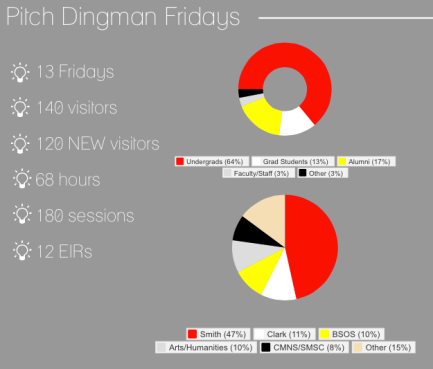
It’s hard to believe it’s already December. Final exams are coming to an end and soon students will be off for the winter break. Those who engage with the Dingman Center, know our mission is to build a community that discovers, equips, connects and celebrates entrepreneurship. This semester was no exception. We hit the ground running in August, bringing back our signature programs, such as Pitch Dingman Fridays, the Pitch Dingman Competition during Global Entrepreneurship Week, and Terp Marketplace.
Dingman Center for Entrepreneurship
Dingman Center for Entrepreneurship

Tag Archives: Student Entrepreneur
Terp Entrepreneur Launches Locks of Curls
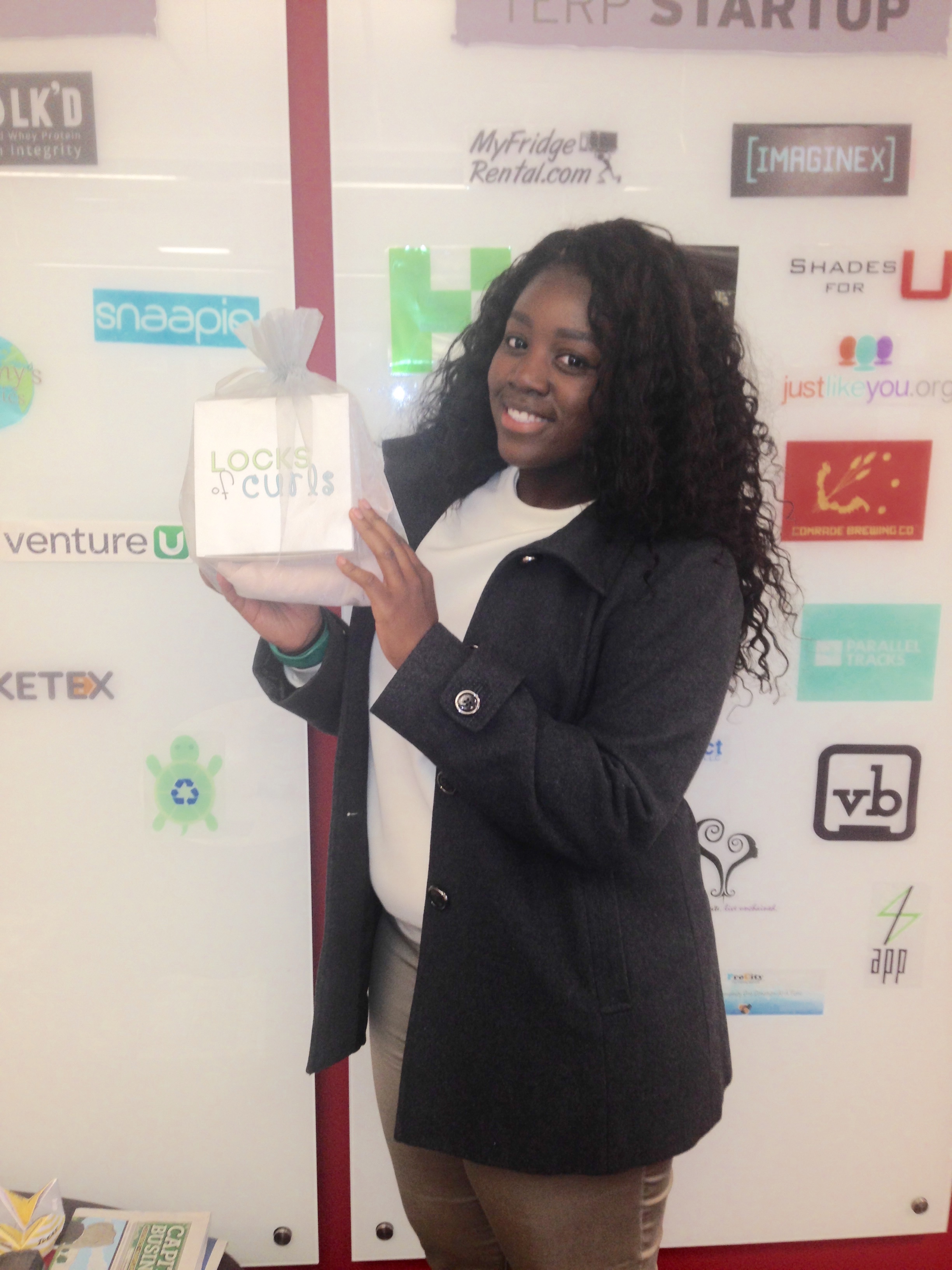
Fredrica Antwi, Founder, Locks of Curls
Fredrica Antwi, a senior studying Accounting and Finance at the University of Maryland, was tired of spending a ton of money purchasing hair products to tame her naturally curly hair. After countless trips to the beauty supply store left her broke and unhappy, she decided to do something about it.
“I would spend so much money purchasing products but at the end of the day, they would end up in a cabinet somewhere unfinished,” said Fredrica.
So, she came up with Locks of Curls, an exciting way for people with naturally curly hair to experiment with products without a huge commitment or breaking the bank.
Top 5 Reasons to Attend The Pitch Dingman Competition
 The Pitch Dingman Competition is THE signature event of UMD’s Global Entrepreneurship Week festivities.
Aside from seeing the five finalists pitch their fearless ventures, here are the top 5 reasons you should attend the Pitch Dingman Competition on November 20th:
Do you have what it takes? Top 10 Reasons to Apply to Cupid’s Cup
Kevin Plank’96, founder and CEO of Under Armour, is looking for the world’s most passionate student entrepreneurs for the 10th Annual Cupid’s Cup. If you are a student entrepreneur with a game-changing business idea, here are 10 reasons you should apply today.
Announcing the Pitch Dingman Competition Finalists
As the Dingman Center for Entrepreneurship gears up for Global Entrepreneurship Week, the countdown is on for its signature event, the Pitch Dingman Competition. On November 20, five student entrepreneurs will pitch their businesses to a panel of judges to compete for $3,500 in cash prizes.
This year, we received the most applications in the competition’s history. The pool of applicants was narrowed to ten, who then each gave a six-minute pitch to the Dingman Center team. From there, five companies were selected to compete at the Pitch Dingman Competition.
Meet our five finalists.
Dingman enTERPreneur Launches Mega Kickstarter Campaign

Obidi Orakwusi, Founder of Gym Supreme
We’ve all heard stories of entrepreneurs whose businesses began on the backs of napkins. But how about the back of a job application?
For one Dingman enTERPreneur, what began as a sketch for an at-home, all-in-one fitness device on the back of a gym job application, has turned into a fully operational business. Today, Gym Supreme’s founder and Dingman enTERPreneur Academy graduate, Obidi Orakwusi, has a patented at-home gym device, Mega Bar, and is launching the company’s first kickstarter campaign.
In 2013, the Dingman Center blog caught up with Obidi. To learn about the genesis of his idea, check out that post here.
Since we’ve been uber-focused on the lean launchpad methodology and customer discovery around the Dingman Center lately, we asked Obidi to share some of those insights from his startup journey.
When Obidi initially gained the idea for Mega Bar, he was confident that it would sell. Mega Bar was not the first at-home gym on the market, but Obidi noticed that what was available at an affordable price point was not the best quality. This validated his hypothesis and he saw an opportunity.
What was your path like toward customer discovery?
I did things a bit backwards. I did much of my customer discovery after the prototype had been developed. I walked around campus and stood outside of Eppley Recreation Center with a clipboard to take notes from discussions with potential customers, who were undergrad students ages 18-22. Through those interviews I found that although my product was an improvement from a quality and design standpoint — think the Nokia compared to an iPhone — it was too expensive for the demographic on campus. The needs matched but the price didn’t. From there, I segmented the target market and shifted focus to a more of a working class, young professional crowd that had money but limited time. Within this space I found my target customer and learned what I was really solving for them: saving people time. This customer spends a majority of his/her time at work, leaving minimal time — sometimes just a few hours at home or outside of the office. With that limited time, people may not always feel like working out, but Mega Bar can help.
What was the biggest challenge in developing and commercializing a new product?
From my experience, the biggest challenges in creating a new product and commercializing it, are marketing and pricing. Pricing will narrow your target market and really affects revenues. For example, if you try to force the price to fit a cheaper audience, you might be faced with a situation where your margins are just too low to keep the company growing. Once you have a set price, the hardest thing is figuring out how to reach the market with the highest willingness to pay when you have no budget for marketing, because marketing has to be continuous for it to be effective.

How did you navigate the patent approval process?
Getting a patent so early on was a great boost of confidence, and the fact that it arrived at the door on my birthday last year was unbelievable. I knew how important it was to have a patent in the pipeline, but I didn’t have the resources to pay excessive legal fees, so I had to learn it all. I read all the rules very carefully, read articles, and called the USPTO anytime I had a question. With all the knowledge I gained, I was able to submit the patent application and receive the approval to grant the patent within nine months of applying, which is extremely rare. I applied for my second patent last summer.
Have you tried any unique marketing campaigns?
I’ve tested three different marketing strategies. The first two were great strategies, but they wouldn’t work with the minimal resources the company had to work with.
The first was a social media campaign. The second involved attempts to have influencers in the fitness industry promote the company, and then the 3rd strategy was to get a booth at a fitness convention. The social media strategy was put on hold because it felt like the posts were getting nowhere without paying for ads; it was taking too long. The fitness influencers marketing strategy didn’t work because we couldn’t afford to send in free gear so early on or pay them to promote to their fan base. I also tried to get the Mega Bar featured in major fitness publications, but the cold emails felt like putting a message in a bottle and throwing it into the ocean of emails that those publications received everyday.
The entire time, I was trying to figure out a way to reach an audience that would also see the value in the product, but I realized that I had been searching for the marketing middleman that would help us reach the potential consumer, when I should have actually been the one reaching directly to the early adopters because middlemen are always more costly. I had to find a way to reach directly to consumers that would understand the value of the product just by seeing a 30 second video of what the product can do without further explanation, so I decided to get the company’s first booth at a personal training convention to gain exposure for the Mega Bar. That turned out to be the most effective strategy based on time and the little resources the company had.
What resources have you found to be most valuable to you as an entrepreneur?
The most valuable resources found throughout my journey, thanks to the Dingman Center, are the entrepreneurship classes. It started with the Entrepreneur Academy that eventually evolved to Fearless Founders. From that class, I learned so much about how to understand your target customer. Everything about the Dingman Center has been a great resource for me along the journey. From winning the first funding ever for the company, which went toward the issue fee for the first patent, to being able to talk to other successful entrepreneurs to get feedback. It’s all been a source of encouragement to keep progressing.
At the Dingman Center, I attended Pitch Dingman on Fridays where I could talk about creative ideas and strategies freely without being looked at like a crazy person because I was so young. You run into a lot of doubters when you first start your idea because no one believes you, but at Dingman, they believe you and are always there to help you succeed even if you are trying to turn water into wine. I had the chance to go on a trip to New York this past spring to show off the cool ideas that are coming out of UMD to Terps who now live in Manhattan. That would have never happened if the Dingman Center didn’t hook us up with a booth at Cupid’s Cup earlier this year where I connected with the UMD Alumni Association.

University of Maryland President Wallace Loh with the Mega Bar
What advice do you have for student entrepreneurs?
The biggest advice I would have for student entrepreneurs is to be confident, but don’t think you already know everything about your idea on day one. Be confident about your idea, but don’t be arrogant because it is just an idea until you can start selling it or acquiring users. You will need help to keep your idea progressing, but watch out for anyone who starts wasting your time because you can not replace time. Learn from the good things that happen along the journey, and also learn from the bad. Every experience will help you understand what to do the next time.
What’s one of the biggest lessons learned in starting Gym Supreme?
I’ve learned so much through building a product and launching a brand to push the product, but the biggest lesson that I’ve learned is that you should always test out your theories, never rush into decisions. Starting a company with no money after product development will force you to find new solutions to overcome marketing barriers.
You recently launched a Kickstarter campaign. What do you hope to achieve through Kickstarter?
My main goal with the Kickstarter campaign is to launch the first sales of the Mega Bar and to introduce Gym Supreme’s story to the world. The goal is to raise $12,000 through sales so that the company can finally generate revenue.
Do you have any bootstrapping tips for our readers?
Start saving your money now! Before senior year, I had a work-study job on campus and saved every paycheck. By the time graduation rolled around, I had enough money to develop a prototype.
Never jump into decisions without thinking twice about it. When you receive that first offer, don’t just take it. Be cautious of investors who are just opportunistic and don’t genuinely believe in your product.
Also, be resourceful. For example, I taught myself to code, which saved a lot of expense and was something I could figure out through studying.
What’s your long-term vision for Gym Supreme?
The long term goal for Gym Supreme is to become a fitness lifestyle brand that creates excellent products, which help us all stay consistent with our health goals. I want this company to help anyone that has a desire to Lift Good, Live good, and Look Good®. 
To learn more about Gym Supreme and to place your order for the Mega Bar, visit their Kickstarter Page to support the $12,000 goal.
And, be sure to connect with Gym Supreme on social media:
https://www.facebook.com/GymSupreme
https://www.youtube.com/GymSupreme
https://twitter.com/GymSupreme
http://instagram.com/gymsupreme
Terp Spotlight on Route One Apparel

Ali Von Paris, Founder & CEO, Route One Apparel
During her junior year at UMD, Ali Von Paris was working at the popular restaurant and bar, The Thirsty Turtle. When the watering hole closed, Ali decided to design a t-shirt for her beloved co-workers as a tribute to the College Park institution. The shirts doned clever designs that read, “Turtle Survivor” and “Barely Remembered, Never Forgotten”.
Originally marketed toward employees, others started asked Ali where they could purchase their own Thirsty Turtle tee, and Route One Apparel was born.
Meet Fearless Founder Chris Lane
By Danielle Bennings
Chris Lane is a Smith School student that wears many hats: entrepreneur, Fearless Founder and campus leader, just to name a few. The role we at the Dingman Center know him best for is founder and CEO of Procity, a University of Maryland service network that rewards users for doing  good. Chris got the idea for Procity, during his first semester at UMD. While taking a Psychology 101 course, he learned about reciprocity; doing something good that may result in getting something good in return, but not asking for it. Chris developed Procity to combat the idea that money is the only value in society. Using his platform, you can do good in your community and receive rewards such as discounts from restaurants or ProPoints used to obtain items from the site. The company launched on September 17, 2013 and now has more than 470 users.

Meet Fearless Founder Osvaldo Bianchi
This week, Dingman Center Marketing Graduate Assistant, Grant Lee, caught up with Osvaldo Bianchi for the third interview of Fearless Founders series. Let’s see what they had to say.
Grant Lee (GL): Hi Osvaldo, nice to meet you. Tell me a little bit about yourself?
Osvaldo Bianchi (OB): I am a freshman majoring in electrical engineering. I was born in Argentina and grew up in Brazil. I came to the U.S. in 2000, and the first place I lived was in Florida. Now I am at the University of Maryland.
GL: How did you get involved with the Dingman Center?
OB: I was in the Startup Shell and people there told me about Innovation Fridays. I always have lots of ideas. One day I said to myself, why not try it! Then I began to get involved. People in the Dingman Center critiqued my ideas a lot, but that helped me to get rid of some unrealistic ideas. What usually happened is that after each session, I come back with another idea.
GL: Describe your business idea. What is the problem and what is your solution?
OB: My Company is called Viip. The problem that I have found is through personal observation. When I went to concerts in South America, there were always long lines, and it was common to see people using fast passes. However, I haven’t seen anything like this here, and I wanted to create something similar. My solution is that customers in a venue who pay a “premium” price would be able to walk in and not wait in line. One of the important ideas of this service is that the price depends on what venue you want to get into. The price someone would pay in College Park would be much lower then a venue in Washington D.C. One of the important mindsets that I have is that innovation starts with empathy. Having a deep connection with the people who are your customers is essential. So what I am willing to pay is what the average customer would be willing to pay.
GL: What is your goal for the business?
OB: My goal is to become something that evolves to be a successful startup, keeps the momentum, and eventually gets seed funding and potential for growth.
GL: Do you have any partners?
OB: Currently I have a developer partner. His name is Jackson Geller, son of Entrepreneur-in-Residence Harry Geller. I work on business networking and he does platform development.
GL: I know it is difficult to be an entrepreneur, what challenges have you encountered so far?
OB: One of the challenges that I have faced is finding partners.I need to show others that I am serious about my business. Because I am young, I also need to show them I am mature enough to pursue the business. Another challenge is to build trust. Often times, it is not just the idea that makes it a viable business, but the trust that you gave built to make it possible. My focus right now is to work on one venue, Cornerstone Bar & Grill in College Park. Cornerstone has the biggest line in the area. It has the biggest hurdle so far.
GL: What have you learned from the Fearless Founders program so far?
OB: This spring, I enrolled in the Fearless Founders Hatch course. The first couple weeks we mostly focused on the “client research”. We needed to do five interviews per week for potential clients. The interviews helped me learn how to find clients. I went to bars in the College Park area and reached out to people standing in lines. I asked them questions like: “How long have you been waiting?”; ”How much are you willing to pay to walk in without waiting in line?”; and “Do you have any suggestions for me?”. These definitely helped me a lot to generate insights from customers.
GL: How has Fearless Founders helped you as a student?
OB: Fearless Founders helped me to better structure problems and ask the right questions. For example, originally one of my question to potential customers was “would you be willing to pay $10 dollars for this service?” But after joining the program, I have learned that I should let customers tell me how much they want to pay, so I revised it to ”What would you pay for this service?” Small things like this can make a big difference. Also, by speaking with Harry Geller I understood the importance of networking. I’ve learned a lot from him.
GL: Is there anything else that you would like say to our readers?
OB: Sure. Many people say that freshmen do not know what to do in their first year. I think those people are wrong. I think freshman year is the time for people to try without being afraid of making mistakes. By doing so they can keep narrowing down their interests and find what they really want to do.
 Osvaldo Bianchi
Osvaldo Bianchi is a student at the University Of Maryland pursuing Electrical Engineering with a focus on entrepreneurship. He is a member of the Startup Shell, an on campus startup incubator. Osvaldo is originally from Argentina and has lived in three countries over the span of ten years. He can be contacted at me@osvaldobianchi.com or Osvaldobianchi.com.
About Viip 
Website: getviip.com
Twitter: @getviip
Facebook: facebook.com/getviip
Grant Lee
 Grant Lee is a second year full-time MBA student focused on Marketing at Smith School of Business. Prior to Smith, he had four year experiences in retail marketing and sales management. He is passionate about sports, innovation, and entrepreneurship. He is currently seeking career opportunities in sports and marketing management. To know more about him, check out his blog: mrgrantlee.com
Meet Fearless Founder Meir Snyder
The Fearless Founders program guides student ventures from idea to launch. By adopting the lean startup methodology, student entrepreneurs can learn the strategy, frameworks and tools necessary to develop their business idea.
There are 61 student entrepreneurs participating in the program. They are different in personalities, majors, and classes, but share one thing in common: fearless in pursuing their business ideas. We caught up with UMD undergraduate Meir Snyder to find out what it takes to be a Fearless Founder.
Grant Lee (GL): Hi Meir, nice to meet you. Tell me a little bit about yourself?
Meir Snyder (MS): I am a junior majoring in entrepreneurial operation. I came in majoring in government and quickly realized that I was fascinated with entrepreneurship. There wasn’t an entrepreneurship major at the time, so I created my own. I did a presentation to key staff members to show what classes I would like to take and how each class would relate to the major. I also had a faculty member as my mentor.
GL: Impressive! How did you get involved with the Dingman Center?
MS: During my freshman year, I was frustrated with my major. I knew political science was a great field to get into being so close to Washington D.C., but I wasn’t happy and I began to question myself. Do I like government? Is this what I want? Then I realized that I actually like coming up with new ideas more than anything. I applied for the Hinman CEOs program and didn’t get accepted. That did not stop me from wanting to get involved in the world of entrepreneurship so I came to the Dingman Center. I remember when I first came here, I came every Friday. I was constantly talking with Entrepreneurs-In-Residence and I learned a lot from them.
GL: Yes I remember seeing you quite often on Fridays last semester. You are really engaged. Why did you decide to participate in the Fearless Founder Program?
MS: I spent the summer in an EMT program and got inspired after learning about the Emergency Medical Test. I came up with my idea for a learning platform and became very passionate about it. I heard about Fearless Founders and immediately applied.
GL: Tell me more about your idea. What is the problem and your solution?
MS: My company is called MyLevelLearning. It is a platform that matches students and teachers based on their availability, teaching and learning styles, and preferences. The idea was inspired by taking the EMT exam. I spoke with colleagues and learned that the exam was very different than other tests. Your ability to do well on the exam heavily relies on the pairing system for teachers and students. I was fortunate enough to learn the information from my teacher to pass the exam. Others failed because their teachers did not prepare them as well.
The idea began to grow. I figured teachers and students should be paired based on their availability and style of learning and teaching. Much like, match.com. Imagine a class with 46 students interested in learning the subjects based on their interests. Then I went to seek out support from the Dingman Center. Dingman challenged me and asked me to speak with more people. It was at that moment that I realize maybe education reform isn’t as difficult as it sounds. Let’s just do it.
GL: Looking forward, what is your goal for developing the idea?
MS: My goal is to develop a solid idea, craft my pitch, then build a website. At Terp Marketplace, I spoke with many potential customers. It helped me to validate my business idea because almost every person I spoke to could feel the pain of not getting the right teacher. Now I am working on the pilot test to get more data.
GL: What challenges have you encountered so far?
MS: Now I am crossing the gap between idea and application and I need partners to help me do that. I plan to add someone to my team who specializes in education technology to help my company build credibility. I also need developers to help build the site.
GL: What is the most important thing you’ve learned from the Fearless Founders program?
MS: How to refine my business idea, learn from mistakes without feeling bad about myself, and how to move forward from those mistakes. Most importantly, I’ve learned that if you are going to fail, fail fast and not later.
GL: If you can use one word to describe entrepreneurship, what will it be?
MS: Diligence.
GL: How about one word for the Dingman Center for Entrepreneurship?
MS: Supportive. The Dingman Center has helped me grow as an entrepreneur and as a person. They helped me understand the critical issues with my idea so I could develop a plan. It is not always easy to accept critical advice, especially for entrepreneurs, who usually take pride in their ideas. But, this has humbled me and helped me to grow.
GL: It was great to meet you Meir! Thank you for your time. I hope everything goes well for My Level Learning.
MS: You are welcome. Thank you for having me!
Meir Snyder
Meir Snyder is a junior at the University of Maryland. His current focuses are his startup “MyLevel” , his managerial responsibilities for the premier College Park hookah lounge “Cafe Hookah” and his volunteer work with America Reads and the PGFD. He can be contacted through linkedin @ linkedin.com/pub/meir-snyder
Grant Lee
Grant Lee is a second year full-time MBA student focused on Marketing Strategy at Smith School of Business. Prior to MBA, he had four years of experience in retail marketing and advertising in Taiwan. During first year, he differentiated himself by participating in three business plan competitions and won top five in Wake Forest Retail Innovation Challenge. Now in his second year, he is dedicated to learning more about entrepreneurship by working as a Marketing Graduate Assistant for the Dingman Center, where he enjoys every moment of it. Grant shares his perspectives in his personal website mrgrantlee.com
 Dingman Center for Entrepreneurship