This week, I am very happy to feature Polly Vail, one the Dingman Center’s biggest supporters and Entrepreneurs in Residence (EIR). Her illustrious background as an intrapreneur and entrepreneur makes her a valuable asset to the University of Maryland community and the Dingman Center for Entrepreneurship. If you have never been to Dingman Fridays to discuss your business ideas with an EIR, maybe this feature about Polly will change your mind. Polly’s perspective and experience are valuable to students considering entrepreneurship.
Polly began her career before the days of Craigslist and Monster, when newspapers “owned” the classified advertising business. One of her first intrapreneurial experiences was launching the first online job search platform for The New York Times where she worked in marketing. It was disruptive and successful. But, ultimately it was shut down. At the time, The New York Times, and others in the industry, were afraid of the changes and retreated to their old ink and paper model. Polly experienced the limits of intrapreneurship and how tough it is for successful organizations to change from within. Polly was able to launch other successful new products for The New York Times including a College edition, a Spanish language edition, and what are now called “native advertising” sections. And, she became the first Managing Director for the paper’s Washington D.C. office focusing on advertising and revenue.
From there, Polly moved to the D.C. Women’s Business Center, where she coached women who were interested in entrepreneurship. The Women’s Business Center served a range of talented women from professionals to women on public assistance. Polly’s main focus was helping low income women move to financial independence through micro-enterprise training. She helped her clients start businesses in the fields of entertainment, childcare, food service, beauty and apparel. After some time at the Women’s Business Center, Polly decided to practice what she had been preaching and began her own independent consulting practice. She helps clients with branding, web site design, social media, and revenue generation. She has worked extensively with the Water Alliance and the International Lyme Disease Association. As an independent consultant, Polly used a crowdsourcing creative services firm called GeniusRocket. Her relationship with the firm led to her tenure as President of the company. As President of GeniusRocket, Polly grew the business and developed a strategic merger with a larger firm.
Polly is still an advisor to GeniusRocket and does consulting in the non-profit space. Having such an enthusiastic, successful, and empathetic EIR as Polly Vail is invaluable.
Polly explained to me that she loves working with student entrepreneurs at UMD because she believes that the Dingman Center does a fantastic job of preparing its pupils for the rigors of running a startup business. She continued by saying that the most important thing for an undergraduate student entrepreneur to develop is a multi-disciplined team so they can execute quickly and effectively and avoid blind spots. The Dingman Center for Entrepreneurship is very lucky to have the talented Polly Vail among its Entrepreneurs in Residence.
At the Dingman Center, we work with many students who want to start their own business. We also work with students who don’t yet have an idea to pursue. For both groups, we encourage them to spend a summer interning in startup land. To jumpstart students’ startup careers, the Center offers two fellowship programs. Dingman Center Angel and Board of Advisors member, Kathryn Stewart, wanted more students to gain the valuable experience of working a venture capital firms and startups so she made a generous gift to form the Kathryn Stewart Fellowship Program. To be selected as a Stewart Fellow, students must secure a summer internship with a VC or angel-funded startup. Once selected, Stewart Fellows are granted a $5,000 stipend to supplement the summer salary offered through their internship.
When the program was launched last winter, student interest sky rocketed. However, many realized how hard it can be to find the right startup or VC to intern. This was not the case for Daniel Stern. Daniel has worked on a few business ideas as a Terp. He’s participated in the Center’s Fearless Founders accelerator program. This summer, he wanted the valuable experience of working at a tech incubator. Through an alumnus from his high school, Daniel learned about the Grand Central Tech Incubator. Pursuing the incubator’s summer internship program would allow Daniel to gain exposure to more than one startup and he jumped at the chance to apply to both Grand Central Tech Incubator and the Stewart Fellows.
Tell us about Grand Central Tech Incubator. What types of startups are there?
DS: Grand Central Tech is really unique in that they offer free rent and office space to startups without asking for equity. They have startups apply to be in their program for a whole year, and after the year is up, most of the startups “graduate” to the upper floor of their building where they continue to operate and remain part of the GCT community. The whole idea is to create the most vibrant tech and entrepreneurial hub in New York City. There are startups working on all different challenges, from 3D printing and Bitcoin solutions to creating unique sports betting and online marketing platforms.
How many and which startups are you working with?
DS: I’m splitting my time working for two startups currently: LiquidText and Barebands. LiquidText helps users better understand, read and make connections with online content and analyzes how these people interact with this online content. Barebands is a lightweight watch for fitness fanatics, looking to take their product into retail. I will most likely spend end up all of my time working for LiquidText.
Take us through your day (or week) at your internship?
DS: So far I’ve mostly been through orientation, which consisted of visiting the offices of Google, Microsoft, and General Assembly to learn about design thinking and the processes that go into building a startup. Currently my day consists of figuring out the best route to get Barebands into retail, learning from people at other startups in the co-working space, and doing market and user research for LiquidText at night.
What projects are you most looking forward to working on this summer?
DS: I’m looking forward to building business partnerships and helping decide what features to launch with for LiquidText, and also helping Barebands get their foot in the door with retail stores.
Why did you want to intern at an incubator rather than a startup?
DS: I wanted to intern at an incubator because I get to work with the best of the best entrepreneurs all under one roof while still getting the experience of working at one of their startups. Being part of this incubator allows me to be part of a large entrepreneurial community while still getting experience at a startup.
What do you hope to gain from a summer spent in NYC?
I hope to learn from experienced startup veterans how to start and grow a business and gain the skills necessary to do so myself. I also hope to build relationships and meet some awesome people along the way.
Have you had any cool startup/networking experiences since you’ve been in NYC?
DS: I haven’t had any crazy stories yet, but there are some impressive people working in GCT (the co-founder of Shapeways, the founder of Gilt, the founder of General Assembly, multiple ex Google executives) who I hope to get to meet and build relationships with as the summer goes on.
What else are you working on this summer?
DS: On the side, I started my own Ecommerce website with a friend from UMD called East Coast Cornhole (www.eccornhole.com). While it has yet to take off, running my own business is an awesome learning experience, and has forced me to learn extensively about internet and content marketing, as well as SEO and the patience it takes to grow a business from absolutely nothing.
Daniel Stern is finance major and a junior at the University of Maryland. He’s from Cheshire, CT, and aspires to run his own startup in the near future. He’s passionate about tackling big problems and changing the way we view the world. During his time at UMD, Daniel has participated in the Dingman Center’s Fearless Founders accelerator and competed in a Pitch Dingman Competition with his startup idea, Globoclub Fitness. In July 2015, Dan and a fellow student launched the e-commerce site, East Coast Cornhole (eccornhole.com), to sell high quality Cornhole Sets and Boards.
As a college student, Jordan Greenwald didn’t know he would become an entrepreneur. It wasn’t until an eye-opening study abroad trip to Spain that he realized he was destined to run his own company.
Imagine a technology that could protect first responders and law enforcement agents from dangerous chemicals.
Not only would the technology protect agents from such chemicals, it would actually block the chemicals from clothing, turn them into water and cause the toxic chemicals to evaporate before even having a chance to touch agents’ skin. That is what the technology behind DC-area startup, Grey Matter, claims to deliver.
The venture, co-founded by part-time Smith MBA student Tommy Luginbill, recently secured $75,000 in federal grant funding to bring this potentially lifesaving, self-decontaminating clothing technology to agents in the field.
How did Grey Matter get its start?
Tommy Luginbill, Grey Matter
Tommy Luginbill is no stranger to entrepreneurship. A part-time MBA student, Tommy comes from a line of entrepreneurs and even helped to start a family-run solar contracting business before business school. Given his strong interest in startups, Tommy started hanging out at the Dingman Center (one of the resources that drew him to UMD) and even pitched an idea to an EIR for an energy software venture.
Dr. Brandy Johnson, Ph.D.
As Terps are known to do, Tommy worked tirelessly and fearlessly dove into the courses available around the Smith School, including the Fearless Founders program. He learned of a new pilot program at the time on campus called iCorps, which matched business students with lab innovations to identify viable commercialization paths. It was here that Tommy met inventor Dr. Brandy Johnson, a Ph.D. working in the Naval Research Lab.
Dr. Johnson was developing smart anti-decontaminating materials made from chitosan, a biopolymer made by treating recycled crab shells. Tommy knew about the lean startup methodology, how to create a business plan, and how to conduct customer discover and identify markets.
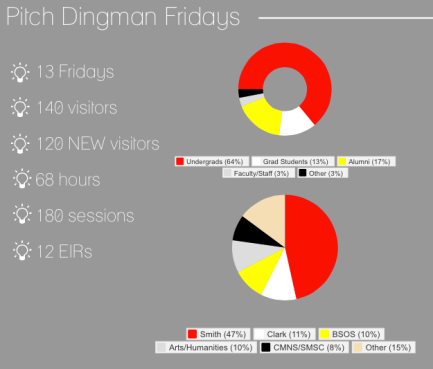
It’s hard to believe it’s already December. Final exams are coming to an end and soon students will be off for the winter break. Those who engage with the Dingman Center, know our mission is to build a community that discovers, equips, connects and celebrates entrepreneurship. This semester was no exception. We hit the ground running in August, bringing back our signature programs, such as Pitch Dingman Fridays, the Pitch Dingman Competition during Global Entrepreneurship Week, and Terp Marketplace.
We are excited to announce that Brent Goldfarb, associate professor of management and entrepreneurship, has been appointed the Academic Director of the Dingman Center, where he will will direct research and education programs for the center.
“Brent is ideal for this role,” said Smith School Dean Alex Triantis. “He pushes his students out of their comfort zones. His #RealEntrepreneurship, for example, has challenged them to conceive, launch and operate actual companies.”
Goldfarb’s entrepreneurship courses are some of Dingman’s most popular at the Smith School of Business. His capstone courses include #RealEntrepreneurship and AdVENTURE Challenge: China, which was recently featured in BizEd magazine.
In his new role, Goldfarb will continue to develop courses similar to AdVENTURE Challenge: China, a program described as “Amazing Race meets venture creation.” Competing students spend a week in China learning critical thinking skills through the practice of customer discovery.
In addition to developing cutting edge curriculum, Goldfarb focuses his research on technology applications and strategies for driving startups and the economy.
“Brent’s expertise has been invaluable to the Dingman Center and our students,” said Dingman Center Managing Director Elana Fine. “His increased role will strengthen our ties to faculty and further integrate Dingman Center programs into the Smith School curriculum. Our combined vision is to create a broader portfolio of courses and experiences to attract and equip students interested in entrepreneurship.”
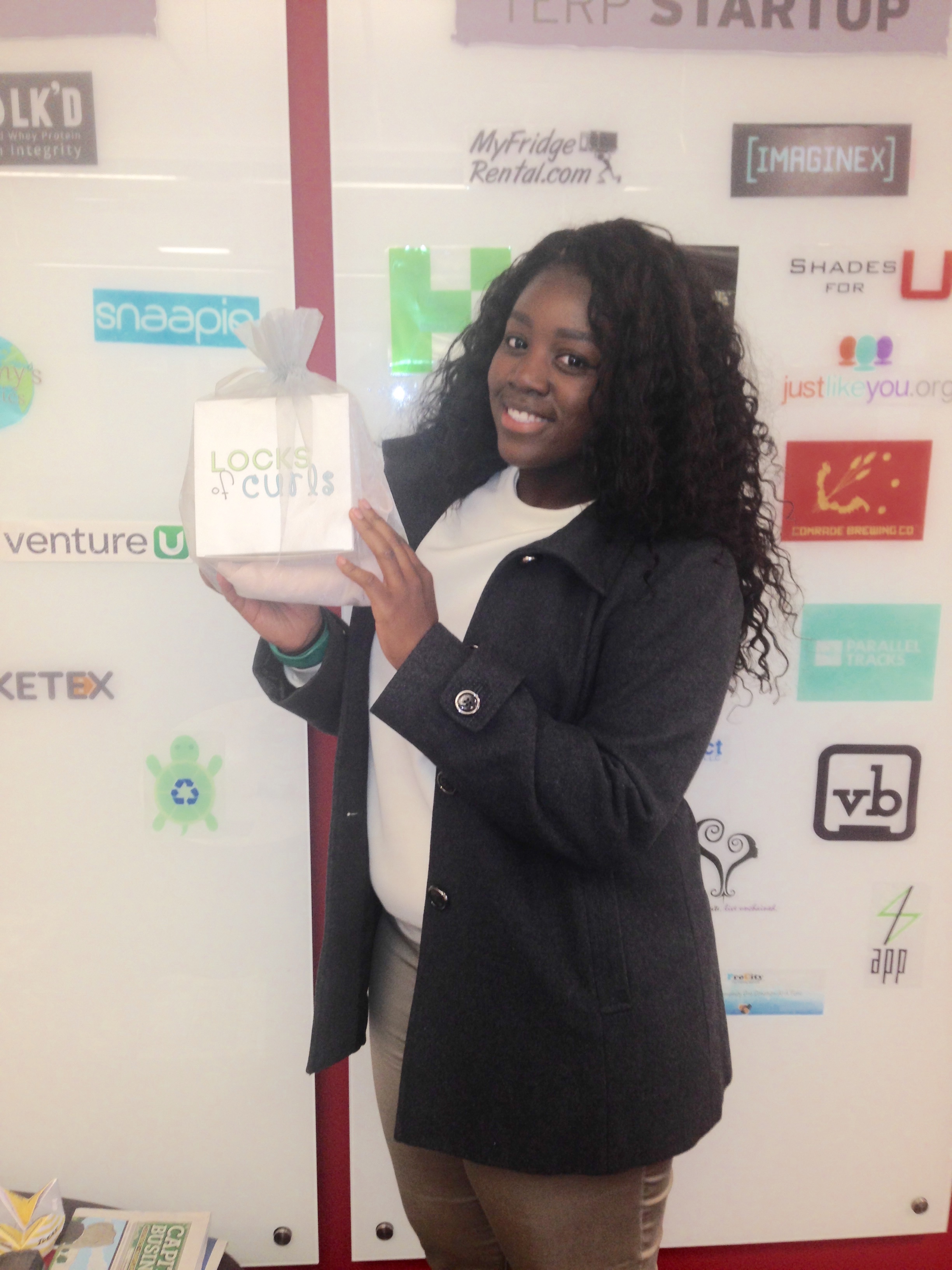
Fredrica Antwi, a senior studying Accounting and Finance at the University of Maryland, was tired of spending a ton of money purchasing hair products to tame her naturally curly hair. After countless trips to the beauty supply store left her broke and unhappy, she decided to do something about it.
“I would spend so much money purchasing products but at the end of the day, they would end up in a cabinet somewhere unfinished,” said Fredrica.
So, she came up with Locks of Curls, an exciting way for people with naturally curly hair to experiment with products without a huge commitment or breaking the bank.
We’ve all heard stories of entrepreneurs whose businesses began on the backs of napkins. But how about the back of a job application?
For one Dingman enTERPreneur, what began as a sketch for an at-home, all-in-one fitness device on the back of a gym job application, has turned into a fully operational business. Today, Gym Supreme’s founder and Dingman enTERPreneur Academy graduate, Obidi Orakwusi, has a patented at-home gym device, Mega Bar, and is launching the company’s first kickstarter campaign.
In 2013, the Dingman Center blog caught up with Obidi. To learn about the genesis of his idea, check out that post here.
Since we’ve been uber-focused on the lean launchpad methodology and customer discovery around the Dingman Center lately, we asked Obidi to share some of those insights from his startup journey.
When Obidi initially gained the idea for Mega Bar, he was confident that it would sell. Mega Bar was not the first at-home gym on the market, but Obidi noticed that what was available at an affordable price point was not the best quality. This validated his hypothesis and he saw an opportunity.
What was your path like toward customer discovery?
I did things a bit backwards. I did much of my customer discovery after the prototype had been developed. I walked around campus and stood outside of Eppley Recreation Center with a clipboard to take notes from discussions with potential customers, who were undergrad students ages 18-22. Through those interviews I found that although my product was an improvement from a quality and design standpoint — think the Nokia compared to an iPhone — it was too expensive for the demographic on campus. The needs matched but the price didn’t. From there, I segmented the target market and shifted focus to a more of a working class, young professional crowd that had money but limited time. Within this space I found my target customer and learned what I was really solving for them: saving people time. This customer spends a majority of his/her time at work, leaving minimal time — sometimes just a few hours at home or outside of the office. With that limited time, people may not always feel like working out, but Mega Bar can help.
What was the biggest challenge in developing and commercializing a new product?
From my experience, the biggest challenges in creating a new product and commercializing it, are marketing and pricing. Pricing will narrow your target market and really affects revenues. For example, if you try to force the price to fit a cheaper audience, you might be faced with a situation where your margins are just too low to keep the company growing. Once you have a set price, the hardest thing is figuring out how to reach the market with the highest willingness to pay when you have no budget for marketing, because marketing has to be continuous for it to be effective.
How did you navigate the patent approval process?
Getting a patent so early on was a great boost of confidence, and the fact that it arrived at the door on my birthday last year was unbelievable. I knew how important it was to have a patent in the pipeline, but I didn’t have the resources to pay excessive legal fees, so I had to learn it all. I read all the rules very carefully, read articles, and called the USPTO anytime I had a question. With all the knowledge I gained, I was able to submit the patent application and receive the approval to grant the patent within nine months of applying, which is extremely rare. I applied for my second patent last summer.
Have you tried any unique marketing campaigns?
I’ve tested three different marketing strategies. The first two were great strategies, but they wouldn’t work with the minimal resources the company had to work with.
The first was a social media campaign. The second involved attempts to have influencers in the fitness industry promote the company, and then the 3rd strategy was to get a booth at a fitness convention. The social media strategy was put on hold because it felt like the posts were getting nowhere without paying for ads; it was taking too long. The fitness influencers marketing strategy didn’t work because we couldn’t afford to send in free gear so early on or pay them to promote to their fan base. I also tried to get the Mega Bar featured in major fitness publications, but the cold emails felt like putting a message in a bottle and throwing it into the ocean of emails that those publications received everyday.
The entire time, I was trying to figure out a way to reach an audience that would also see the value in the product, but I realized that I had been searching for the marketing middleman that would help us reach the potential consumer, when I should have actually been the one reaching directly to the early adopters because middlemen are always more costly. I had to find a way to reach directly to consumers that would understand the value of the product just by seeing a 30 second video of what the product can do without further explanation, so I decided to get the company’s first booth at a personal training convention to gain exposure for the Mega Bar. That turned out to be the most effective strategy based on time and the little resources the company had.
What resources have you found to be most valuable to you as an entrepreneur?
The most valuable resources found throughout my journey, thanks to the Dingman Center, are the entrepreneurship classes. It started with the Entrepreneur Academy that eventually evolved to Fearless Founders. From that class, I learned so much about how to understand your target customer. Everything about the Dingman Center has been a great resource for me along the journey. From winning the first funding ever for the company, which went toward the issue fee for the first patent, to being able to talk to other successful entrepreneurs to get feedback. It’s all been a source of encouragement to keep progressing.
At the Dingman Center, I attended Pitch Dingman on Fridays where I could talk about creative ideas and strategies freely without being looked at like a crazy person because I was so young. You run into a lot of doubters when you first start your idea because no one believes you, but at Dingman, they believe you and are always there to help you succeed even if you are trying to turn water into wine. I had the chance to go on a trip to New York this past spring to show off the cool ideas that are coming out of UMD to Terps who now live in Manhattan. That would have never happened if the Dingman Center didn’t hook us up with a booth at Cupid’s Cup earlier this year where I connected with the UMD Alumni Association.
University of Maryland President Wallace Loh with the Mega Bar
What advice do you have for student entrepreneurs?
The biggest advice I would have for student entrepreneurs is to be confident, but don’t think you already know everything about your idea on day one. Be confident about your idea, but don’t be arrogant because it is just an idea until you can start selling it or acquiring users. You will need help to keep your idea progressing, but watch out for anyone who starts wasting your time because you can not replace time. Learn from the good things that happen along the journey, and also learn from the bad. Every experience will help you understand what to do the next time.
What’s one of the biggest lessons learned in starting Gym Supreme?
I’ve learned so much through building a product and launching a brand to push the product, but the biggest lesson that I’ve learned is that you should always test out your theories, never rush into decisions. Starting a company with no money after product development will force you to find new solutions to overcome marketing barriers.
You recently launched a Kickstarter campaign. What do you hope to achieve through Kickstarter?
My main goal with the Kickstarter campaign is to launch the first sales of the Mega Bar and to introduce Gym Supreme’s story to the world. The goal is to raise $12,000 through sales so that the company can finally generate revenue.
Do you have any bootstrapping tips for our readers?
Start saving your money now! Before senior year, I had a work-study job on campus and saved every paycheck. By the time graduation rolled around, I had enough money to develop a prototype.
Never jump into decisions without thinking twice about it. When you receive that first offer, don’t just take it. Be cautious of investors who are just opportunistic and don’t genuinely believe in your product.
Also, be resourceful. For example, I taught myself to code, which saved a lot of expense and was something I could figure out through studying.
What’s your long-term vision for Gym Supreme?
The long term goal for Gym Supreme is to become a fitness lifestyle brand that creates excellent products, which help us all stay consistent with our health goals. I want this company to help anyone that has a desire to Lift Good, Live good, and Look Good®.
To learn more about Gym Supreme and to place your order for the Mega Bar, visit their Kickstarter Page to support the $12,000 goal.
And, be sure to connect with Gym Supreme on social media:
Applications are now being accepted for the 2015 Cupid’s Cup Business Competition, presented by Under Armour founder and CEO Kevin Plank ’96 and the Dingman Center for Entrepreneurship at the University of Maryland’s Robert H. Smith School of Business. In the 10th annual competition, the top student entrepreneurs from across the country and around the world can compete for $115,000 in total cash prizes.
The application deadline is Jan. 5, 2015. The final competition is set for Wednesday, April 22, 2015, at UMD’s Clarice Smith Performing Arts Center.
The Dingman Center is excited to announced our Fall 2014 Idea Shell cohort. Idea Shell is the first stage in Dingman’s Fearless Founders accelerator program, which guides student venturesfrom idea to launch.

 MBA Candidate

 Daniel Stern is finance major and a junior at the University of Maryland. He’s from Cheshire, CT, and aspires to run his own startup in the near future. He’s passionate about tackling big problems and changing the way we view the world. During his time at UMD, Daniel has participated in the Dingman Center’s Fearless Founders accelerator and competed in a Pitch Dingman Competition with his startup idea, Globoclub Fitness. In July 2015, Dan and a fellow student launched the e-commerce site, East Coast Cornhole (
 Imagine a technology that could protect first responders and law enforcement agents from dangerous chemicals.








 Dingman Center for Entrepreneurship