Tag Archives: pitch dingman

Worth Reading 4/26/2013

Welcome back! It’s hard to believe that there’s only a few weeks left in the school year, soon the halls in front of the Dingman Center will be a lot quieter.  But before the school year ends, there’s still one last Pitch Dingman Competition, taking place next Friday at Tyser Auditorium.  Don’t forget to stick around after the competition as well as the Dingman Center will be sponsoring a post-competition mixer for our guests, food and refreshments will be provided!

Enough plugs though, onto what’s worth reading from the week!

As always, we take some time to recognize enTERpreneurs in the press.  This week, Cupid’s Cup and Pitch Dingman alum Diagnostic anSERS were featured on the Washington Post’s weekly Business RX column.  In addition, this Businessweek article that examines the usefulness of the traditional business plan also features one of our very own MBA entrepreneurship classes, led by Smith Professor Brent Goldfarb.

Everyone knows that to do business in today’s world, you need a social media presence, but do you really know what a social media strategy entails? Inc. examines the basics of setting up a social media strategy that works for your business.

Companies everywhere have struggled with making their own “viral” marketing campaigns.  How does a campaign go viral?  Can it be forces?  Is it more about luck?  Inc. continues its social media primer, by offering a look at what attributes successful viral campaigns share, and how businesses can take apply those lessons.

Finally, a high ranking director at Oglivy & Mather examines the virtues of being weird, and how it’s helped him find success in his career. Inspiring words for weirdos everywhere, and to be fair, aren’t we all a little weird?

Until next time!

Tagged , , , , ,

Pitch Dingman Competition Results!

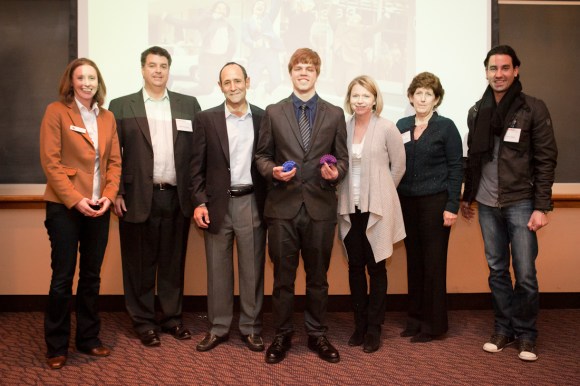
Earlier today, five student startups pitched to a panel of judges for the first Pitch Dingman Competition of 2013. The competition was fierce and each entrepreneur put up equally compelling arguments for their ventures. In the end the judges and audience both chose Wheel Shields as their winning student startup, with UPride receiving 2nd place honors. Wheel Shields was awarded $2,250 and a Cupid’s Cup prize package allowing the company to participate in the Cupid’s Cup Business & Innovation Showcase on April 5. UPride took home $500 to propel their business. Congratulations to both startups, the Dingman Center expects great things from you in the future!

PitchDingman-15Feb13-151

We’d also like to recognize Parallel Tracks, Electric Squeeze and Adaptive Motion Technologies for giving great pitches, we wish them the best in their ventures, and given their performance, we’re sure they’re well on their way!

About Wheel Shields

Student Entrepreneur: Chase Kaczmarek

Shield Boards, LCC produces my patented invention Wheel Shields. Wheel Shields are a skateboarding accessory that solve “wheel bite” (a dangerous safety problem), keep riders dry and allow riders to stand over their wheels. “Wheel bite” occurs during hard turns when wheels come in contact with the deck, stopping the board and throwing riders to the pavement. Wheel Shields completely eliminate “wheel bite” and work universally with any skateboard. Wheel Shields have gone viral: our Facebook page has over 25,000 likes, we’re endorsed by a Guinness world record-holding skater, and we are in an upcoming edition of Heelside Magazine.

About Pitch Dingman Competition

Twice a semester, students can compete for $2,750 in start-up funding at the Pitch Dingman Competition. Everyone is welcome to attend Pitch Dingman Competitions as an audience member and there is no need to register. The next Pitch Dingman Competition is scheduled for Friday May 10, 2013 Interested in competing? Start with an informal Pitch Dingman Session

Tagged , , , , , ,

Meet the Feb. 15 Pitch Dingman Competition Finalists!

The first Pitch Dingman Competition of 2013 will take place at 11 a.m. Friday, Feb. 15 at Tyser Auditorium in Van Munching Hall.  Five UMD-based student startups will pitch for the chance to win $2,500 in startup funding. In addition, audience members will also have the opportunity to vote for their favorite entrepreneur of the day to award them with additional prizes!

Here’s a little preview of our finalists:

3841_356297531135361_89754252_nParallel Tracks
EnTERPreneur Academy Member
Team: Daniel Noskin, Vinnie Vendemia, Scott Block, and Jeff Hilnbrand

Parallel Tracks is a social networking web site and mobile application that gives users the ability to broadcast and listen to music with others in real time, creating a more social and enjoyable listening experience. Using a twitter like interface, users can “track” more than just their friends. They can also follow their favorite celebrities, athletes, and musicians to discover new music in a unique way. Detailed analytics help users strategize their music brand so that they can target specific audiences and advertise accordingly. Now everyone has a music voice. Play it louder!

Logo_20Adaptive Motion Technologies
EnTERPreneur Academy Member, Dingman Jumpstart
Team: Yoni Kozlowski, Emmanuel Klein, and Jonathan Howarth

Adaptive Motion Technologies LLC is a medical device development company that intends to design, patent, and market prosthetic devices related to the fit and comfort of the human/prosthetic interface. A group of engineers are currently developing three devices designed with the participation of prosthetists, physicians, surgeons, and patents.  The principal technique for maintaining a secure fitting of a prosthetic device with a patient is through the use of a socket. A properly fitted socket distributes the forces on the prosthetic device around the patents limb while holding the socket aligned and in place. This is primarily accomplished through the use of custom made shells which are formed based on molds of the patient’s limb. This process is both limited in function and expensive in practice costing about a billion dollars per year in the United States alone. Adaptive Motion Technologies LLC has developed technology which would allow a socket to conform to the unique and variable shape of a patient’s limb every time they don their socket. This would allow sockets to be used comfortably over longer periods of time and without the need for custom components reducing the overall cost. Adaptive Motion Technologies LLC intends to license this technology to a larger company. In this way the company will mature quickly from product development.

61153_190721601053181_1102597725_nUPride
EnTERPreneur Academy Member
Team: Suyash Mehta and Dan Martinez

UPride is an innovative apparel company that strives to bring universities across the nation pride gear. The target audience for the company has no boundaries; it can apply to all ages depending on the nature of the merchandise. Currently, the majority of our merchandise is Maryland Flag themed. We constantly are designing new designs to keep our target audience up to date with the current fashion trends. We have started talking to many large companies about supplying them with our merchandise. In the near future, we plan on branching out and becoming a distributor as well as a retailer.

601249_413571745384601_408988131_nThe Electric Squeeze
Team: Julian Ragland, Fuad Balashov, and Eugene Skinner

The Electric Squeeze is a business dedicated to bringing a culture of music into College Park while helping to create opportunities for local, partner, DJ’s.  The business was originally formed as a blog to share the music that its founders listed to with their friends. As it grew, the opportunity to host events at local venues and establish a physical presence presented itself. Since the fall of 2012 the Electric Squeeze has organized seven events in three venues, both in DC and College Park. We plan to continue our growth and would value the Dingman Center’s assistance.

9695_471694029535714_1794550549_nWheel Shields
Team: Chase Kaczmarek

Shield Boards, LCC produces my patented invention Wheel Shields. Wheel Shields are a skateboarding accessory that solve “wheel bite” (a dangerous safety problem), keep riders dry and allow riders to stand over their wheels. “Wheel bite” occurs during hard turns when wheels come in contact with the deck, stopping the board and throwing riders to the pavement. Wheel Shields completely eliminate “wheel bite” and work universally with any skateboard. Wheel Shields have gone viral: our Facebook page has over 25,000 likes, we’re endorsed by a Guinness world record-holding skater, and we are in an upcoming edition of Heelside Magazine.

Interested in being a part of the action? Your first step would be to attend a Pitch Dingman informal advising session to talk to one of our expert Entrepreneurs-in-Residence who will help point you in the right direction.  Pitch Dingman informal advising sessions take place every Friday during the school year from 11am to 1pm at the Dingman Center for Entrepreneurship.

Tagged , , , , , ,

EnTERPreneur Academy Profile – Triple Impact

To celebrate Global Entrepreneurship Week, the Dingman Center is featuring a series of blog posts about our EnTERPreneur Acadmey, a program to help guide student ventures from idea to launch. The Academy provides members with a variety of resources including startup fundamentals workshops, advising, office space, selling opportunities and seed funding. The Academy’s three stages Idea Shell, Hatch and Terp Startup provide students with specific resources and requirements that suit the level of progress for their ventures.

Our last featured startup is Triple Impact, founded by EnTERPreneur Academy member Abby Murray and her co-founders. Abby is a senior at the University of Maryland who came up with Triple Impact as part of the Smith School’s Social Innovation Fellows Program. Triple Impact won the Audience Choice Award for the Pitch Dingman Competition at last year’s Social Enterprise Symposium (hosted by the Smith School’s Center for Social Value Creation) and is poised to do great things in the Corporate Social Responsibility space.  Read the Q&A to find out more about Triple Impact!

Q: Please describe your business.

A: Triple Impact works closely with a company’s Corporate Social Responsibility department or leadership development team to provide the corporation’s employees a system where they can leverage their skills to support underdeveloped communities. We coordinate meaningful corporate service projects both domestically and abroad that provide benefits the company, the employees and the community. Through these meaningful projects, we strive to transform communities and enrich companies through developing employee leadership, world awareness and motivation.

Q: How did you get the idea for your business?

A: In the fall of 2011, my partners and I were brought together by the Robert H. Smith School of Business’ Social Innovation Fellows program where we were given the assignment of developing a business plan for a non-profit or social enterprise. We soon realized that we all had a similar view: one should not have to choose between conventional and altruistic career paths. Triple Impact was created to be a solution for having to choose between going into a corporate setting or the field of development/non-profits after graduation.

Q: What phase is your venture in and what are your next steps?

A: We recently presented to our first potential client, the R.H. Smith School of Business, which is developing a leadership institute for its top-performing faculty and staff.  We are also registered as a Benefit L.L.C. in Maryland. From a marketing perspective, we have created a website and set up various forms of social media.  We are currently in the process of scaling our business plan to a more manageable size and setting realistic goals for the next year. Additionally, we are working to form strong partnerships with both local and global non-profits as well as organizations in the development field. This will not only be very helpful to us from an informational perspective but it will give us access to communities worldwide.

Q: What drew you to become entrepreneurs?

A: We are all business students with entrepreneurial mindsets as well as a passion for service. As a result of our involvement in the Social Innovation Fellows Program, we saw that it was possible to combine these two passions. Triple Impact is a company that we all truly believe in and we can all see ourselves spending the rest of our careers working towards our ultimate goal: to live in a world where all corporations enrich the world we live in as part of their normal operations.

Q: As a student startup, what are some of the challenges that you face?

A: Like many startup companies, Triple Impact faces challenges in obtaining customers. While we have done extensive research, built our networks, and honed our leadership skills with service projects abroad, we face challenges in identifying ways to convey our value to potential clients. To address these challenges, we have been proactive in seeking advice from investors, professors and mentors to build a plan to not only boost our experience but also our confidence. We are also focusing on understanding our market, clearly identifying our unique value proposition and establishing an experienced set of advisors who can offer advice while lending credibility to our venture.

Q: How did the Dingman Center contribute to the development of your start up?

A: The Dingman Center has always been a great resource and has truly been the differentiator in the development of our company. We participated in the Pitch Dingman Competition this past March and received $250 in seed funding by winning the audience choice award. With this money, we were able to advance our business by printing business cards and hiring a web designer. Through working with the Dingman Center and the momentum we gained from Pitch Dingman, we were able to reach out to our first investor who contributed $1,000 to help kick start our business.

Q: What about being a part of the EnTERPreneur Academy excites you the most?

A: We are all incredibly excited about being a part of the EnTERPreneur Academy. When building a venture from scratch, it is always great to be surrounded by like-minded individuals who share the same passion for entrepreneurship. The idea of collaborating with other student entrepreneurs who can also make an impact on the development of our business is really exciting. In addition, having a designated office space where all four of our founders can meet is also a great help given our busy schedules.

Tagged , , , , , , ,

EnTERPreneur Academy Profile – Comrade Brewing Company

To celebrate Global Entrepreneurship Week, the Dingman Center is featuring a series of blog posts about our EnTERPreneur Acadmey, a program to help guide student ventures from idea to launch. The Academy provides members with a variety of resources including startup fundamentals workshops, advising, office space, selling opportunities and seed funding. The Academy’s three stages Idea Shell, Hatch and Terp Startup provide students with specific resources and requirements that suit the level of progress for their ventures.

Today’s featured startup is Comrade Brewing Company, the dream company of EnTERPreneur Academy member, David Lin. David is a Full Time MBA student at the University of Maryland who can frequently be found in the halls of the Dingman Center volunteering with programs and absorbing everything he can about entrepreneurship. David’s company, Comrade Brewing, was an honorable mention at the 2012 China Business Plan Competition and also an audience choice award winner at Pitch Dingman.  Read the Q&A to find out more about David and his business, Comrade Brewing Company!

Q: Please describe your business.

A: Comrade Brewing Company will be a Denver, CO based business that will brew and serve hand crafted beer, free of corn syrup and chemically modified hop extract. Customers will be able to visit and drink beer by the glass on the brewery premises.  The brewery will follow a tasting room model, where no food and only beer is served.  I’m planning to head back to Denver after finishing up my MBA this semester and I hope to open sometime in 2013.

Q: How did you get the idea for your business?

A: Ever since I started brewing professionally in 2005, I have known that I eventually wanted to work in the craft beer industry full time.  I saw the success of other breweries and thought to myself, hat a great way to make a living, doing what I love and what I would normally be doing anyways. After two years of brainstorming, the name of Comrade Brewing came to me one day while I was on vacation.  In the brewing industry, there is a lot of camaraderie between small breweries who often help each other out. I want to showcase this “brotherhood” as well as provide the foundation for some funny “tongue in cheek” beer names.  The idea for a tasting room model was something that always intrigued me as I visited breweries across the country.
Q: What phase is your venture in and what are your next steps?

A: We’re on our way to becoming operational.  I have already taken on a talented brewmaster as a partner, contracted my raw materials, talked with equipment manufacturers, met with cities, and looked at zoning.  I also have nearly all the funding I need as well as the domains, social media handles, and incorporation needed to start my business.  My next step is to sign a lease on a building, place the down payment on the brewhouse, apply for federal and state licensing and permits, and begin construction.

Q: As a student start up, what are some of the challenges that you face?

A: This is a brick-and-mortar business, and because my business is located in Denver, being 1,500 miles away makes it difficult for me to do things like overseeing construction.  There’s only so much I can do electronically or via paper.  While I’m enjoying my time as a student here at Smith, I am eager to head back to Denver once I graduate to oversee the remaining steps to opening the brewery.

Q: How did the Dingman Center contribute to the development of your startup?

A: The Entrepreneurs in Residence have been an incredible resource. Some of them have had relevant experience on starting a food service company and have advised me on the common pitfalls of the industry. Being part of the Dingman Center’s active entrepreneurial community has also given me the opportunity to listen to a variety of business ideas and taught me how to look at them from a more critical business standpoint giving me a framework that I would use while running the brewery.

Q: What about being a part of the EnTERPreneur Academy excites you the most?

A: Meeting all the other students who are as passionate and driven as I am. There are so many people out there that say that they have a passion for something, but in reality I believe they just like the idea of that something.  My fellow Academy members are people with the initiative to actually pursue their passions.  The networking with these passionate people, as well as sharing feedback on our ideas, has been incredibly helpful and rewarding.

Tagged , , , , , , , ,

EnTERPreneur Academy Profile – imagine(x)

To celebrate Global Entrepreneurship Week, the Dingman Center is featuring a series of blog posts about our EnTERPreneur Acadmey, a program to help guide student ventures from idea to launch. The Academy provides members with a variety of resources including startup fundamentals workshops, advising, office space, selling opportunities and seed funding. The Academy’s three stages Idea Shell, Hatch and Terp Startup provide students with specific resources and requirements that suit the level of progress for their ventures.

Today’s featured startup is imagine(x), the brainchild of EnTERPreneur Academy member, Eric Mintzer. Eric is also an undergraduate student at the University of Maryland who has been engaging frequently with the Dingman Center for Entrepreneurship. Eric’s current startup, imagine(x), which was the runner-up at last month’s Pitch Dingman Competition, is an engineering firm poised to change the way we experience performance art.  Read the Q&A to find out more about Eric and his business, imagine(x)!

Q: Please describe your business.

A: imagine(x) is a creative engineering firm which bridges the gap between science and art.  We strive to develop the most innovative and awe-inspiring technologies of the future, today.  We specialize in augmented reality, pixel mapping, interactive installations, and real time visualizations.

Q: How did you get the idea for your business?

A: I had the idea to create imagine(x) after being blown away by incredible stage setups and immersive entertainment environments.  I wondered, “What can we come up with next?” and decided to become part of that ‘we’ by creating systems that allow concert-goers to naturally interact with these complex audio-visual systems.

Q: What phase is your venture in and what are your next steps?

A: imagine(x) is hatching.  My next step is to finish developing various projects I am working on, while servicing a handful of clients to enhance my portfolio and create revenue to reinvest.

Q: What drew you to become an extrepreneur?

A: I attribute three large areas of my life that contributed towards my entrepreneurial motivations: my parents, my education, and the internet.

My parents, from a very young age, prioritized the importance of being happy and doing what I wanted to do.  This was very different from what my outside environment suggested – financial success.  When financial success became less important, education towards an industrial job became boring and I started doing what any middle-school student would do for fun – independently studying computer programming.  This old drive to Create has gratefully stayed with me long enough to be amplified by the University of Maryland with their unparalleled support and initiatives.

Q: As a student startup, what are some of the challenges that you face?

A: Apart from my daily challenges of generating and debugging code, my greatest is managing my time efficiently.   I have various business oriented goals that involves marketing, branding, analyzing and more, but I am more interested in testing and bringing new technology to the market quickly.  This temporary solution is allowing me to super-accelerate my learning and development, but also has the potential to restrict the speed of business growth.

Q: How did the Dingman Center contribute to the development of your startup?

A: The Dingman Center has been a tremendous resource for my venture.  Faculty and staff have provided me with outstanding mentorship; entrepreneurs-in-residence and alumni have consistently offered guidance and experience; the supporting network and relationships connected me with industry leaders, potential clients and growth opportunities; and the workshops, speaker events and week-long summer entrepreneurship boot camp provided hands-on education, real life experiences, and startup funding.

While many classes at the University teach you to learn from the past using best practices and the Dingman Center for Entrepreneurship expands on this by also encouraging and fostering innovation and leadership for an unpredictable future.

Q: What about being a part of the EnTERPreneur Academy excites you the most?

A: The enTERPreneur Academy is a large leap forward towards alternate opportunities and reform in education for students that strive on it,\ and I am excited to be in the inaugural EnTERPreneur Academy class!  I am anxious to watch the growth of this program and the successful stories that result from it.

Come back for tomorrow’s feature!  And don’t forget to “like” the Dingman Center’s Facebook Page tomorrow!  One lucky new fan will receive an awesome prize package from the Dingman Center for liking us tomorrow for our Facebook Challenge!

Tagged , , , , ,

Center Stage with Doug Humphrey, CEO of Joss Heavy Industries

What are you most focused on right now?
Helping other people with their businesses — that’s not just being nice; it exposes me to a wide range of other entrepreneurial thinking. Some things can be invented by focusing on narrow subject matter but it’s not how I work. I’m more of a synergist. I like to understand broad areas and look for overlap. At a certain point in the discovery process, you hurt yourself a lot if you limit your areas of interest.

What is your involvement at Dingman and why is it a special place?
I don’t know if the Dingman Center is unique, but it’s very rare. This is a well-established organization, which has a good focus on true entrepreneurship.

What is “true entrepreneurship”?
An organization that is about true entrepreneurship cannot be too focused. The beauty of focus is that it allows you to get a lot done, but that can limit what else you see. A true entrepreneur is always heads-up, always looking for what he or she doesn’t know.

What do you think of the DC area as a place to start a business?
DC is a good place to start a company. It has a very, very different culture and mindset than Silicon Valley. It’s very different from Boston as well. DC right now is trying hard to move from the “good place to start up” to the “great place to start up”.  There’s a huge effort by cashed-out entrepreneurs and by company founders to coalesce around this region and to get it to the next tier.

What is the single most important piece of advice you could give going into an investor pitch?
Understand who your customer is. It’s usually the guy writing the check. Also, understand your cost inputs. Many, many people who are new at this show up and say, “I’m giving my labor for free”. You need to be sure to include those costs.

Also, it’s not just your business, it’s you. Many venture capitalists who I’ve met with say, “we bet on the jockey, not on the horse”. What I mean by that is that they’d rather have a great entrepreneur taking a shot at a decent opportunity than a decent entrepreneur taking a shot at a great opportunity. A startup company is the creature of the people who start it.

Mr. Humphrey is an Internet pioneer and “Father of Managed Hosting” who resides in Laurel, Maryland. He has been the CEO of Joss Heavy Industries since 2004 where he also directs the Joss Research Institute, a 501(C)3 non-profit doing scientific research in a wide array of subject areas. He also mentors startup companies at the Dingman Center for Entrepreneurship. Perhaps best known for co-founding Digex in 1992, Humphrey took the Internet Service Provider public and sold it in 1997 to Intermedia Communications Inc. WorldCom then bought Intermedia in 2001 and it is now a part of Verizon.

Connect with Doug on LinkedIn

Tagged , , , ,

Center Stage with Harry Geller ’81, Entrepreneur-in-Residence

If you’ve ever been to a Pitch Dingman informal session, it’s likely you’ve met Entrepreneur-in-Residence Harry Geller. Harry generously volunteers his time every Friday to meet with students, providing advice and valuable feedback on starting a new business. He also helps prepare students for Pitch Dingman competitions, coaches students participating in the China Business Plan Competition, and mentors Cupid’s Cup finalists. Keep reading for Center Stage with Harry Geller.

How did you get involved with the Dingman Center?

About 8 years ago I worked with the Smith School of Business mentoring MBA students and at the time I was still quite busy with my various business interests. In early 2009, I sold my interest in a large restaurant group and approached [former managing director] Asher Epstein with the idea that I had more time and wanted to spend it helping aspiring entrepreneurs.

What do you look for in a good pitch?

An idea that is easily understandable within the first 15 seconds. The simpler the better.

How did you start your first business?

How most people do – after years working in a specific industry, in my case the logistics field, I became frustrated with the corporate world. I figured I could do it better than the company I was working for.

What has been your greatest entrepreneurial challenge?

My first startup experienced hyper growth. Being 20-something and virtually overnight managing hundreds of people and tens of millions of dollars in sales was quite a challenge.

What made you want to work for yourself?

My dad was an entrepreneur and I spent a lot of my early years around the various businesses he had in Washington, DC, so I had a good basis for entrepreneurship.

What makes a Cupid’s Cup winner different from companies that compete, but don’t win?

Showing passion for the idea, having a proven track record for execution, and being well prepared for the presentation.

What advice can you give to students entering a Pitch Dingman competition?

Use the resources at the Dingman Center to practice your pitch and develop your business idea. Have all your bases covered regarding what the idea is, what problem you’re solving, what market you’re serving, and what your competition is. Make sure the numbers add up, and refer to question 2, keep it simple so the judges understand right away what you are pitching.

Why do you spend so much time with the Dingman Center?

I’m blessed that I have the time, and I enjoy hearing business ideas and helping and learning from the next generation of entrepreneurs.

Harry Geller

Harry Geller is an Entrepreneur-in-Residence and a member of the Dingman Center Board of Advisors. He is also on the University of Maryland, President’s Advisory Board and has been an active mentor of entrepreneurial students at the Smith School. Harry founded SoDel Concepts, a successful restaurant development company focusing on upscale, relaxed resort dining that has opened and operated five fine and casual dining seafood restaurants. Previously, Harry owned and managed seven multi-million dollar businesses, mostly in the logistics and distribution fields. He is the former CEO of the America’s of Deutsche Post, the world’s largest logistics company that now operates under the DHL/Global Mail name. Four of his companies have been named to the INC. 500 list of fastest growing companies, the most recent one in 2009. Geller is married to a successful entrepreneur Nicole, and they have two children, residing in McLean, Virginia.

Tagged , ,

Elana Fine, Associate Director, on ABC’s Washington Business Report

Associate Director, Elana Fine was interviewed by Rebecca Cooper of  ABC’s Washington Business Report about the Dingman Center for Entrepreneurship. The segment includes an overview of our key programs: Pitch Dingman, Dingman Center Angels, and Cupid’s Cup. The segment originally aired on ABC 7 on Sunday, February 5. Watch the video below and leave your comments!

Tagged , , , , , , , ,

Tips for pitching your business idea

A business pitch can make or break a startup. Delivering a successful pitch can grab the attention of potential investors, attract customers, and even win funding in a Pitch Dingman Competition! How can you tell if your pitch will be successful? Check out these tips from a few of our Dingman Center all-stars to get advice on pitching your new business idea.

.

Rudy Lamone, Dingman Center Founder

“Your opening statement must grab the attention of your listener or in most cases you have failed; so try again.”

.

Asher Epstein, Dingman Center Managing Director

“Focus first on what problem you are solving. Is this a vitamin or aspirin problem (must have vs. nice to have)? Second, concentrate on who specifically has this problem. The target market needs to be tight and focused. Finally, what is your solution and why is it better, faster or cheaper than current options?”

.

Elana Fine, Dingman Center Director of Venture Investments

“Know your customer. Pitching a business isn’t just about the product or technology you are creating, but about who you will sell it to, why they will buy it and how often/how much. Before you start a business, make sure you spend time talking to potential customers to confirm that you have identified a real market needs that people are willing to pay for versus other existing options.”

.

Alla Corey, Dingman Center Program Manager

“Show passion and commitment to your idea. Investors must believe that not only you possess skills necessary to carry out your plan, but are also dedicated and will not give up when challenges arise. “

.

Harry Geller, Dingman Center Entrepreneur-in-Residence

“Be brief. You should be able to clearly state your idea in two or three sentences. Practice this with some friends and see if they can comprehend the idea, if so then you are ready. Pitch Dingman sessions are limited to 10-15 minutes so you want to get the idea understood quickly so you have time to receive valuable feedback.”

.

Do you have a business idea still in the “back-of-the-napkin” stage? Come to a Pitch Dingman informal session held every Friday 11am-1pm in the Dingman Center for valuable feedback from one of our Entrepreneurs-in-Residence. Our team of veteran entrepreneurs are here to share their advice and expertise.

For more information, visit the Pitch Dingman Homepage

7″My best tip that I al
grsgfgfs7
Tagged , , , , , , ,