Tag Archives: dingman center

Top Ten Reasons to Compete in Cupid’s Cup

The University of Maryland and Kevin Plank, founder and CEO of Under Armour, are looking for the nation’s best student-run businesses. For those passionate entrepreneurs who are still on the fence about applying, here are the top ten reasons why you should apply:

10. Win the prestigious Cupid’s Cup, the University of Maryland’s top entrepreneurial prize.

9. Take part in the exciting startup scene in the DC area, one of the fastest growing entrepreneur communities in the nation.

8. Receive local and national exposure.  Let the world know about your great work.

7. Visit Under Armour’s corporate HQ in Baltimore, MD for the Cupid’s Cup Training Camp and Semi-final competition.

6. Show your passion on center stage.  If you make it past the semi-finals, pitch your business on April 5 to a panel of expert judges and in front of 1,000 attendees.

5. See how you stack against the best in the nation.

4. Be among some great company of Cupid’s Cup alumni and success stories, which include tech, consumer product, media, and even event production companies.

3. Network with the “who’s who” in entrepreneurship and investing from the Mid-Atlantic region.  In addition to winning cash prizes, you might also meet your next investor.

2. Compete for $70K in cash prizes to turn your startup dreams into reality.

1. Gain access to the professional network of Kevin Plank, founder and CEO of Under Armour and Maryland’s most famous student entrepreneur!

Interested now?  On Friday, January 4 from noon to 1 p.m. the Dingman Center for Entrepreneurship will host a virtual information session that will answer any questions you may have about Cupid’s Cup. You will also get the inside scoop on the prize package and more. Register today:  http://ter.ps/ccinfo

Tagged , , , , ,

Business Rx Entrepreneur Q&A with Elana Fine – Part 5

Elana Fine, Managing Director of the Dingman Center recently participated in a live chat with the Capital Business section of the Washington Post for their Business Rx column. Elana answered questions from regional entrepreneurs on improving and starting a business. This post features some of the questions from the live chat. Follow the Dingman Center’s Facebook Page and Twitter Page for information on the next live chat and other Dingman Center news and events:

Q. How do you think small businesses should use advertising to help sales? What are new and efficient opportunities?

Elana Fine: Depending on your business, online advertising can be an inexpensive and somewhat effective tool to build brand awareness to a target group of customers. Advertising platforms are sophisticated in their ability to use customer behavior for ad placement. However, you get what you pay for — you are still focused on customers that might not be looking for the product you are selling. Small businesses might be better served by lead generation platforms that might better connect you with potential customers, even though you may have to give them a higher percentage of your revenue. If you are brick and mortar — focus on promotions that will drive foot traffic.

Q. I am looking to open a small restaurant, and I am looking to consider my revenue before I can decide what costs I can incur. How should I calculate anticipated revenue for my restaurant?

Elana Fine: This is a tough one to answer in just a few sentences as it really depends on a number of factors. Start building your model based on expected traffic, expected revenue per customer based on price points (is this fast food or sit-down, low-end or high-end?), throughput of customers per meal (are you open for breakfast, lunch or dinner? etc.) You also need to forecast how long it will take for traffic to ramp up and how much it will cost to drive traffic. Also, think through the mix of new customers and repeat ones. Is this something people will eat once a week or once a month? You also need to think through the ongoing expenses — once you build out the space, you’ll still have food expense, which can be costly. Since you can’t store most food inventory for very long, you have to figure out a sophisticated approach to forecasting demand. So … you have a lot of questions to ask yourself.

Q. I want to start a business but not sure in what industry — my passion is sweets (candy/cupcakes/chocolate), but not sure if this can be profitable enough to sustain. Any suggestions?

Elana Fine: There are certainly a lot of options out there for sweet tooth’s — so clearly there is a business model to be found. The issue will be finding a niche for yourself among the many cupcake companies. The takeaway from the proliferation of cupcake and hamburger chains has been that people are willing to pay for high-end treats. If we are going to eat “unhealthy,” we want to do it right. This is also part of an experience — so creating a unique experience for buying candy, cupcakes, chocolate or all three is part of the model just as much as the products themselves. Look at what has been successful among brands like Georgetown Cupcake, Pinkberry and Elevation Burger. Think about what they have done well and where there might be additional opportunities that their current product lines don’t address.

Q. It would seem to me that the answer is almost right in front of this writer: If you want to have a sweets shop, you really need to get into some bakery that specializes in this to get the inside experience of how this business runs (i.e., store size, ingredients order, recipe development, etc.).

Elana Fine: Yes, get smart and educate yourself. Learning from others’ successes and mistakes is better, faster and cheaper than learning from your own.

Q. How much of my savings should I put up for starting a solo PR agency serving medical, dental and other health care professionals? I can’t borrow because of an ongoing foreclosure. I have savings, but I’m not sure how much to tap.

Elana Fine: Before investing your entire nest egg, think about how you can test the market for your services. Talk to health care professionals first and understand their current demand, how much they will be willing to pay for a retainer and what kind of pilot arrangement they’d be willing to commit to. Understand your competition — are they using other providers (which would require switching costs) or are they not engaging any providers (which might mean a longer sales cycle because they don’t have a budget)? Try to forecast when you might line up some initial paying clients and when you will have enough for the business to be sustainable. If you don’t have enough runway in your savings, you may need to think about initially consulting as part of a group or on the side before you fully commit.

Q. For tech start-ups, what are your thoughts on raising seed funding via crowdfunding (i.e., Kickstarter)? Will this scare away formal forms of financing down the road (e.g., venture capital)? If so, how should entrepreneurs address that?

Elana Fine: VC firms will need to be open minded about crowdsourced funding because of its increasing popularity on sites such as Angel List. These sites also give VCs insight into deal flow and help build future pipeline of early stage deals. Entrepreneurs do need to be aware of their capitalization and careful about having too many small investors that might cause problems in later rounds. I think crowdfunding can be a helpful substitute to a friends and family round—to help fund development so you can test the market. Beyond that, I think it is important to really know your investors and what they can bring to the table in exchange for equity. Angel investing is very risky even for the most sophisticated investors, so the diligence really needs to go both ways.

cupidscup-033012-185_hr1Elana Fine was appointed Managing Director of the Dingman Center in July 2012, after joining the team in 2010 as Director of Venture Investments. As Managing Director, Elana’s primary focus is leading the Dingman Center in support of its mission and strategic plan. Key responsibilities include oversight of our student venture incubator, Dingman Center Angels investor network, business competitions, and technology

Tagged , , , , , ,

EnTERPreneur Academy Profile – Triple Impact

To celebrate Global Entrepreneurship Week, the Dingman Center is featuring a series of blog posts about our EnTERPreneur Acadmey, a program to help guide student ventures from idea to launch. The Academy provides members with a variety of resources including startup fundamentals workshops, advising, office space, selling opportunities and seed funding. The Academy’s three stages Idea Shell, Hatch and Terp Startup provide students with specific resources and requirements that suit the level of progress for their ventures.

Our last featured startup is Triple Impact, founded by EnTERPreneur Academy member Abby Murray and her co-founders. Abby is a senior at the University of Maryland who came up with Triple Impact as part of the Smith School’s Social Innovation Fellows Program. Triple Impact won the Audience Choice Award for the Pitch Dingman Competition at last year’s Social Enterprise Symposium (hosted by the Smith School’s Center for Social Value Creation) and is poised to do great things in the Corporate Social Responsibility space.  Read the Q&A to find out more about Triple Impact!

Q: Please describe your business.

A: Triple Impact works closely with a company’s Corporate Social Responsibility department or leadership development team to provide the corporation’s employees a system where they can leverage their skills to support underdeveloped communities. We coordinate meaningful corporate service projects both domestically and abroad that provide benefits the company, the employees and the community. Through these meaningful projects, we strive to transform communities and enrich companies through developing employee leadership, world awareness and motivation.

Q: How did you get the idea for your business?

A: In the fall of 2011, my partners and I were brought together by the Robert H. Smith School of Business’ Social Innovation Fellows program where we were given the assignment of developing a business plan for a non-profit or social enterprise. We soon realized that we all had a similar view: one should not have to choose between conventional and altruistic career paths. Triple Impact was created to be a solution for having to choose between going into a corporate setting or the field of development/non-profits after graduation.

Q: What phase is your venture in and what are your next steps?

A: We recently presented to our first potential client, the R.H. Smith School of Business, which is developing a leadership institute for its top-performing faculty and staff.  We are also registered as a Benefit L.L.C. in Maryland. From a marketing perspective, we have created a website and set up various forms of social media.  We are currently in the process of scaling our business plan to a more manageable size and setting realistic goals for the next year. Additionally, we are working to form strong partnerships with both local and global non-profits as well as organizations in the development field. This will not only be very helpful to us from an informational perspective but it will give us access to communities worldwide.

Q: What drew you to become entrepreneurs?

A: We are all business students with entrepreneurial mindsets as well as a passion for service. As a result of our involvement in the Social Innovation Fellows Program, we saw that it was possible to combine these two passions. Triple Impact is a company that we all truly believe in and we can all see ourselves spending the rest of our careers working towards our ultimate goal: to live in a world where all corporations enrich the world we live in as part of their normal operations.

Q: As a student startup, what are some of the challenges that you face?

A: Like many startup companies, Triple Impact faces challenges in obtaining customers. While we have done extensive research, built our networks, and honed our leadership skills with service projects abroad, we face challenges in identifying ways to convey our value to potential clients. To address these challenges, we have been proactive in seeking advice from investors, professors and mentors to build a plan to not only boost our experience but also our confidence. We are also focusing on understanding our market, clearly identifying our unique value proposition and establishing an experienced set of advisors who can offer advice while lending credibility to our venture.

Q: How did the Dingman Center contribute to the development of your start up?

A: The Dingman Center has always been a great resource and has truly been the differentiator in the development of our company. We participated in the Pitch Dingman Competition this past March and received $250 in seed funding by winning the audience choice award. With this money, we were able to advance our business by printing business cards and hiring a web designer. Through working with the Dingman Center and the momentum we gained from Pitch Dingman, we were able to reach out to our first investor who contributed $1,000 to help kick start our business.

Q: What about being a part of the EnTERPreneur Academy excites you the most?

A: We are all incredibly excited about being a part of the EnTERPreneur Academy. When building a venture from scratch, it is always great to be surrounded by like-minded individuals who share the same passion for entrepreneurship. The idea of collaborating with other student entrepreneurs who can also make an impact on the development of our business is really exciting. In addition, having a designated office space where all four of our founders can meet is also a great help given our busy schedules.

Tagged , , , , , , ,

EnTERPreneur Academy Profile – Comrade Brewing Company

To celebrate Global Entrepreneurship Week, the Dingman Center is featuring a series of blog posts about our EnTERPreneur Acadmey, a program to help guide student ventures from idea to launch. The Academy provides members with a variety of resources including startup fundamentals workshops, advising, office space, selling opportunities and seed funding. The Academy’s three stages Idea Shell, Hatch and Terp Startup provide students with specific resources and requirements that suit the level of progress for their ventures.

Today’s featured startup is Comrade Brewing Company, the dream company of EnTERPreneur Academy member, David Lin. David is a Full Time MBA student at the University of Maryland who can frequently be found in the halls of the Dingman Center volunteering with programs and absorbing everything he can about entrepreneurship. David’s company, Comrade Brewing, was an honorable mention at the 2012 China Business Plan Competition and also an audience choice award winner at Pitch Dingman.  Read the Q&A to find out more about David and his business, Comrade Brewing Company!

Q: Please describe your business.

A: Comrade Brewing Company will be a Denver, CO based business that will brew and serve hand crafted beer, free of corn syrup and chemically modified hop extract. Customers will be able to visit and drink beer by the glass on the brewery premises.  The brewery will follow a tasting room model, where no food and only beer is served.  I’m planning to head back to Denver after finishing up my MBA this semester and I hope to open sometime in 2013.

Q: How did you get the idea for your business?

A: Ever since I started brewing professionally in 2005, I have known that I eventually wanted to work in the craft beer industry full time.  I saw the success of other breweries and thought to myself, hat a great way to make a living, doing what I love and what I would normally be doing anyways. After two years of brainstorming, the name of Comrade Brewing came to me one day while I was on vacation.  In the brewing industry, there is a lot of camaraderie between small breweries who often help each other out. I want to showcase this “brotherhood” as well as provide the foundation for some funny “tongue in cheek” beer names.  The idea for a tasting room model was something that always intrigued me as I visited breweries across the country.
Q: What phase is your venture in and what are your next steps?

A: We’re on our way to becoming operational.  I have already taken on a talented brewmaster as a partner, contracted my raw materials, talked with equipment manufacturers, met with cities, and looked at zoning.  I also have nearly all the funding I need as well as the domains, social media handles, and incorporation needed to start my business.  My next step is to sign a lease on a building, place the down payment on the brewhouse, apply for federal and state licensing and permits, and begin construction.

Q: As a student start up, what are some of the challenges that you face?

A: This is a brick-and-mortar business, and because my business is located in Denver, being 1,500 miles away makes it difficult for me to do things like overseeing construction.  There’s only so much I can do electronically or via paper.  While I’m enjoying my time as a student here at Smith, I am eager to head back to Denver once I graduate to oversee the remaining steps to opening the brewery.

Q: How did the Dingman Center contribute to the development of your startup?

A: The Entrepreneurs in Residence have been an incredible resource. Some of them have had relevant experience on starting a food service company and have advised me on the common pitfalls of the industry. Being part of the Dingman Center’s active entrepreneurial community has also given me the opportunity to listen to a variety of business ideas and taught me how to look at them from a more critical business standpoint giving me a framework that I would use while running the brewery.

Q: What about being a part of the EnTERPreneur Academy excites you the most?

A: Meeting all the other students who are as passionate and driven as I am. There are so many people out there that say that they have a passion for something, but in reality I believe they just like the idea of that something.  My fellow Academy members are people with the initiative to actually pursue their passions.  The networking with these passionate people, as well as sharing feedback on our ideas, has been incredibly helpful and rewarding.

Tagged , , , , , , , ,

EnTERPreneur Academy Profile – imagine(x)

To celebrate Global Entrepreneurship Week, the Dingman Center is featuring a series of blog posts about our EnTERPreneur Acadmey, a program to help guide student ventures from idea to launch. The Academy provides members with a variety of resources including startup fundamentals workshops, advising, office space, selling opportunities and seed funding. The Academy’s three stages Idea Shell, Hatch and Terp Startup provide students with specific resources and requirements that suit the level of progress for their ventures.

Today’s featured startup is imagine(x), the brainchild of EnTERPreneur Academy member, Eric Mintzer. Eric is also an undergraduate student at the University of Maryland who has been engaging frequently with the Dingman Center for Entrepreneurship. Eric’s current startup, imagine(x), which was the runner-up at last month’s Pitch Dingman Competition, is an engineering firm poised to change the way we experience performance art.  Read the Q&A to find out more about Eric and his business, imagine(x)!

Q: Please describe your business.

A: imagine(x) is a creative engineering firm which bridges the gap between science and art.  We strive to develop the most innovative and awe-inspiring technologies of the future, today.  We specialize in augmented reality, pixel mapping, interactive installations, and real time visualizations.

Q: How did you get the idea for your business?

A: I had the idea to create imagine(x) after being blown away by incredible stage setups and immersive entertainment environments.  I wondered, “What can we come up with next?” and decided to become part of that ‘we’ by creating systems that allow concert-goers to naturally interact with these complex audio-visual systems.

Q: What phase is your venture in and what are your next steps?

A: imagine(x) is hatching.  My next step is to finish developing various projects I am working on, while servicing a handful of clients to enhance my portfolio and create revenue to reinvest.

Q: What drew you to become an extrepreneur?

A: I attribute three large areas of my life that contributed towards my entrepreneurial motivations: my parents, my education, and the internet.

My parents, from a very young age, prioritized the importance of being happy and doing what I wanted to do.  This was very different from what my outside environment suggested – financial success.  When financial success became less important, education towards an industrial job became boring and I started doing what any middle-school student would do for fun – independently studying computer programming.  This old drive to Create has gratefully stayed with me long enough to be amplified by the University of Maryland with their unparalleled support and initiatives.

Q: As a student startup, what are some of the challenges that you face?

A: Apart from my daily challenges of generating and debugging code, my greatest is managing my time efficiently.   I have various business oriented goals that involves marketing, branding, analyzing and more, but I am more interested in testing and bringing new technology to the market quickly.  This temporary solution is allowing me to super-accelerate my learning and development, but also has the potential to restrict the speed of business growth.

Q: How did the Dingman Center contribute to the development of your startup?

A: The Dingman Center has been a tremendous resource for my venture.  Faculty and staff have provided me with outstanding mentorship; entrepreneurs-in-residence and alumni have consistently offered guidance and experience; the supporting network and relationships connected me with industry leaders, potential clients and growth opportunities; and the workshops, speaker events and week-long summer entrepreneurship boot camp provided hands-on education, real life experiences, and startup funding.

While many classes at the University teach you to learn from the past using best practices and the Dingman Center for Entrepreneurship expands on this by also encouraging and fostering innovation and leadership for an unpredictable future.

Q: What about being a part of the EnTERPreneur Academy excites you the most?

A: The enTERPreneur Academy is a large leap forward towards alternate opportunities and reform in education for students that strive on it,\ and I am excited to be in the inaugural EnTERPreneur Academy class!  I am anxious to watch the growth of this program and the successful stories that result from it.

Come back for tomorrow’s feature!  And don’t forget to “like” the Dingman Center’s Facebook Page tomorrow!  One lucky new fan will receive an awesome prize package from the Dingman Center for liking us tomorrow for our Facebook Challenge!

Tagged , , , , ,

EnTERPreneur Academy Profile – AquaSwitch

To celebrate Global Entrepreneurship Week, the Dingman Center is featuring a series of blog posts about our EnTERPreneur Acadmey, a program to help guide student ventures from idea to launch. The Academy provides members with a variety of resources including startup fundamentals workshops, advising, office space, selling opportunities and seed funding. The Academy’s three stages Idea Shell, Hatch and Terp Startup provide students with specific resources and requirements that suit the level of progress for their ventures.

Today’s feature is AquaSwitch, a product created by EnTERPreneur Academy member, Aashay Doshi. Aashay is an undergraduate student at the University of Maryland who has taken advantage of several of programs offered by the Dingman Center, including an entrepreneurial class and JumpStart. Aashay’s current entrepreneurial venture is AquaSwitch, a bottle that allows a user to carry two different liquids at the same time. Read the Q&A to find out more about Aashay and his business, AquaSwitch!

Q: Please describe your business.

A: AquaSwitch is a unique dual compartment bottle that facilitates the portability and storage of two different liquids at the same time. Our intricate engineering and detailed design ensures no mixing of liquids and no change in temperature. Water and Gatorade, water and juice, water and protein shake–whatever the combination may be, AquaSwitch provides a convenient solution to do so. We aim to provide a convenient, cost effective and stylish solution to diverse hydration requirements.

Q: How did you get the idea for your business?

A: My business idea stemmed out of a class project at UMD. Our assignment was to think of business ideas and form teams to draft papers for the class. However, I decided to take this process to the next level and work on actually launching a product.

Q: In what phase is your venture and what are your next steps?

A: We are in the test marketing phase. We have our preliminary designs and we need to test a sample market to see if we need to make changes to the bottle. Our next step is to get a production run going so we have enough bottles to test with a representative sample.

Q: As a student start-up, what are some of the challenges you face?

A: The biggest challenge as a student entrepreneur is to gather funds. Because college students like us are poor, it is hard to get investments for our passions. In addition, the deteriorating economy pushes us to look for jobs thereby diverting our attention from our  passion. Money is by far the biggest problem.

Q: What part of being in the EnTERPreneur Academy excites you most?

A: The EnTERPreneur Academy provides an extremely exciting and conducive environment for budding entrepreneurs to connect and develop together. What excites me most is the networking and professional development potential the Academy provides. It is an absolute pleasure to brainstorm with fellow innovators.

Stay tuned for the next EA company!

Tagged , , , ,

Worth Reading 11/9/2012

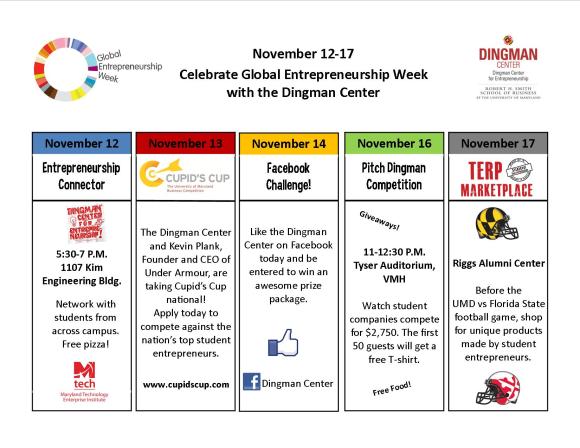
With Digital Capital Week going on and the election just wrapping up, we hope everyone is having an eventful week!  We at the Dingman Center have been hard at work preparing for Global Entrepreneurship Week next week.  We have a full schedule of activities planned for the community.  Check out the schedule below for details!  As always, check out our Facebook or Twitter to stay updated on the latest Dingman Center news.

Be sure to join us next week if you can!  Now onto some things worth reading!

As always, we begin with this week’s Business Rx column, this time featuring ConferenceEdge, a tech startup looking for advice on where and how to find advisers.

In case you missed it, The Dingman Center launched the website for the new and improved 2013 Cupid’s Cup.  Check it out at www.cupidscup.com!

If you use LinkedIn, you’ve probably noticed the introduction of LinkedIn “endorsements.”  Inc.com explores how small business owners can take advantage of this new feature.

Finally, as marketing on Facebook becomes more sophisticated, like with its new “promote” feature, it will inevitably start to become more costly as well.  This article from Entrepreneur.com explores how businesses can promote their brands outside of the popular social network.

Tagged , ,

Business Rx Entrepreneur Q&A with Elana Fine – Part 4

Elana Fine, Managing Director of the Dingman Center recently participated in a live chat on Wednesday October 17with the Capital Business section of the Washington Post for their Business Rx column. Elana answered questions from regional entrepreneurs on improving and starting a business. This post features some of the questions from the live chat. Follow the Dingman Center’s Facebook Page and Twitter Page for information on the next live chat and other Dingman Center news and events.

 Q.  Elana, I am building out my software business and I want to have an advisory board. Is this a good idea? How do I compensate them?

Elana Fine:  All startups should have an advisory board that can balance out any voids in expertise you might have and to help make additional connections. Some advisory boards are given equity, but some also volunteer their time because they enjoy working with early stage companies.  More importantly, you will need to differentiate between an advisory board and a Board of Directors (BoD).  A BoD has very specific rights and accountability whereas an advisory board does just that – advises the company, but does not have the same kind of decision making power as a BoD.  Typically, board seats refer to a Board of Directors and are related to equity stakes granted via angel or VC financing terms.

Q. I am a graduate student at a local university and I want to start a business with my engineering professor. How do I get started? No lawyers please – I already have lots of loans!

Elana Fine: You don’t need lawyers…yet.  If you and your professor are interested in spinning out a company based on university IP, the first place to go is your Office of Technology Commercialization. They will help you through the process of licensing the technology from the university. I’d also suggest doing lots of market research as well as speaking to a lot of customers in different industry verticals to understand the commercial opportunities of your product. Steve Blank’s Lean Launchpad class is a great model for this. Startups based on university technologies have significantly better chances of success, so good luck!

Q. My business has experienced a lot of growth in the past year and I can no longer run daily operations alone and I’ve recently hired 4 new employees. I have experience running a business, but very little experience being a boss. Can you give me some general advice on how to manage my staff? 

Elana Fine: We see a lot of entrepreneurs start to stumble a bit while they transition from starting a business to growing a business.  At your stage you need to make sure you hire staff members that are also self-starters who will not need to be micro managed.  You need to find people who will be almost as passionate and committed as you are, or your will lose momentum.  You also need to make sure that you keep your team focused.  A lot of startups fail because they lose focus and try to do too many things at once.  I’d make sure that 80% of what your team is working on is part of your plan (which will always be evolving) and the other 20% of their time is available to be opportunistic.  Have a checklist of top three priorities and if something doesn’t fit, don’t do it.  You should also make sure you understand your team’s work style and make sure they understand yours.  For example, if you’d prefer to be in touch via email. If you plan to have daily or weekly meetings, make sure they are on the calendar and don’t get skipped.

Q. Are you aware of any new state funding or tax breaks for entrepreneurs in Maryland? I want to start a kids clothing boutique but the tax breaks and credits seem to be only for biotech companies.

Elana Fine: There are a number of new funding opportunities in Maryland through TEDCO, such as the Propel Baltimore fund and Maryland Innovation Initiative but these are all more focused broadly on technology vs. apparel and retail.  I do not know of any breaks for a retail boutique.

Q. I have a full-time job and sometimes I do some side work by helping friends with their websites. While I charge for my services, I haven’t created a formal business. I know that if I ever formally create a small business, I will have to separate my personal expenses from my business expenses. Should I begin separating personal and business expenses now while my business is still informal?

Elana Fine: I’m certainly not an accountant, but sounds like you are at the point where you should keep a separate account for those expenses. Business expenses are generally tax deductible (so I hear) so you are better off keeping them separate.  If you are charging for services it is kind of like being half pregnant – you either have a business or you don’t.

Q. Does Maryland have any areas where students can run their businesses? It would be great if I could operate at a football game or at a basketball game.

Elana Fine: Our team at the Dingman Center is working very hard to create additional opportunities for student businesses on campus. There are a few regulatory/bureaucratic hurdles we are facing, but we are working with a number of partners across campus to create student marketplaces. Stay tuned!

Q. I am currently interested in starting my own brand of ice cream. How do I get in touch with an ice cream manufacturer who will be willing to produce my ice cream?

Elana Fine: I’d suggest networking with ice cream shops to understand who supplies their product. If you create a flavor they like, they might be more likely to make an introduction! You may also want to look in the dairy cases of high end stores like Fresh Market and Whole Foods who carry a lot of upstart ice cream companies – I know a few are made locally. There could be some partnership opportunities there.

Q. My friend and I started a company. I designed the product and he was going to be the COO/CFO. Now, we are close to getting some VC money and I am afraid I am going to be Eduardo from Facebook, the co-founder who winds up with nothing. What do I do?

Elana Fine: I just gave a few answers above that indicated not needing lawyers, but in the case of protecting your equity stake and rights you do need counsel. When you are negotiating term sheets with VCs, make sure you understand the anti-dilution provisions and what will happen in future funding rounds. Most founders will get diluted along the way, but you need to make sure you understand how, why, and when that will happen. In many cases you will have a smaller stake of a larger pie if the valuation of your company continues to increase. In general, I will repeat three pieces of advice that one of our angel investors gives 1) READ THE DOCS 2) READ THE DOCS and 3) READ THE DOCS.

Q. If the fiscal cliff happens, where do you see angel funding in 2013?

Elana Fine: I think the biggest driver in angel funding in 2013 will be related to increased VC funding or exit opportunities. Angel investing has been incredibly strong these past 2 years, but investors will hold back if they don’t see their companies receiving follow-on capital to grow the business and increase its value. The same goes for exit opportunities, if strategic buyers sit on cash and don’t grow through acquisition, angel investors will be less inclined to take the risk and will allocate investment dollars in safer alternatives. I think crowd funding is only one aspect of the JOBS Act that will have an impact. The increased cap on private shareholders, reduced disclosure requirements and broad classification of “emerging growth” public companies increase the access to capital and reduce the cost of taking companies public.

Q. We are trying to sell a new product in a fast growing market with existing competitors. Any thoughts on how we can introduce our product and gain some attention without cutting our prices too low or being forced to spend a ton on marketing? 

Elana Fine: It’s hard to say without knowing more about the product or the market you are targeting.  However, the key is just that. Understand what part of this growing market you can gain the best traction. Is there a customer segment that will appreciate a feature of your product vs. another? Is it a high end product that differentiates by a high level of customer service? Or will you in fact gain more traction by being a low cost provider? In a fast growing market, a newcomer can often be more nimble in attacking the fastest growing portion of the market, but you have to do your research to find your own niche. We often suggest that companies identify their first target market and then test three different ways to attract that market whether via social media, paid advertising, earned media, promotional events, or word of mouth. See what works and then double down.

Q. Hello, my wife and I have a small non-franchise residential cleaning service in Maryland. So far, our only marketing is through word of mouth and a simple website. Where should we go from here in terms of marketing our business?

Elana Fine: There are actually a couple of new local companies like Seva Call, Urgnt.ly and Trust Pages that are focused on connecting residential service providers to customers. Word of mouth is really the best way when it comes to service providers coming in to your home so you need to think about how you can engage new customers that will make referrals. You could think about going out to real estate agents and offering to clean houses for free before going out on the market.  If you do a good job they may recommend you to whomever buys the house or they may pay you to do the next job. One free cleaning may pay dividends in the future.

Q. I have an idea for a business I’d like to start, but I’d love to have an advisor who could help me think through all the particulars. Is there a resource in the D.C. area for that?

Elana Fine: There are a lot of great resources for startups around the area, such as FoundersCorp, Maryland’s SBDC, Startup MD/DC/VA, Foster.ly, DC Tech Meetups, ProudlyMadeinDC, Rockville Economic Development Inc., etc.  However, before you start thinking about paying for an advisor you need to first find the right advisors that understand the problems your company is tackling as well as the challenges that you are facing.  When you network, specifically say “I’m looking for someone with a skill set in X that can help me with Y.” I know I’m always more likely to make connections when it’s good match.
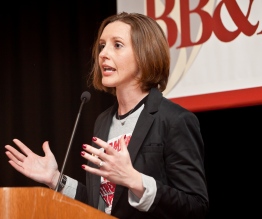
Elana Fine was appointed Managing Director of the Dingman Center in July 2012, after joining the team in 2010 as Director of Venture Investments. As Managing Director, Elana’s primary focus is leading the Dingman Center in support of its mission and strategic plan. Key responsibilities include oversight of our student venture incubator, Dingman Center Angels investor network, business competitions, and technology commercialization efforts.

Tagged , , , , , ,

Center Stage with Andrea Keating ’83, Founder & CEO, Crews Control

Recently, we caught up with entrepreneur Andrea Keating ’83, one of the newest members of the Dingman Center Board of Advisors. Ms. Keating shares her insights on building multiple businesses from scratch, her advice to young entrepreneurs, as well as what excites her the most about the Dingman Center’s programs and the DC startup scene.

What are you most focused on right now?

Growth. Every company needs to focus on growth at all times, whether its growth in brand reach, sales pipeline, contract numbers, or company size, you always need to continue growing.

The way that I have been able to grow my companies has been to develop companies that sell to the same pipeline. My first company was Crews Control, a video crew outsourcing service that provides over 2000 crews worldwide to in-house media departments of Fortune 500 companies. Those companies then approached me to handle their staffing needs for freelance production. So I co-founded Team People, a company that targeted the same pipeline, but with a slightly different product that my clients were looking for.

Fast forward to last year when I came across a tech company called Scenios that provides cloud-based production tools. I immediately saw that this product was applicable to my corporate clients, and now I sit on their board. This opportunity came about because the founders of Scenios knew that I was knowledgeable about the corporate media and that was the market that they wanted to target.

What is your involvement at Dingman and why is it a special place?

I’m a serial entrepreneur. I’ve founded or co-founded 4 companies and had the ideas for at least dozen more. When I was asked to judge my first Pitch Dingman Competition I was blown away by the knowledge, the creativity and the passion of the students and their business models. It’s so exciting to feel the startup energy of what could be the next great business. I have been so lucky to be successful in business and I am honored to be able to share some of the insights and lessons learned I have a gained over the past 25 years with other entrepreneurs.

What do you think of the DC area as a place to start a business?

I think the DC area is a great place to start a business. It is ripe with intellectual and financial capital and people who live and work in the area are driven to succeed. I also believe that there’s a different kind of energy here because it’s an international city with close proximity to the federal government while also being a growing tech hub. All of this combines into a perfect storm with opportunities in both the public and private sector. It’s one of the best kept entrepreneurial secrets, and by putting together programs such as the Dingman Center with what the tech community is also doing to establish its presence, it’s only a matter of time before the world recognizes DC as a top tier entrepreneurial region.

What Inspires you?

My fellow entrepreneurs are my biggest motivators. When you start a business, especially if you start it alone and without a partner, it can get very lonely. I made it a point to get involved with organizations such as YEO (Young Entrepreneurs Organization) and joined a forum, which gave me the opportunity to build a peer group to share ideas, challenges, frustrations, and successes. This led to me joining other groups such as YPO (Young Presidents Organization) and C200, an invitational only organization of women business owners worldwide. Surrounding yourself with other entrepreneurs is the best way to grow.

What originally made you decide to start a business?

I saw a need and knew I could provide a better, more cost effective solution. I never set out to make money or to build a global company, but rather to fill a need in the industry. If you are providing potential clients with a great product or solution at a good price the rest will follow.

What has been your greatest entrepreneurial challenge?

Seeing the big picture. Often times I would get bogged down by a challenge or process and had to remind myself to step back and to look at the big picture objectively. By taking a look at the market, my client base and my vendors from a bird’s eye view, solutions suddenly become clearer.

What is the single most important piece of advice you would give to a young entrepreneur?

Follow your instincts. If it feels right it probably is. I’ve never made a business decision that I felt good about that ended badly… but I’ve ignored a few red flags or over – analyzed a few opportunities and later regretted my decision. Follow your gut.

Andrea has more than two decades of production management experience and is considered to be the founder of the crewing agency industry. In 1988 she founded Crews Control, the world’s first and leading crewing agency representing location talent worldwide. Today she guides the screening, management, scheduling and payment of more than 2,000 creative specialists worldwide. In addition, Andrea co-founded TeamPeople, a premier creative staffing company that provides on-site management of corporate, association and broadcast media departments as well as recruitment, paymaster and payroll services. Andrea graduated from the University of Maryland and is a member of the Dingman Center’s Board of Advisors. Connect with Andrea on LinkedIn.

Tagged , , ,

Worth Reading 9/28/2012

It’s been another exciting week at the Dingman Center, just earlier today we held our first Dingman Center Angels Review Day of the 2012-2013 Academic Year!  Participating entrepreneurs came in to pitch in front of a packed crowd of Dingman Center Angels and eager business students.  Across the hall, Dingman Center EIRs advised a full docket of aspiring entrepreneurs for Pitch Dingman.  Amidst the hustle and bustle at the Dingman Center, we are still excited to continue our new feature started last week!

So here’s what we found worth reading this week!

  • Did you know that the US Chamber of Commerce has ranked the State of Maryland the #1 state for innovation and entrepreneurship? Maryland secretary of business and economic development breaks it down for us.
  • Nobody can build anticipation like Apple.  With the recent release of the iPhone 5, Catherine Kaputa of Fast Company examines the strategies that Apple employs to get its fans pumped for every new release, and what lessons entrepreneurs can learn from these strategies!
  • With political campaigns in full swing, there’s a lot of talk about China and the potential threat it imposes, as well as jobs lost to India.  Michael Silverstein, the founder of BCG’s global consumer practice joined the HBR Ideacast this week to argue why China (and India) should be seen as an opportunity for businesses, not a threat. (More of a worth listening.)
  • The District of Columbia continues its quest to find ways to become a more attractive location for entrepreneurs.  However, the mayor’s plans hit a speed bump this week as the DC Council refused to pass a major capital gains tax break for tech investors and entrepreneurs.
  • Finally, Google launched its new microsite “Google for Entrepreneurs” this week.  Check out the different ways that Google supports the startup community and stay up to date about upcoming community events around the world.
Tagged , , ,